NITI Aayog aims to boost sports exports to $8.1 billion by 2036, creating 54 lakh jobs. The roadmap focuses on tariff rationalization, mechanized manufacturing, and port-proximate clusters to overcome high costs and technological lags, driving India toward Viksit Bharat @2047.
Copyright infringement not intended
Picture Courtesy: knnindia
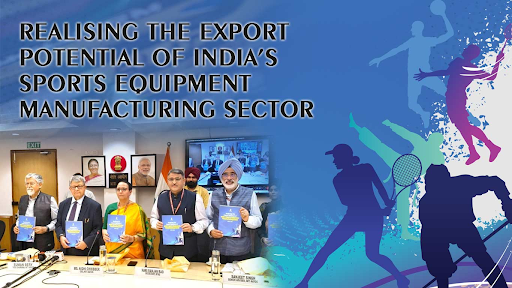
NITI Aayog has released a strategic report, "Realising the Export Potential of India’s Sports Equipment Manufacturing Sector," as part of the Viksit Bharat @2047 vision.
|
Read all about: SPORTS GOVERNANCE IN INDIA I GOVERNANCE OF SPORTS IN INDIA |
The report outlines a plan to transform India into a global manufacturing hub, aiming to increase sports equipment exports from $275 million in 2024 to an ambitious $8.1 billion by 2036.
Current Status of the Sector
Vast Global Market
The global sports goods market was valued at $700 billion in 2024 and is projected to exceed $1 trillion by 2036. The sports equipment segment alone is a $140 billion market.
India's Minimal Share
Despite a domestic market of $2.5 billion, India's exports are only $275 million, which is a mere 0.5% share of the global export market.
MSME-Driven Industry
The sector is highly labor-intensive and is dominated by Micro, Small, and Medium Enterprises (MSMEs), which contribute to nearly 90% of total production.
Geographical Concentration
Manufacturing is heavily concentrated in traditional, landlocked clusters like Meerut (Uttar Pradesh) and Jalandhar (Punjab). Meerut alone accounts for 40% of India’s total sports goods exports.
Significant Cost Disadvantage
Indian manufacturers face a 15–20% cost disadvantage compared to competitors like China and Pakistan.
Lack of Technology and Scale
The industry relies heavily on traditional manual craftsmanship, making it difficult to produce precision-engineered, mechanized products (like thermo-molded footballs) at the scale required for large global orders.
Logistical Inefficiencies
The location of major clusters in landlocked states like Punjab and UP results in high inland transportation costs to seaports, which erodes the price competitiveness of exports.
Weak Global Branding
High costs for international certification and the absence of a strong "Brand India" push Indian manufacturers to bring low-value, unbranded suppliers in global value chains.
Tariff Rationalization
Implement a zero-duty regime on imported raw materials and capital goods to eliminate the 15-20% cost disadvantage faced by manufacturers.
Develop New Greenfield Clusters
Establish four new manufacturing clusters in coastal states like Gujarat, Tamil Nadu, and Andhra Pradesh to slash logistics costs, while also modernizing existing hubs in Meerut and Jalandhar.
Leverage MSME Frameworks
Integrate sports manufacturing units with schemes like the Self-Reliant India (SRI) Fund to provide equity funding for technology adoption and capacity expansion.
Shared Quality Infrastructure
Create Common Facility Centres (CFCs) for shared testing and certification. This will help MSMEs meet global quality standards without bearing prohibitive individual costs.
Massive Employment Generation
The targeted export growth has the potential to create 54 lakh additional cumulative jobs by 2036, effectively utilizing India's demographic dividend. (Source: NITI Aayog)
Capitalizing on the "Decade of Sports"
With India bidding to host the 2036 Olympic Games, developing a robust domestic manufacturing ecosystem is a strategic imperative.
Moving Up the Global Value Chain
This initiative can help transform India's global image from a low-cost vendor to a high-quality, premium supplier, much like Taiwan did with high-value carbon-fiber sports equipment.
India must transform traditional craftsmanship into a high-tech, export-led powerhouse by slashing tariffs, funding MSMEs, and moving manufacturing closer to ports to ensure global competitiveness.
Source: PIB
|
PRACTICE QUESTION Q. Examine the role of the MSME sector in employment generation and export promotion in India. 150 words |
India currently holds a microscopic 0.5% share in the $52 billion global sports equipment export market, with total exports valued at just $275 million in 2024.
The main challenges include a 15-20% cost disadvantage due to high import duties on specialized raw materials, a heavy reliance on traditional manual labor instead of modern mechanization, high inland logistics costs due to landlocked legacy clusters (Meerut, Jalandhar), and expensive international quality certification processes.
The NITI Aayog report envisions exponentially increasing India's sports equipment exports from $275 million in 2024 to $8.1 billion by 2036, aiming to capture an 11% global market share.




© 2026 iasgyan. All right reserved