Navy Day is celebrated on December 4 to honour Operation Trident (1971), when the Indian Navy’s missile boats attacked Karachi harbour, sinking Pakistani ships without suffering losses, marking a turning point in the Bangladesh Liberation War.
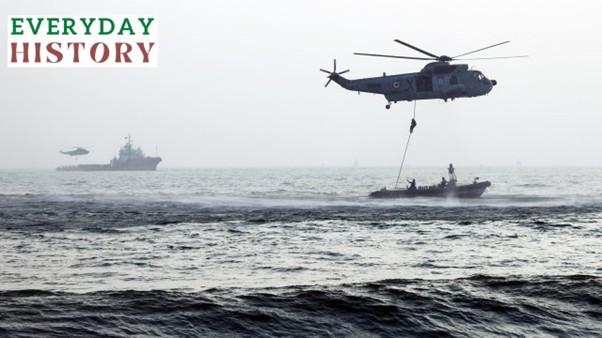
Copyright infringement not intended
Picture Courtesy: Indian Express
Context:
December 4 is observed annually as Indian Navy Day, marking one of the boldest maritime strikes in modern naval history i.e. Operation Trident, carried out during the 1971 India-Pakistan War.
|
Must Read: NAVY DAY | |
About Navy Day:
Navy Day is an annual observance celebrated to honour naval forces, by recognising their role in safeguarding maritime borders, and celebrate their achievements, service, and sacrifices.
In India Navy Day is celebrated on 4 December every year. It marks Operation Trident (1971), a successful naval strike on Pakistan’s Karachi harbour during the Bangladesh Liberation War.
The day salutes the courage, professionalism and commitment of the Indian Navy, which protects India’s coastline, trade routes, island territories and strategic interests at sea.
|
Operation Trident Operation Trident unfolded against the tense backdrop of Pakistan’s pre-emptive air strikes on Indian bases on December 3, which compelled India to formally enter the war just past midnight. As the conflict escalated, the Indian Navy launched a bold maritime offensive on December 4, 1971, deploying a task group centred around newly inducted Soviet-origin Osa-class missile boats — INS Nipat, Nirbhik and Veer supported by ships such as INS Kiltan and Katchall. These vessels moved stealthily towards Karachi, striking at Pakistan’s naval heartland and challenging its maritime confidence. The attack achieved dramatic outcomes: PNS Khaibar was sunk, costing Pakistan 222 personnel; PNS Muhafiz went down with 33 naval men on board; and the merchant vessel MV Venus Challenger was also destroyed. Complementing this naval strike, the Indian Air Force separately targeted Karachi’s oil storage facilities, intensifying pressure on Pakistan and compounding its logistical vulnerability. The operation’s overwhelming success was confirmed when the code word “Angaar”, signalling mission accomplishment, reached Western Naval Command chief Vice Admiral S.N. Kohli on December 5, marking Operation Trident as a moment of decisive strategic advantage and a lasting symbol of Indian naval prowess. |
What made Operation Trident a historic significance?
What are lessons we can draw from Trident?
Conclusion:
Navy Day reminds us that India’s maritime strength is built on courage, innovation and silent preparation. It honours the sailors who secure our seas and commemorates victories like Operation Trident that transformed the Navy from a coastal force to a strategic power. Above all, it reinforces that safeguarding the oceans is central to securing the nation’s future.
Source: Indian Express
|
Practice Question Q. Operation Trident is often described as a turning point in India’s maritime doctrine. Discuss (250 words) |
It marks Operation Trident (1971), when the Indian Navy carried out a successful strike on Karachi harbour during the Indo-Pakistan War.
A naval offensive launched on 4 December 1971 using missile boats that destroyed Pakistani warships and fuel installations, earning India a decisive maritime advantage.
Osa-class missile boats such as INS Nipat, INS Nirbhik and INS Veer, supported by ships like INS Kiltan and INS Katchall.


© 2026 iasgyan. All right reserved