The Model Code of Conduct ensures free and fair elections by regulating political entities. Lacking direct statutory backing, its enforcement relies on Article 324. Emerging challenges like deepfakes and freebies necessitate modernizing the framework with robust legal and digital tools.
Opposition Parties criticized that the Prime Minister broadcast on public media violated the Model Code of Conduct (MCC) by using state resources for partisan campaigning.
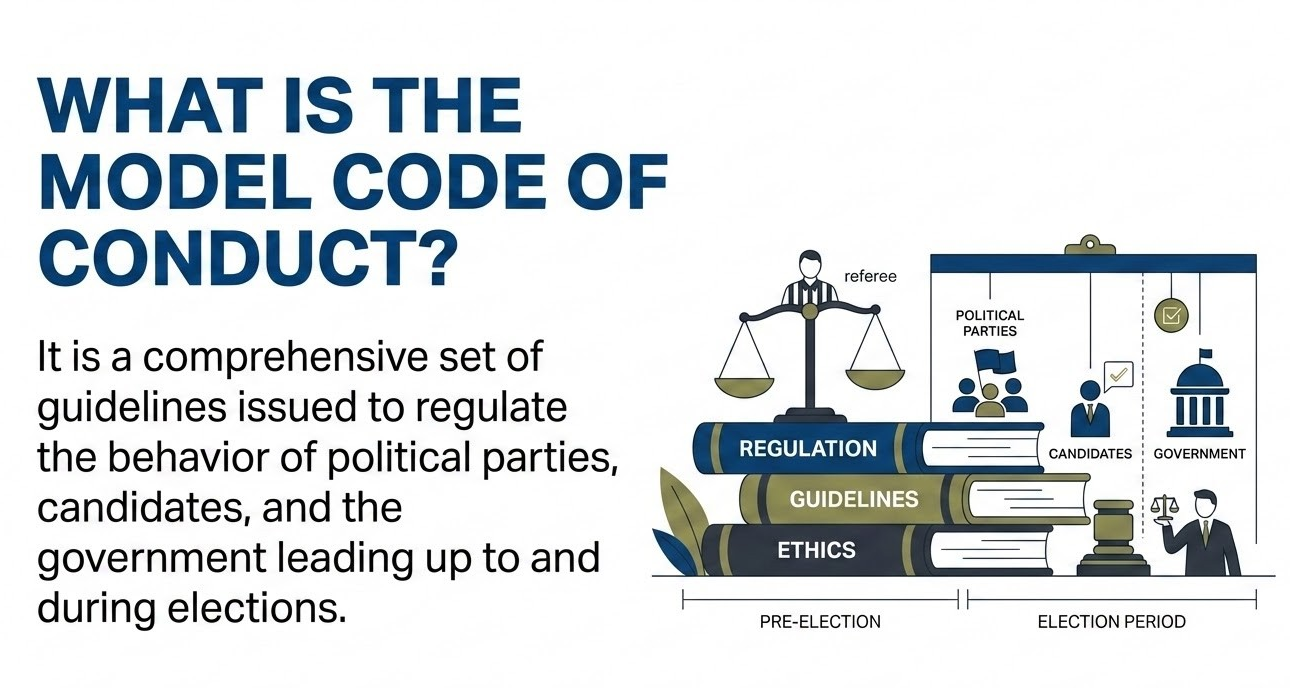
What is the Model Code of Conduct?
It is a comprehensive set of guidelines issued to regulate the behavior of political parties, candidates, and the government leading up to and during elections.
Objectives: Maintain the purity of the electoral process, ensure a level playing field, and prevent the ruling party from gaining an unfair advantage through the misuse of state resources.
When does it come into force? The MCC comes into effect immediately upon the announcement of the election schedule by the Election Commission of India (ECI).
How long does it last? The code remains operational until the entire electoral process is completed. This timeline includes:
Applicability by Election Type: The reach of the MCC depends on the specific type of election being held:
1960: The MCC originated during the Kerala Assembly elections when the state administration drafted a basic set of guidelines to regulate the conduct of participating political institutions.
1968-1969: Guidelines were formalized and circulated nationwide.
1979: A section (Part VII) was added to regulate the "party in power," explicitly restricting the misuse of official positions to obtain an undue electoral advantage.
1991: The MCC was consolidated and institutionalized with strictness under Chief Election Commissioner T.N. Seshan.
2013: Supreme Court in S. Subramaniam Balaji vs Govt. of Tamil Nadu case, issued specific guidelines governing election manifestos to prevent parties from making promises that vitiate the purity of the election process.
General Conduct and Harmony: Political parties and candidates are prohibited from engaging in activities that aggravate existing differences, create mutual hatred, or incite tension between different castes, communities, or religious groups.
Respect for Places of Worship: Mosques, churches, temples, or any other places of worship must not be used as forums for election propaganda or to solicit votes.
Meetings and Processions: Organizers must give police advance notice of meeting details to manage traffic, ensure security, and prevent rival clashes.
Regulated Criticism: Criticism of competing political parties must be confined exclusively to their policies, programs, and past records, with a total ban on personal attacks or discussing the private lives of opposition leaders.
Restrictions on the Party in Power: Ministers cannot combine official visits with campaigning. Usage of government machinery, transport, or personnel for election purposes is forbidden.
Polling Booth Regulations: Campaigning within 100 meters of a polling station is strictly prohibited.
Financial Restrictions: Activated MCC prohibits the ruling government from announcing grants, starting new public projects, or making appointments that could influence voters.
Manifesto Standards: Manifestos must avoid undue influence and provide a clear financial rationale for welfare promises.
Statutory Backing Absence: The MCC is a consensus-based voluntary document lacking legal force. The Election Commission cannot deregister parties or disqualify candidates based solely on its violations.
Delayed Legal Redress: While violations can be prosecuted under penal laws, judicial delays often extend beyond the election cycle, undermining the MCC's role as a real-time deterrent.
Technological Vulnerabilities: AI deepfakes, encrypted apps, and unregulated social media ads hinder real-time enforcement by authorities.
The "Freebies" Issue: Ambiguity between welfare policies and populist "freebies" allows parties to exploit loopholes just before the MCC takes effect.
Governance Disruption: Strict enforcement can paralyze administration, stalling development and welfare projects for weeks.
Granting Statutory Status: Enact legislation to give the MCC statutory backing by integrating its core provisions into the Representation of the People Act, ensuring defined, tiered punitive measures for violations, as recommended by the Parliamentary Standing Committee on Law and Justice.
Empowering the Election Commission: Amend existing laws to grant the Election Commission the power to deregister or suspend political parties for severe and repeated MCC violations.
Fast-Track Tribunals: Establish special judicial benches or fast-track tribunals tasked with disposing of election petitions and severe MCC violations within a strict six-month timeframe.
Statutory Rules for Big Tech: Replace voluntary digital ethics codes with mandatory statutory obligations under IT Rules, forcing social media platforms to take down MCC-violating content.
Regulating Paid News: "Paid News" and surrogate digital advertising should be legally classified as a "Corrupt Practice" and an electoral offense under the Representation of the People Act.
Expanding the Silence Period: Amend electoral laws to explicitly extend the 48-hour campaign silence period before polling to include the internet, social media, and OTT platforms.
Mandatory AI Watermarking: Require political parties to use cryptographic watermarks for all digital campaign materials to combat deepfakes and trace the origin of manipulated content.
Capping Party Expenditure: Introduce a statutory cap on total party campaign expenditure to prevent the unrestricted use of money power and ensure a genuine level playing field among all political entities.
Providing the Model Code of Conduct with tailored statutory backing and modernized digital frameworks is vital to transform it from a moral guideline into a highly enforceable tool that guarantees the integrity of democratic elections.
Source: THEHINDU
|
PRACTICE QUESTION Q. The Model Code of Conduct (MCC) is often described as a 'tiger without teeth' due to its lack of statutory backing. Critically Analyze. 150 words |
The MCC is a comprehensive set of guidelines issued to regulate the behavior of political parties, candidates, and the government during elections. Its primary objective is to ensure a level playing field, maintain electoral purity, and prevent the ruling party from gaining an unfair advantage.
The MCC comes into operation the exact moment the Election Commission of India announces the election schedule and remains active until the final election results are declared.
The MCC faces criticism for its lack of legal binding, subjective interpretation, and ineffective post-election redressal where judicial processes outlast the election cycle. Furthermore, the rise of digital misinformation, encrypted messaging, and AI deepfakes has made real-time monitoring and enforcement incredibly difficult.



© 2026 iasgyan. All right reserved