Copyright infringement not intended
Picture Courtesy: The Hindu
Context:
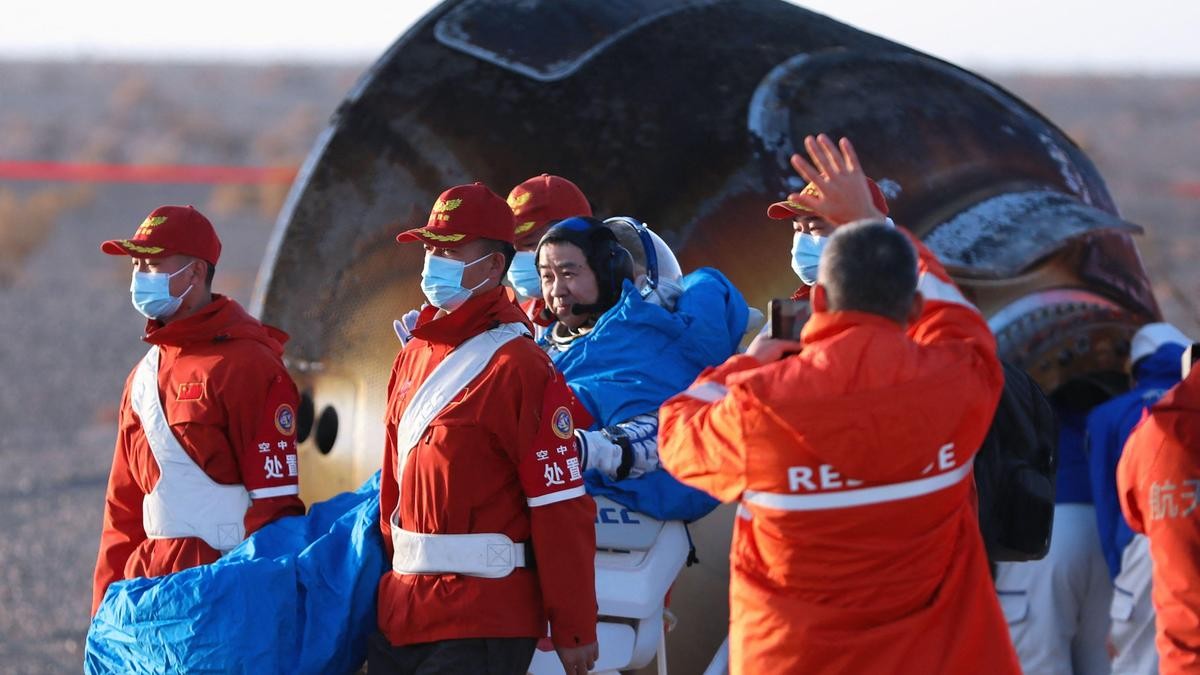
Millions of naturally occurring Micrometeoroids and Orbital Debris (MMOD) orbit the earth, posing a constant threat to all spacecraft and space stations. The menace attracted global attention recently when a piece of debris struck the Chinese crewed vehicle Shenzhou-20, causing a minor crack in the window of its return capsule, rendering it unusable for crew travel.
What are Micrometeoroids?
Micrometeoroids are naturally occurring tiny particles of rock or metal in space that usually range in size from a few micrometers to a few millimeters, originate mainly from collisions between asteroids and from comets, and travel at extremely high velocities typically between 11 and 72 kilometres per second, which allows even very small particles to carry significant kinetic energy and damage spacecraft surfaces and instruments. They are present throughout the Solar System, and due to Earth’s gravity, their concentration is slightly higher near our planet.
What is Orbital Debris?
Orbital debris, also known as space debris or space junk, refers to human-made objects that remain in Earth’s orbit but no longer serve any useful purpose, such as fragments from defunct satellites, exploded rocket stages, accidental collisions, and intentional anti-satellite weapon tests. These objects usually travel at average speeds of around 10 kilometres per second in orbit, are concentrated mainly in Low Earth Orbit between about 200 and 2,000 kilometres altitude, and pose collision risks to operational satellites and human space missions.
The term Micrometeoroids and Orbital Debris (MMOD) collectively describes the combined natural and human-made high-velocity particle environment in space that can damage spacecraft, space stations, and astronaut systems through hypervelocity impacts.
Distribution of Micrometeoroids and Orbital debris:
- Micrometeoroids are distributed throughout interplanetary space.
- Their density becomes slightly higher near Earth due to gravitational attraction.
- They originate from the wider solar system, mainly from asteroids and comets, not just Earth’s vicinity.
- They can be encountered in all orbital regions including Low Earth Orbit, Geostationary Orbit, cislunar space and beyond.
- Their distribution is considered ubiquitous, meaning it is spread everywhere rather than confined to one band.
- Higher concentrations occur near planets and along comet trails due to gravitational and dynamical effects.
- Orbital debris is concentrated mainly in Low Earth Orbit (200–2,000 km altitude).
- This is where most satellites, space stations and human missions operate, creating dense debris belts.
- A significant amount of debris is also found in Geostationary Orbit (~36,000 km) around the geostationary belt.
- Objects in Geostationary Orbit remain longer because natural decay is very slow at that altitude.
- In Low Earth Orbit, smaller debris gradually re-enters the atmosphere due to atmospheric drag.
- At higher altitudes, debris can remain for decades to centuries because drag is negligible.
Global Initiatives to Manage Space Debris:
- United Nations Committee on the Peaceful Uses of Outer Space (UNCOPUOS) has issued Space Debris Mitigation Guidelines and Long-Term Sustainability (LTS) Guidelines that promote responsible space behaviour.
- Inter-Agency Space Debris Coordination Committee (IADC) coordinates major space agencies (NASA, ESA, ISRO, JAXA etc.) to develop technical standards, models, and best practices for debris mitigation.
- Outer Space Treaty (1967) and Liability Convention (1972) establish responsibility for damage caused by space objects, encouraging responsible operations.
- Registration Convention (1976) mandates countries to register space objects, aiding tracking and accountability.
- Post-mission disposal norms encourage de-orbiting spacecraft within 25 years of mission end to reduce debris accumulation.
- Passivation guidelines require venting remaining fuel and energy in rockets to prevent explosions that create debris.
- Active Debris Removal missions are being developed globally (e.g., ESA’s ClearSpace-1, JAXA’s removal experiments) to capture and deorbit defunct satellites.
- Space Situational Awareness (SSA) networks operated by NASA, ESA and others track thousands of debris objects using radar and optical telescopes.
- Anti-satellite (ASAT) testing norms are being discussed globally, and several nations have declared moratoria on destructive ASAT tests to prevent debris generation.
Indian Initiatives to Manage Space Debris:
- ISRO Space Debris Mitigation Guidelines align with UNCOPUOS and IADC standards and are implemented in mission design.
- India participates in IADC and UN forums, contributing to global debris policy and technical discussions.
- Project NETRA (Network for Space Object Tracking and Analysis) strengthens India’s Space Situational Awareness capability to track objects in Low Earth Orbit and beyond.
- ISRO System for Safe and Sustainable Operations Management (IS4OM) supports monitoring, collision avoidance planning, and risk assessment for Indian satellites.
- Multi-Object Tracking Radar (MOTR) at Sriharikota and optical telescopes help track space objects and predict conjunctions.
- Post-mission disposal practices are followed by ISRO, including de-orbiting satellites and moving geostationary satellites to graveyard orbits.
- Passivation of launch vehicle stages is increasingly implemented to avoid in-orbit explosions.
- Indian satellites are designed with debris-mitigation features, such as controlled re-entry planning and fuel-venting at end of life.
- Gaganyaan human spaceflight program incorporates strict MMOD risk analysis and debris-avoidance strategies, reinforcing national standards.
Importance of these initiatives:
- They reduce the risk of the Kessler Syndrome by preventing runaway collision cascades, thereby ensuring that Low Earth Orbit and Geostationary Orbit remain usable for future scientific, commercial, and defence missions.
- They enhance astronaut safety and spacecraft longevity by lowering the probability of lethal high-velocity debris impacts on crewed missions, satellites, launch vehicles, and space stations, which in turn reduces mission failure rates and insurance costs.
- They safeguard essential space-based services such as communication, navigation, banking networks, weather forecasting, disaster management, remote sensing, climate monitoring, and national security operations that modern economies and governance systems heavily depend on.
- They promote responsible behaviour in an increasingly commercialised and crowded space environment by encouraging norms, transparency, and accountability among governments and private companies, helping prevent reckless launches, destructive anti-satellite tests, and unsustainable satellite mega-constellations.
- They ensure long-term sustainability of outer space as a global common, preserving it for scientific exploration, planetary defence activities, academic research, and future human settlements beyond Earth.
- They reduce economic losses by preventing costly satellite damage, avoiding service disruptions, lowering debris-tracking and collision-avoidance costs, and protecting billions of dollars invested in space infrastructure.
- They strengthen global cooperation and governance by pushing countries toward collective rule-making, data-sharing, transparency in space operations, and peaceful uses of outer space.
Conclusion:
Managing space debris is essential to keep Earth’s orbits safe and sustainable. Effective global and national initiatives help prevent collision cascades, protect astronauts and satellites, and ensure the continuity of vital space-based services that modern life depends on. Strengthening debris mitigation today safeguards outer space as a shared resource for future scientific exploration, security, and economic development.
Source: The Hindu
|
Practice Question
Q. Discuss the growing challenge of space debris and examine the effectiveness of global and Indian initiatives in ensuring the long-term sustainability of outer space. (250 words)
|
Frequently Asked Questions (FAQs)
Space debris refers to non-functional, human-made objects left in Earth’s orbit, such as defunct satellites, rocket fragments, and collision remnants.
Micrometeoroids are natural particles from asteroids and comets, while orbital debris is man-made junk left in Earth orbit after space activities.
Even small debris travels at very high speeds (about 10 km/s), and impacts can damage or destroy satellites, threaten astronauts, and trigger collision cascades.