The Union Budget 2026 has approved the establishment of the National Large Solar Telescope (NLST) and the National Large Optical–Near Infrared Telescope (NLOT), along with the upgrade of the Himalayan Chandra Telescope in Ladakh. Leveraging the region’s high altitude, dry atmosphere, and clear skies, these facilities will strengthen India’s capabilities in solar studies, space weather monitoring, exoplanet detection, and deep-space research. The projects will enhance indigenous technological expertise, provide greater access to Indian scientists, support major missions like Aditya-L1 and LIGO-India, and position India as a key global hub for advanced observational astronomy.
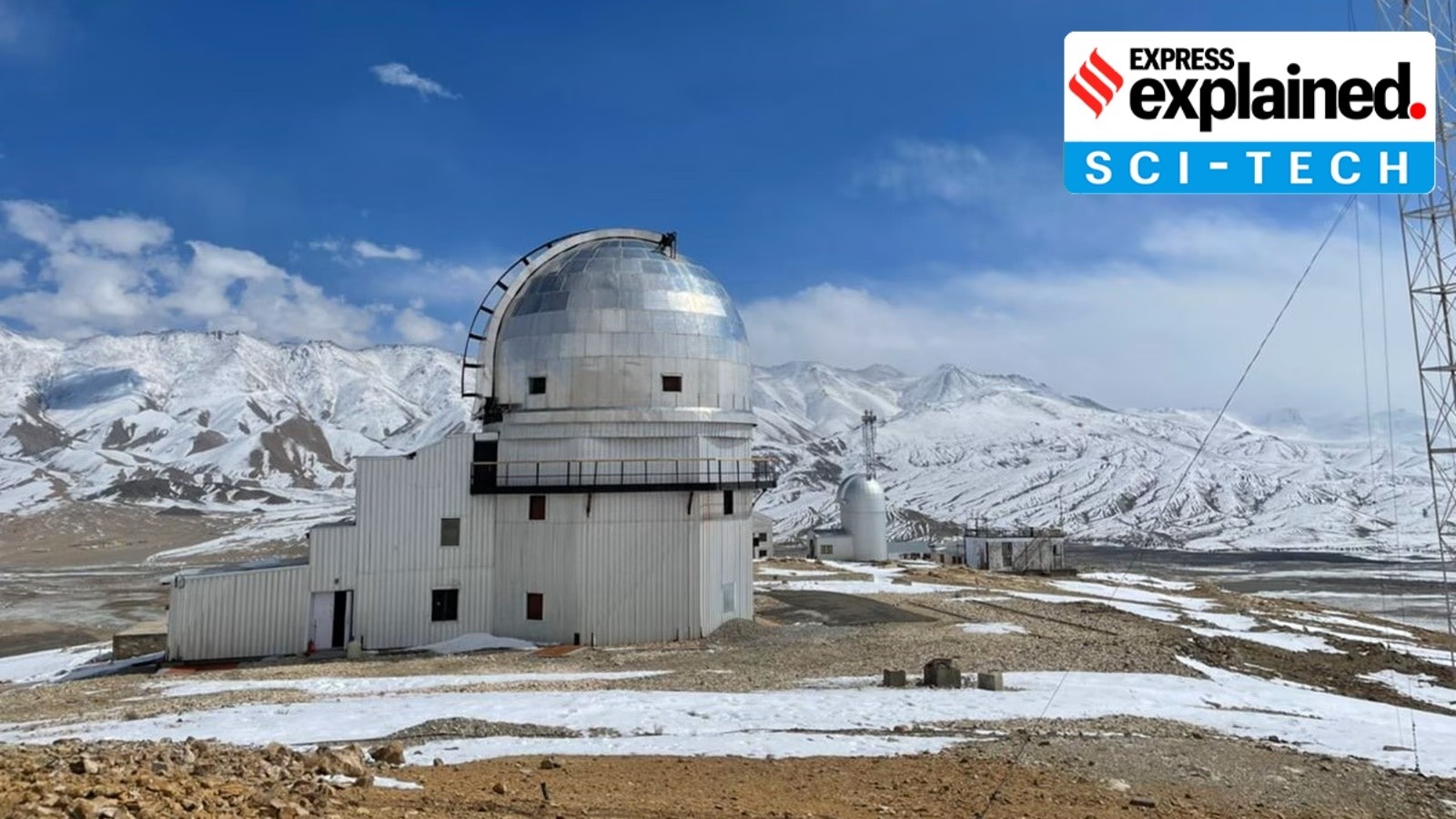
Copyright infringement not intended
Picture Courtesy: Indian Express
The Union Budget 2026 has approved two new advanced telescopes and the upgrade of an existing facility in Ladakh, strengthening India’s position in global observational astronomy.
|
Must Read: HANLE DARK SKY RESERVE | INDIAN ASTRONOMICAL OBSERVATORY | HIMALAYAN CHANDRA TELESCOPE | |
The National Large Solar Telescope (NLST) is an upcoming advanced ground-based facility dedicated to high-resolution solar observations. Planned to be operational within 5 - 6 years, it will be installed at Merak in Ladakh, near Pangong Tso, a site known for its high altitude, dry atmosphere, and clear skies. The telescope will have a 2-metre aperture and will become India’s third ground-based solar observatory, after the Kodaikanal (1899) and Udaipur (1975) solar observatories.
Operational Range: NLST will observe the Sun in the visible and near-infrared wavelengths, enabling detailed imaging and spectroscopy of solar surface and atmospheric features.
Scientific objectives:
Synergy with space missions: Observations from NLST will work in tandem with ISRO’s Aditya-L1 mission, providing complementary ground-based data and enhancing India’s role in heliophysics research.
The National Large Optical–Near Infrared Telescope (NLOT) is a proposed next-generation ground-based astronomical facility aimed at deep-space observations. It will be established at Hanle in Ladakh, one of the world’s best sites for optical astronomy due to its high altitude, cold and dry climate, and low atmospheric disturbance. With an expected development timeline of about a decade, NLOT will significantly enhance India’s observational capabilities in modern astronomy.
Technical Features
Scientific Objectives
Strategic significance
The establishment of new large telescopes and the upgrade of existing facilities in Ladakh represent a transformative step for India’s astronomy ecosystem. By leveraging the region’s unique high-altitude and low-disturbance conditions, these projects will significantly enhance the country’s capabilities in solar studies, deep-space observations, and time-domain astronomy. The developments will not only improve space weather forecasting and support the safety of critical space and communication infrastructure, but also enable cutting-edge research on exoplanets, stellar evolution, galaxies, and the early universe. At the same time, they will strengthen indigenous expertise in precision optics, advanced instrumentation, and high-technology manufacturing. Together, these initiatives will expand opportunities for Indian scientists, foster international collaboration, and position India as a major global centre for observational astronomy and big-science research.
Source: Indian Express
|
Practice Question Q. The development of large ground-based astronomical facilities in Ladakh marks a significant milestone for India’s space science capabilities. Discuss. (250 words) |
Ladakh offers ideal conditions for astronomy due to its high altitude, dry and cold climate, low atmospheric turbulence, minimal light pollution, and a large number of clear nights, which together enable high-resolution and long-duration observations
The NLST is designed to study solar dynamics, magnetic fields, sunspots, and solar eruptions, and to improve space weather prediction that affects satellites, communication systems, navigation, and power infrastructure.
NLOT will enable advanced studies of exoplanets, stellar evolution, galaxy formation, supernovae, transient astronomical events, and the early universe using optical and near-infrared observations.






© 2026 iasgyan. All right reserved