The Mahanadi Water Disputes Tribunal has given Odisha and Chhattisgarh a final deadline of May 2, 2026, to settle their long-standing river water dispute.
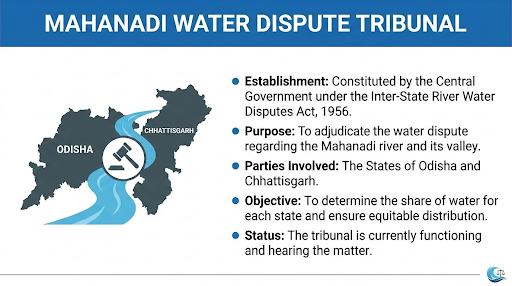
The Mahanadi water dispute is a long-standing inter-state conflict between Odisha and Chhattisgarh over the sharing, management, and use of the waters of the Mahanadi River.
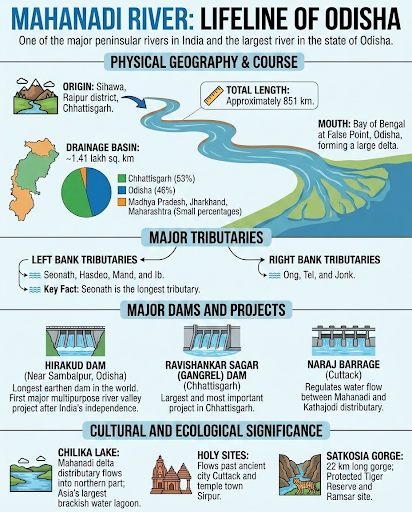
Core Conflict: Odisha claims Chhattisgarh’s upstream barrages, like Kalma, reduce non-monsoon water flow into the Hirakud Dam.
Odisha's Stand: Maintains that reduced flow threatens drinking water, irrigation, and industry, risking environmental degradation.
Chhattisgarh's Stand: Asserts its right to its basin share and argues that overall flow to Odisha remains largely unaffected.
The Mahanadi Water Disputes Tribunal (MWDT) is a quasi-judicial body constituted by the Central Government to adjudicate and provide a final settlement for the dispute.
Establishment: It was constituted in 2018, under the Inter-State River Water Disputes Act, 1956, following an order from the Supreme Court.
Composition: Tribunal is chaired by Justice A.M. Khanwilkar (retired Supreme Court Judge) and includes two other members (high court judges).
Mandate: The tribunal is tasked with:
Current Status: The Tribunal's mandate has seen multiple extensions, recently until May 2, 2026. It remains active in field assessments and judicial hearings to establish a definitive water allocation.
Weak Institutional Framework for Conflict Resolution
The Inter-State River Water Disputes Act, 1956, and Article 262 of the Constitution have failed to provide timely solutions.
State Sovereignty vs Central Oversight
Water is a State Subject (Entry 17, State List), but "Regulation and development of inter-state rivers" is in the Union List (Entry 56).
Lack of Basin-Wide Management
India manages rivers based on political boundaries rather than hydrological boundaries.
Politicization of Resource Sharing
River water is an emotive issue that directly impacts the farming vote bank.
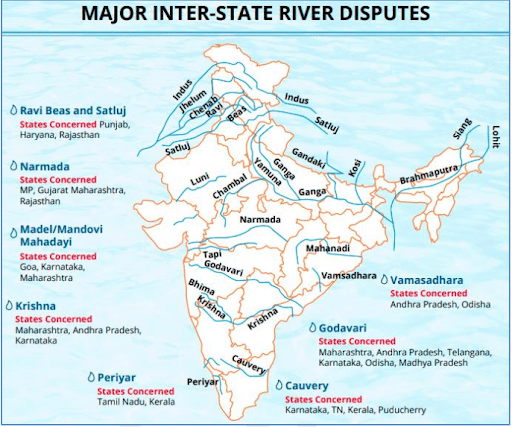
Jurisdictional Bar of Courts: Under Article 262 of the Constitution, Parliament has enacted the Inter-State River Water Disputes (ISRWD) Act, 1956, which excludes the Supreme Court and other courts from exercising jurisdiction over these disputes. This makes the Tribunal the sole adjudicatory body.
Ad-hocism of Tribunals: Historically, a separate tribunal was created for every new dispute. This led to delays in setting up infrastructure, appointing judges, and gathering data from scratch each time.
Lack of Enforcement Power: Tribunals have the powers of a civil court, but they lack an effective execution mechanism. If a state refuses to implement an award, the Central Government finds it politically difficult to compel them.
Data Mistrust: There is no "single source of truth" for hydrological data. States submit conflicting data on rainfall, runoff, and water usage to suit their own arguments, leading to years of technical cross-examination.
Structural and Legal Reforms
Single Permanent Tribunal: Instead of creating ad-hoc tribunals for every new dispute, a Standalone National Tribunal with multiple benches should be established. This ensures institutional memory and prevents delays in setting up infrastructure for each case.
Mandatory Dispute Resolution Committee (DRC): Every dispute should first go to a DRC comprising experts and policy-makers to attempt resolution through mediation and negotiation within one year, before moving to formal adjudication.
Strict Timelines: To curb delays, legal frameworks should mandate a final award within three years and strictly limit extensions. This addresses historical cases where tribunals remained unresolved for over two decades.
Data and Technical Reforms
National Water Informatics Centre (NWIC): Establishing a central, transparent, and real-time data repository for river flows and rainfall would prevent states from submitting conflicting data to suit their claims.
Independent Hydrological Experts: Tribunals should be assisted by an independent wing of technical experts (hydrologists, geologists, and environmentalists) rather than relying solely on legal arguments and state-provided engineers.
Institutional and Federal Reforms
Integrated River Basin Management (IRBM): Shift from political boundaries to hydrological boundaries. Creating River Basin Authorities with statutory powers would allow for the holistic management of a river from its source to its mouth.
Strengthen Inter-State Council (ISC): A high-level political forum to build consensus on water-sharing during distress years (lean monsoons), rather than leaving such emotive decisions entirely to the judiciary.
Formula for Distress Sharing: Adopt an automatic "Distress Sharing Formula" for drought-year water distribution to minimize emergency litigation.
The Mahanadi dispute challenges Cooperative Federalism. Effective resolution necessitates Integrated River Basin Management (IRBM), treating water as a national asset. Collaborative burden-sharing during lean periods is essential for ecological and socio-economic stability.
Source: THEHINDU
|
PRACTICE QUESTION Q. Inter-state river water disputes in India are less about political alignment and more about resource survival and institutional inadequacies. Analyze. 150 words |
The dispute is primarily caused by Chhattisgarh constructing numerous upstream barrages and anicuts to meet its industrial and agricultural demands. Downstream Odisha argues these structures significantly reduce the river's water flow into the Hirakud Dam, especially during the non-monsoon (lean) season.
Inter-state river water disputes are addressed under Article 262 of the Indian Constitution, which empowers Parliament to enact laws (like the Inter-State River Water Disputes Act, 1956) for adjudicating such conflicts.
The reduced freshwater flow during lean seasons disrupts the delicate salinity balance in coastal estuaries, notably the internationally recognized Chilika Lake. This unnatural change in salinity threatens the breeding grounds of native fish and the livelihoods of traditional fisherfolk.





© 2026 iasgyan. All right reserved