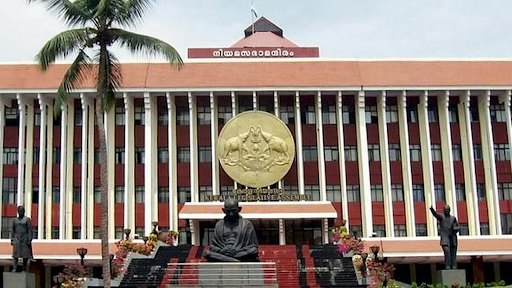
The Union Cabinet approved renaming Kerala as “Keralam,” reflecting Malayalam roots and the Aikya Kerala movement. Under Article 3, Parliament can change state names by simple majority, with state views consultative per the Babulal Parate case. The move raises administrative, economic, and federalism considerations.
Copyright infringement not intended
Picture Courtesy: thehindu
Context
The Union Cabinet approved the proposal to officially rename the state of Kerala as ‘Keralam’.
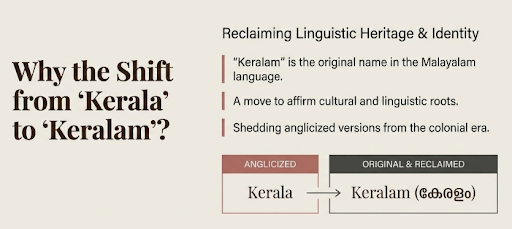
Why the Shift from ‘Kerala’ to ‘Keralam’?
The demand to change the name from 'Kerala' to 'Keralam' is rooted in correcting a historical, linguistic discrepancy created during the colonial era.
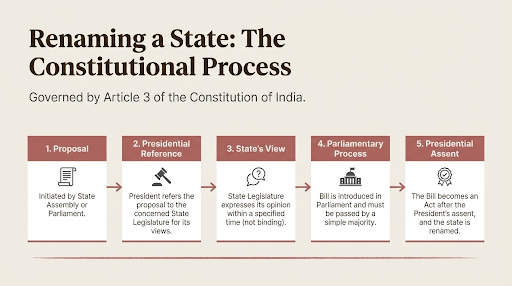
How is a State Renamed Under the Constitution?
The power to alter the name of a state rests with the Parliament and is governed by Article 3 of the Constitution.
Initiation (Resolution by State): Usually, the concerned State Assembly passes a unanimous resolution seeking a name change and sends it to the Ministry of Home Affairs (MHA) for approval.
Presidential Recommendation: A Bill to rename the state can only be introduced in either House of Parliament on the prior recommendation of the President.
Consulting the State: Before recommending the Bill, the President must refer it to the concerned State Legislature to express its views within a specified timeframe.
Parliamentary Approval: The Bill must be passed in both the Lok Sabha and the Rajya Sabha by a simple majority of members present and voting.
Presidential Assent: Once passed by both Houses, the Bill is sent to the President for final assent. Upon signing, the Bill becomes law, and the state is officially renamed.
Constitutional Update: Under Article 4, a law altering state boundaries (made under Article 3) automatically amends the First Schedule (states list) and Fourth Schedule (Rajya Sabha seats) of the Constitution and is not considered a Constitutional Amendment under Article 368.
|
Case Studies
|
Renaming a State vs Renaming the Country
The process for renaming a state is different from the procedure required to rename the country (e.g., from India to Bharat).
|
|
Renaming a State (e.g., Keralam) |
Renaming the Country (India to Bharat) |
|
Constitutional Article |
Article 3 |
Article 1 ("India, that is Bharat...") |
|
Procedure |
Ordinary Legislative Bill |
Constitutional Amendment (under Article 368) |
|
Majority Needed |
Simple Majority in Parliament |
Special Majority in Parliament |
|
Judicial View |
Clearly defined parliamentary process. |
SC rejected pleas, stating both names are already constitutional (Source: Namah v. Union of India, 2020). |
Implications and Challenges of Renaming
While the name change reinforces cultural pride, it comes with significant administrative and economic challenges.
Administrative and Financial Costs
The change requires amending the First Schedule and Fourth Schedule of the Constitution. It also necessitates updating all official documents, government websites, signage, and public records, which involves substantial expenditure.
Global Standardization
International bodies like the ISO (International Organization for Standardization), World Bank, and IATA (for airports) must update their databases. A carefully managed transition is needed to avoid confusion in international trade, tourism, and diplomatic relations.
Way Forward
The Union Cabinet's approval for 'Keralam' recognizes linguistic federalism and the state's democratic will. A smooth, cost-effective transition requires prioritizing the Bill in Parliament and seamlessly updating digital infrastructure like Aadhaar and GSTN.
While the name has cultural value, the state's progress remains defined by its exceptional human development performance.
Source: INDIANEXPRESS
|
PRACTICE QUESTION Q. With reference to the renaming of states in India, consider the following statements: 1. A Bill for this purpose can be introduced in Parliament only with the prior recommendation of the President. 2. The views expressed by the State Legislature are binding on the President and the Parliament. 3. Such a law is deemed to be an amendment to the Constitution for the purposes of Article 368. Which of the statements given above is/are correct? A) 1 only B) 1 and 2 only C) 2 and 3 only D) 1, 2 and 3 Answer: A Explanation: Statement 1 is correct: According to Article 3 of the Indian Constitution, any bill seeking to change the name, boundaries, or area of a state can be introduced in either House of Parliament only with the prior recommendation of the President. Statement 2 is incorrect: While the President must refer the bill to the concerned State Legislature for its views within a specified period, these views are not binding on the President or the Parliament. Parliament can proceed with the bill even if the state legislature opposes it or fails to provide views within the timeframe. Statement 3 is incorrect: Article 4 of the Constitution states that laws made under Article 2 (admission/establishment of new states) and Article 3 (renaming/alteration of existing states) are not to be deemed as amendments to the Constitution for the purposes of Article 368. Such laws can be passed by a simple majority through the ordinary legislative process. |
The renaming is a "Linguistic Correction." In the Malayalam language, the state is naturally referred to as 'Keralam'. 'Kerala' is an anglicized version from the British era. The name change honors the Aikya Kerala movement and aligns with the state's linguistic identity.
According to Article 4 of the Indian Constitution, laws made under Article 3 (which covers renaming) are not considered Constitutional Amendments under Article 368. Therefore, they do not require a special majority.
Renaming a state falls under Article 3 and requires a Simple Majority. Renaming the country affects Article 1 and would require a Constitutional Amendment under Article 368, necessitating a Special Majority in Parliament.



© 2026 iasgyan. All right reserved