The Archaeological Survey of India successfully restored the 12th-century Kalyana Mandapa at Hanamkonda's Thousand Pillar Temple using traditional Kakatiya sandbox technology. This highlights the architectural brilliance of the Kakatiyas, alongside the Ramappa Temple, renowned for its floating bricks.

The Archaeological Survey of India restored the 12th-century Kalyana Mandapam at Hanamkonda’s Thousand Pillar Temple.
Kakatiya King Rudra Deva commissioned the Thousand Pillar Temple (locally known as Veyyi Sthambhala Gudi or Rudreswara Swamy Temple) in Hanamkonda, Telangana, in 1163 AD.
Architectural & Engineering Marvels
Trikutalaya Architecture: The temple features three sanctums joined by a hall, honoring Lord Shiva, Vishnu, and Surya.
Star-Shaped Foundation: Built on a raised star-shaped platform, the structure exhibits clear Ekakuta Vimana design traits.
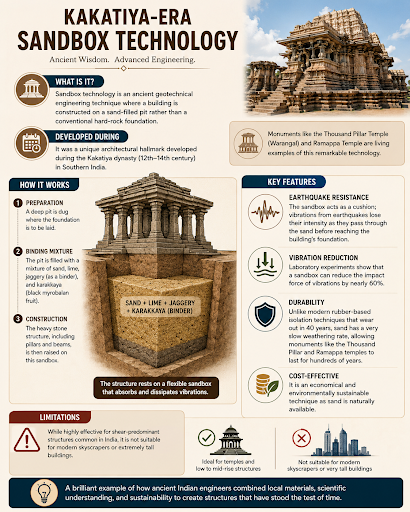
Sandbox Foundation: Utilizing Kakatiya sandbox technology, engineers filled deep pits with sand to buffer against structural loads and tremors.
Craftsmanship: Carved from polished granite and dolerite, the temple features lathe-turned pillars, perforated screens, and panels depicting the Ramayana, Mahabharata, and Puranas.
Monolithic Nandi: Artisans carved a massive Nandi bull from a single block of black basalt (dolerite), positioning it to face the Shiva sanctum directly.
Visual Illusion: The name "Thousand Pillar" denotes the volume of intricately carved pillars supporting the temple and its Navarangamandapa (dance pavilion), creating an illusion of endless symmetry rather than exactly 1,000 pillars.
Destruction And Conservation
Tughlaq Invasion: Invading forces led by Ulugh Khan of the Tughlaq dynasty destroyed parts of the temple complex during their Deccan campaign in 1323-24.
Nizam's Contribution: Mir Osman Ali Khan, the 7th Nizam of Hyderabad, donated a grant of ₹1 lakh to initiate the reconstruction of the ruined temple.
Geological Threat: Over time, a north-east geological fracture compromised the original sandbox foundation, causing the heavy Kalyana Mandapam (12th-century dance pavilion) to gradually sink into the earth.
ASI Restoration (42-Year Project): Archaeological Survey of India (ASI) recently completed restoration project.
UNESCO Tentative List: UNESCO currently includes the Thousand Pillar Temple on its tentative list of World Heritage Sites, grouping it alongside the nearby Warangal Fort and the Kakatiya Kala Thoranam.
Source: THEHINDU
|
PRACTICE QUESTION Q. Consider the following statements regarding Kakatiya-era architecture:
Which of the statements given above is/are correct? A) 1 only B) 2 only C) Both 1 and 2 D) Neither 1 nor 2 Answer: C Explanation: Statement 1 is Correct: The Thousand Pillar Temple (also known as the Rudreshwara Swamy Temple) was indeed built in 1163 AD by the Kakatiya ruler King Rudra Deva. Statement 2 is Correct: The Ramappa Temple (Rudreshwara Temple) is famous for its use of 'sandbox technology' in its foundation. This ancient engineering technique involved filling foundation pits with a mixture of sand, lime, jaggery, and black myrobalan fruit to act as a cushion against earthquake tremors. |
The Thousand Pillar Temple is a historic 12th-century Hindu temple located in Hanamkonda, Telangana. Built by the Kakatiya King Rudra Deva in 1163 AD, it is dedicated to Lord Shiva, Lord Vishnu, and Lord Surya.
Sandbox engineering is a traditional architectural technique used by the Kakatiyas. It involves excavating a deep foundation pit and filling it with sand before constructing the superstructure. This confines the sand, allowing it to absorb heavy structural loads and seismic shocks.
The Perini Shivatandavam dance form is closely associated with these temples. It was revived after 800 years by the late Nataraja Ramakrishna, who meticulously studied the intricate dance sculptures found in the Ramappa Temple.



© 2026 iasgyan. All right reserved