Description
Copyright infringement not intended
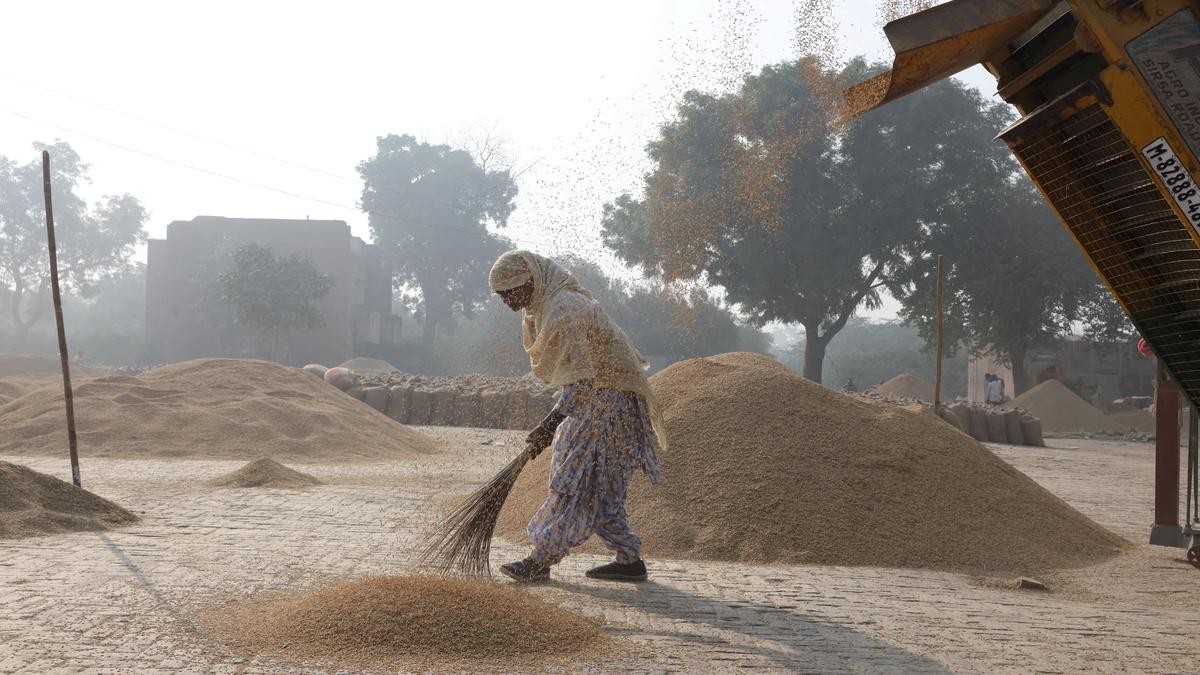
Picture Courtesy: The Hindu
Context:
India recorded a sharp rise in rice exports in 2025 after the Union government lifted all export restrictions that had been imposed during 2022–23. The move significantly improved India’s competitiveness in the global rice market.
Key highlights in India’s rice export surge:
- Overall export performance: India’s rice exports witnessed a strong revival in 2025 following the complete withdrawal of export restrictions. Total shipments increased by 4% year-on-year, reaching 21.55 million tonnes, making it the second-highest export volume on record, just below the 2022 peak of 22.3 million tonnes. The rebound was supported by record domestic production and improved policy certainty.
- Non-basmati rice exports: Exports of non-basmati rice showed the sharpest growth. Shipments rose by 25% to 15 million tonnes, reflecting India’s price competitiveness in mass-consumption markets. Demand expanded significantly from Bangladesh and several African countries such as Benin, Cameroon, Ivory Coast, and Djibouti, where affordability is a key determinant of food imports.
- Basmati rice exports: Basmati rice exports increased by 8%, reaching a record high of 6.4 million tonnes. Premium markets in West Asia and Europe, particularly Iran, the UAE, and the UK, accounted for much of this growth. Stable quality standards and competitive pricing helped sustain India’s dominance in the high-value rice segment.
- Global market impact: The surge in Indian exports led to a decline in rice prices across Asia, pushing them to their lowest level in nearly a decade. Increased supply from India curtailed exports from rival producers such as Thailand and Vietnam, reshaping global trade flows and easing food import costs for low-income, import-dependent countries, especially in Africa.
- India’s position in global rice trade: India retained its status as the world’s largest rice exporter, with export volumes exceeding the combined shipments of Thailand, Vietnam, and Pakistan. The restoration of market shares highlighted India’s structural advantages, including scale of production, diversified varieties, and cost efficiency.
- Policy and supply-side factors: The export recovery followed the removal of restrictions imposed during 2022–23, once domestic availability improved. Strong procurement, adequate buffer stocks, and favourable production conditions allowed the government to balance food security concerns with export growth.
Significance for India:
- Strengthening agricultural export leadership: The surge in rice exports reinforces India’s position as the world’s largest rice exporter, exporting more than the combined volumes of Thailand, Vietnam, and Pakistan. This enhances India’s credibility as a reliable supplier in global food markets and consolidates its leadership in both non-basmati and basmati rice segments.
- Boost to farm incomes and rural economy: Higher export volumes improve demand for paddy, supporting better price realisation for farmers, especially in surplus-producing states. Increased exports also stimulate allied activities such as milling, storage, logistics, and port handling, contributing to rural employment and income generation.
- Improvement in foreign exchange earnings: Rising rice exports add to agricultural export revenues, helping improve India’s trade balance. Basmati rice, in particular, contributes high value per unit, strengthening foreign exchange inflows from premium international markets.
- Enhanced global food security role: By increasing supply and lowering global rice prices, India plays a stabilising role in global food security, especially for import-dependent and low-income countries in Africa and Asia. This enhances India’s image as a responsible food exporter during periods of global volatility.
- Geopolitical and strategic influence: Consistent rice supplies strengthen bilateral relations with importing countries, particularly in Africa, West Asia, and South Asia. Food exports act as a form of soft power, complementing India’s broader diplomatic and development engagement.
- Validation of policy flexibility: The export rebound highlights the importance of adaptive trade policies that respond to domestic supply conditions. The ability to lift curbs once food security concerns eased demonstrates improved policy calibration between inflation control and export promotion.
- Support to Agri-export vision: The rise in rice exports aligns with India’s objective of becoming a major agricultural export hub, supporting initiatives such as value-chain development, market diversification, and branding of Indian agricultural products.
Factors driving the surge in rice exports:
- Lifting of export restrictions: The most immediate trigger for the export surge was the complete removal of rice export curbs in March 2025. These restrictions, imposed during 2022–23 to control domestic prices, were withdrawn after domestic availability improved. This policy shift enabled exports to rebound sharply, pushing total shipments to 55 million tonnes in 2025, up from 18.05 million tonnes in 2024.
- Record domestic production and adequate stocks: India witnessed record rice production, ensuring sufficient availability for both domestic consumption and exports. Improved procurement and comfortable buffer stocks reduced food security concerns, allowing the government to permit higher exports without risking domestic price instability.
- Sharp growth in non-basmati rice demand: Exports of non-basmati rice increased by 25%, reaching 15 million tonnes, accounting for nearly 70% of total rice exports. Price-sensitive markets in Bangladesh and African countries increased imports due to India’s ability to supply large volumes at lower prices compared to rival exporters.
- Expansion of premium basmati markets: Basmati rice exports rose by 8% to a record 6.4 million tonnes. Demand from Iran, the UAE, and the UK remained strong, driven by stable quality, brand recognition, and competitive pricing in the premium segment.
- Price competitiveness in the global market: Indian rice remained cheaper than supplies from Thailand and Vietnam, enabling India to quickly regain lost market share. Increased Indian shipments led to Asian rice prices falling to their lowest level in nearly a decade, further stimulating demand for Indian exports.
- Weak export performance of rival countries: Higher costs and limited export growth in Thailand and Vietnam reduced their competitiveness. As Indian supplies returned strongly to the market, shipments from these countries declined, creating space for India to dominate key importing regions.
- Diversified export destinations: India’s rice exports were well-diversified across Asia, Africa, West Asia, and Europe. Non-basmati exports surged to African nations such as Benin, Cameroon, Ivory Coast, and Djibouti, while basmati exports expanded in West Asian and European markets, reducing dependence on any single region.
Key constraint in India’s export:
- Balancing exports with domestic food security: While exports surged to 55 million tonnes, ensuring affordable rice availability within India remains a major challenge. Any sudden spike in exports can exert upward pressure on domestic prices, particularly affecting low-income households and the Public Distribution System (PDS).
- Risk of food inflation: Higher international demand and price arbitrage may incentivise excessive exports, potentially leading to food inflation. This could force the government to reintroduce export curbs, creating policy uncertainty for farmers and exporters.
- Climate and production risks: Rice cultivation remains highly dependent on the southwest monsoon. Climate change–induced risks such as erratic rainfall, floods, and droughts could affect production, threatening the sustainability of high export volumes.
- Rising input and logistics costs: Increasing costs of fertilisers, electricity, transport, and port handling can erode India’s price competitiveness. Any rise in logistics costs may reduce margins for exporters, especially in price-sensitive non-basmati markets.
- Sustainability and resource stress: Rice is a water-intensive crop, and large-scale production places pressure on groundwater resources, particularly in states like Punjab and Haryana. Sustaining export growth without addressing water-use efficiency poses long-term environmental concerns.
- Quality control and compliance issues: Meeting stringent quality, pesticide residue, and traceability standards in premium markets remains a challenge, especially for small exporters. Non-compliance can lead to shipment rejections and loss of market credibility.
Way Forward:
- Ensure policy stability with built-in safeguards: India should adopt a predictable and transparent rice export policy, avoiding frequent bans. At the same time, buffer stock norms under the Food Corporation of India (FCI) and price-monitoring mechanisms should be strengthened to protect domestic consumers. The calibrated lifting of curbs in 2025 provides a useful policy template.
- Strengthen food security architecture: Government initiatives such as the Public Distribution System (PDS) and Pradhan Mantri Garib Kalyan Anna Yojana (PMGKAY) must continue to ensure food availability for vulnerable sections, even during periods of high exports. Efficient procurement and stock management will help balance exports with domestic needs.
- Promote climate-resilient and water-efficient farming: Schemes like the Pradhan Mantri Krishi Sinchai Yojana (PMKSY) and promotion of System of Rice Intensification (SRI) should be expanded to reduce water use in rice cultivation. The adoption of climate-resilient rice varieties under ICAR programs can mitigate monsoon-related risks.
- Encourage crop and export diversification: The government should incentivise diversification towards less water-intensive crops through MSP reforms and crop diversification programmes, especially in Punjab and Haryana. Export promotion of value-added rice products can be supported under the Agricultural Export Policy (2018).
- Improve quality standards and traceability: Initiatives such as APEDA’s traceability systems, Geographical Indication (GI) tagging of basmati rice, and strengthened residue monitoring should be scaled up to meet stringent global food safety norms and reduce export rejections.
- Enhance logistics and export infrastructure: Programs like PM Gati Shakti National Master Plan and Sagarmala can reduce logistics costs by improving port connectivity, storage, and multimodal transport. Better infrastructure will sustain India’s price competitiveness in global markets.
Conclusion:
The sharp rise in rice exports in 2025 reflects India’s strong production base, improved policy calibration, and global competitiveness. While export growth enhances farmer incomes, foreign exchange earnings, and India’s role in global food security, sustaining this momentum requires a careful balance between domestic food security, price stability, and environmental sustainability. A stable export policy, climate-resilient farming, efficient logistics, and alignment with ongoing government initiatives will be crucial to ensuring that India’s leadership in global rice trade remains both economically beneficial and socially sustainable.
Source: The Hindu
|
Practice Question
Q. The surge in India’s rice exports in 2025 has significant economic and strategic implications.
Discuss. (250 words)
|
Frequently Asked Questions (FAQs)
India lifted the restrictions after record domestic production and adequate buffer stocks reduced food security concerns. The move aimed to restore export competitiveness while maintaining domestic price stability.
Non-basmati rice contributed the most, with exports rising by 25% to about 15.15 million tonnes, mainly due to strong demand from price-sensitive markets in Asia and Africa.
Basmati exports increased by 8% to a record 6.4 million tonnes due to consistent quality, GI protection, and sustained demand from West Asia and Europe, especially Iran, the UAE, and the UK.