India declared Pakistan a Frankenstein State at the UNHRC, condemning its state-sponsored terrorism. Following the deadly Pahalgam terror attack, India suspended the outdated Indus Waters Treaty, launched Operation Sindoor, and assumed FATF leadership to globally dismantle terror financing networks.
Why In News?
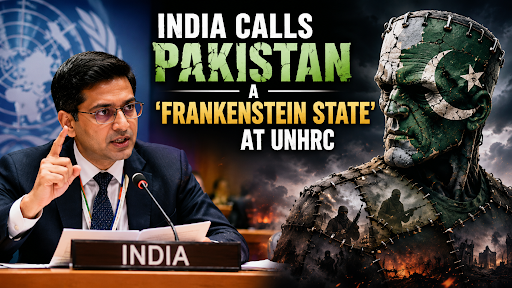
India recently designated Pakistan a "Frankenstein State" at the 62nd UN Human Rights Council (UNHRC) session.
What is a "Frankenstein State"?
Geopolitical Metaphor: India defines a Frankenstein State as a nation that creates and nurtures terrorist proxy groups, only to lose control and suffer domestic instability when the "monster bites back."
Diplomatic Rebuttal: India invokes its Right of Reply at the 62nd UNHRC Session in Geneva to reject baseless allegations from Pakistan and the Organisation of Islamic Cooperation (OIC) regarding Jammu and Kashmir.
State Policy Admission: India highlights that Pakistan’s sitting Defence Minister openly boasts of hosting, training, and deploying terrorists as a deliberate instrument of state policy.
Dual Narrative Deception: Pakistan attempts to project itself as a victim of terrorism globally while masking its active role in funding and arming militant networks for asymmetrical warfare.
About UN Human Rights Council (UNHRC)
It is an intergovernmental body within the UN system responsible for promoting and protecting human rights worldwide.
Headquartered in Geneva, Switzerland, it consists of 47 Member States elected by the UN General Assembly and addresses critical human rights violations globally.
Mission & Core Responsibilities
Forum for Dialogue: Serves as a primary global platform to discuss, address, and issue recommendations on urgent human rights situations.
Crisis Management: Holds special sessions to respond immediately to pressing human rights emergencies or violations.
Key Mechanisms
Universal Periodic Review (UPR): Assesses the human rights records of all 193 UN Member States to improve human rights conditions on the ground.
Special Procedures: Appoints independent experts and fact-finding missions to investigate specific country situations or thematic issues (e.g., freedom of expression, women's rights, and minority rights).
Advisory Committee: Functions as a think tank for the Council, helping to guide thematic priorities.
Structural Details
Membership: 47 states serve staggered three-year terms and are apportioned by geographic region: African States (13), Asia-Pacific States (13), Eastern European States (6), Latin American and Caribbean States (8), and Western European and Other States (7).
Sessions: Convenes at least three regular sessions annually.
Source: THEHINDU
|
PRACTICE QUESTION Q. Consider the following statements regarding the Indus Waters Treaty (1960):
Which of the statements given above is/are correct? A) 1 and 2 only B) 3 only C) 2 and 3 only D) 1, 2, and 3 Answer: B Explanation: Statement 1 is incorrect: The Indus Waters Treaty (1960) allocates the three Eastern Rivers (Ravi, Beas, and Sutlej) for unrestricted and exclusive use to India, not Pakistan. The three Western Rivers (Indus, Jhelum, and Chenab) are allocated primarily to Pakistan. Statement 2 is incorrect: The treaty was negotiated and brokered by the World Bank (then known as the International Bank for Reconstruction and Development), not the United Nations Security Council. Statement 3 is correct: In April 2025, the Indian government announced a historic suspension of the Indus Waters Treaty obligations following cross-border terror attacks (specifically following the Pahalgam terror attack), asserting that it would hold its commitments in abeyance until Pakistan stops sponsoring cross-border terrorism. |
The United Nations Human Rights Council (UNHRC) is an intergovernmental body responsible for strengthening human rights promotion globally and investigating specific violations, such as state-sponsored terrorism or suppression of free speech.
India fiercely criticised Pakistan at the 62nd UNHRC session (June 2026) for being a "Frankenstein state" that institutionalises cross-border terrorism, while also formally declaring the 1960 Indus Waters Treaty "outdated" due to Pakistan's refusal to stop exporting terror.
The Financial Action Task Force (FATF) chokes terror networks by setting global anti-money laundering standards and maintaining a "grey list" to penalise nations that fail to prosecute individuals funding groups like Jaish-e-Mohammed.
The confrontation signals a major diplomatic escalation where India is moving beyond verbal condemnation to potentially abrogating or renegotiating the Indus Waters Treaty, while actively pushing for renewed international financial sanctions against Islamabad.


© 2026 iasgyan. All right reserved