India assumes the 2026 Kimberley Process Chair, focusing on Credibility, Compliance, and Consumer Confidence. With dominance in diamond polishing, India aims to reform the certification scheme through blockchain technology, broaden conflict definitions, and balance global geopolitical trade interests.
India is hosting the 2026 Kimberley Process Intersessional Meeting in Mumbai from May 11–14.
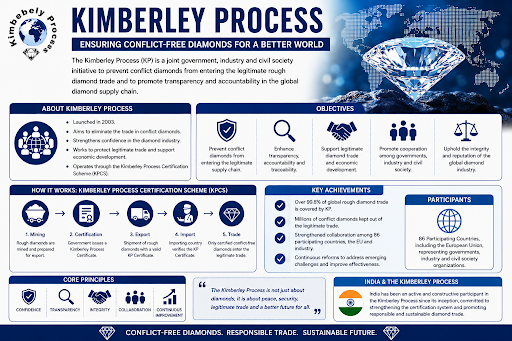
It is a UN-backed international certification scheme established in 2003 to prevent "conflict diamonds" or "blood diamonds"—rough diamonds used by rebel movements to finance wars—from entering the mainstream market.
It acts as a global, tripartite initiative that brings together governments, the international diamond industry, and civil society, to prevent the trade of "conflict diamonds" or "blood diamonds".
The Kimberley Process Certification Scheme (KPCS) serves as the core regulatory tool, operating since 2003.
Membership and Operational Mechanism
The KP comprises 60 participants representing 86 countries, with the European Union participating as a single bloc.
The participating members collectively control approximately 99.8% of global rough diamond production.
The KPCS requires members to ensure every cross-border shipment of rough diamonds with a forgery-resistant, tamper-proof KP certificate.
The rules permit trade in rough diamonds only between certified KP members who fully comply with the minimum standards.
In India, the Department of Commerce functions as the nodal department, while the Gem & Jewellery Export Promotion Council (GJEPC) operates as the designated KPCS Importing and Exporting Authority.
India assumes the Chair of the Kimberley Process for 2026, taking on the leadership role for the third time.
India advocates the "3Cs" theme for 2026 Chairship: Credibility, Compliance, and Consumer Confidence.
India dominates the processing sector, acting as the world's premier cutting and polishing center (primarily in Surat and Mumbai) that processes nearly 90% of the world's diamonds.
India stands as the world's largest importer of rough diamonds, accounting for about 40% of total global imports.
India produces a negligible amount of rough diamonds natively; the Majhgawan mine in the Panna diamond belt (Madhya Pradesh) operates as India's only commercial diamond mine.
Drive technological modernization by piloting blockchain-based digital certification to create immutable, time-stamped ledgers that eliminate fraud and improve traceability.
Balance the Global South's sovereignty against unilateral G7 traceability mandates, warning that high-cost compliance could isolate artisanal miners.
Establishing technical working groups to assess violence and human rights risks, aiming to build an evidence-based consensus before broadening the scope of the conflict diamond definition.
Strict institutional accountability by implementing independent third-party audits (peer reviews) and mandating the public disclosure of granular trade statistics.
India advocates for an Africa-centric developmental lens, aligning the KP with Sustainable Development Goals to ensure that diamond revenues directly fund health, education, and infrastructure in local mining communities.
Source: PIB
|
PRACTICE QUESTION Q. Consider the following statements about the Kimberley Process (KP):
Which of the statements given above is/are correct? A. 1 and 2 only B. 2 and 3 only C. 1 and 3 only D. 1, 2, and 3 Answer: A Explanation: Statement 1 is correct: The Kimberley Process (KP) is a tripartite initiative involving governments, the international diamond industry, and civil society organizations to prevent the trade of conflict diamonds. Statement 2 is correct: India was selected to assume the Chair of the Kimberley Process for the year 2026, taking over as Vice Chair in December 2025. Statement 3 is incorrect: Participation in the Kimberley Process is not limited to UN Security Council members. It has 60 participants (as of late 2025), including the European Union and many countries, and is open to all countries that meet its requirements. |
The Kimberley Process is a global, tripartite initiative established in 2003 that brings together governments, the international diamond industry, and civil society to prevent the global trade of "conflict diamonds".
The KP currently defines conflict diamonds strictly as rough, unpolished diamonds used by rebel groups or their allies to finance armed conflicts aimed at undermining legitimate governments.
India dominates the processing sector, serving as the world's premier cutting and polishing center (primarily in Surat and Mumbai) that processes nearly 90% of the world's diamonds. It is also the largest importer, handling about 40% of total global rough diamond imports.

© 2026 iasgyan. All right reserved