The India-Egypt relationship has evolved from Non-Alignment to a Strategic Partnership anchored in trade security via the Suez Canal, a 2026 defense roadmap, and mutual leadership within BRICS+ to empower the Global South.
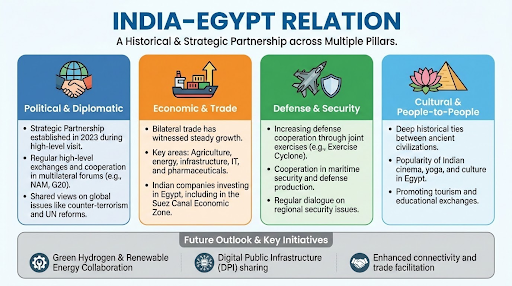
The 11th India-Egypt Joint Defence Committee meeting in Cairo (April 2026) finalized a 2026-27 plan for enhanced military exercises and defence industrial co-production.
Historical & Post-Colonial Era (1950s–1960s)
Diplomatic relations: The formal diplomatic relations were established in 1947. A formal Friendship Treaty signed in 1955 between Indian Prime Minister Jawaharlal Nehru and Egyptian President Gamal Abdel Nasser.
Founding of NAM: Under Prime Minister Jawaharlal Nehru and President Gamal Abdel Nasser, both nations co-founded the Non-Aligned Movement (NAM) in 1961, cementing a bond based on anti-colonialism and sovereignty.
Period of Stagnation & Revival (1980s–2010s)
Relations remained cordial but lacked high-momentum economic or strategic engagement during the late Cold War and early post-Cold War era.
Revival: High-level exchanges resumed more frequently after 2014, with President Abdel Fattah El-Sisi visiting India for the India-Africa Forum Summit in 2015.
The Strategic Shift (2023–Present)
Republic Day 2023: President Sisi was the Chief Guest at India’s 74th Republic Day, signaling a major upgrade in ties.
Strategic Partnership (June 2023): During PM Narendra Modi’s visit to Cairo (the first by an Indian PM since 1997), the relationship was elevated to a "Strategic Partnership" covering political, defense, security, energy, and economic areas.
Recent Defense Roadmap (April 2026): In the 11th Joint Defence Committee meeting held in Cairo in April 2026, both sides finalized a roadmap for 2026-27, focusing on co-production of defense equipment and maritime security.
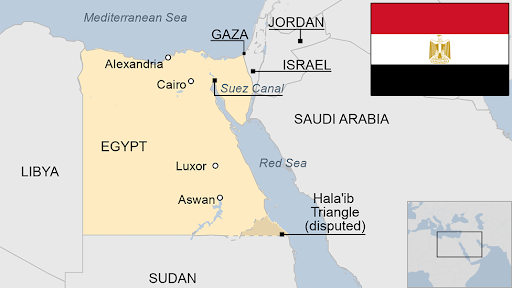
Geostrategic Significance
The Suez Canal: The Suez Canal handles 12% of global trade, making Egypt a vital choke point for India's energy and economic links to Europe and the Americas.
Gateway to Markets: Egypt serves as a bridge to both the African continent (via the African Continental Free Trade Area) and Europe, offering Indian companies a hub for re-exporting goods.
Defense & Security
Maritime Security: Amid Red Sea instability, collaboration with the Egyptian Navy is vital for securing Indian vessels and countering piracy.
Defense Exports: Egypt’s interest in the Tejas LCA, Akash missiles, and Dhruv helicopters offers a significant market for India.
Counter-Terrorism: As a moderate partner, Egypt is crucial for intelligence sharing and combatting radicalization.
Economic & Energy Partnership
Green Energy Hub: Egypt serves as a green corridor where Indian firms like ReNew Power have pledged approximately $8 billion for hydrogen plants in the Suez Canal zone.
Trade Relations: Bilateral trade reached $4.88 billion in FY 2024-25, targeting $12 billion by 2028. Key exchanges include Egyptian phosphate and cotton for Indian petroleum and meat.
Multilateral Cooperation
Global South Advocacy: Both countries partner in the G20 and BRICS (which Egypt joined in 2024) to champion the interests of developing nations.
Regional Instability and the Red Sea Crisis: Middle East conflicts and Houthi attacks have disrupted Suez Canal shipping, raising freight and insurance costs for Indian trade.
Economic Volatility in Egypt: Despite relief from a $35 billion UAE deal and IMF bailout, inflation and forex shortages pose risks to Indian investments.
Chinese Influence: As Egypt’s top trading partner, China has invested heavily in the Suez Canal and the New Administrative Capital, challenging Indian infrastructure and defense interests.
Defense Integration Hurdles: Despite interest in India’s Tejas LCA and Akash Missiles, Egypt’s reliance on Western and Russian hardware creates technical and political obstacles for adopting Indian systems.
Bureaucratic Red Tape: Indian investors often cite complex regulatory hurdles and administrative delays in Egypt as barriers to ease of doing business.
Expanding Local Currency Trade: To bypass Egypt’s dollar liquidity issues, both nations should fast-track a Rupee-Pound trade mechanism, similar to India’s arrangement with the UAE.
Operationalizing the India-Egypt Defense Roadmap: Following the April 2026 Joint Defence Committee meeting, the focus must shift to MRO (Maintenance, Repair, and Overhaul) facilities for Egyptian aircraft and joint production of ammunition.
Digital Public Infrastructure (DPI) Export: India should actively assist Egypt in implementing its UPI-based payment system and digital identity (Aadhaar-like) frameworks to boost financial inclusion.
Energy Corridor Development: Expediting the $8 billion Green Hydrogen projects by Indian firms in the Suez Canal zone will establish India as a key player in Egypt’s energy transition.
Enhanced Maritime Domain Awareness (MDA): Given the Red Sea risks, India and Egypt should establish a permanent hotline and intelligence-sharing mechanism for maritime security.
The India-Egypt relationship has evolved from Non-Alignment to a result-oriented Strategic Partnership anchored in trade security via the Suez Canal, a 2026 defense roadmap, and mutual leadership within the BRICS+ framework.
Source: PIB
|
PRACTICE QUESTION Q. The elevation of India-Egypt ties to a 'Strategic Partnership' marks a decisive shift from historical idealism to geopolitical pragmatism. Analyze. 150 words |
Egypt serves as a critical gateway connecting Africa, Asia, and Europe. Its control over the Suez Canal is vital for India's maritime security and trade with the West. Furthermore, Egypt acts as a crucial anchor for India's expanded "Think West" policy in the MENA (Middle East and North Africa) region.
Exercise CYCLONE is a joint military exercise between the Special Forces of India and Egypt. It focuses on sub-conventional warfare, combat first aid, hostage rescue strategies, and enhancing interoperability in harsh desert environments. The 3rd edition (CYCLONE-III) was held in Rajasthan in February 2025.
The primary challenges include Egypt's macroeconomic instability (such as high inflation and severe US dollar shortages), geopolitical disruptions in the Red Sea (like Houthi attacks that severely disrupt Suez Canal trade routes), and the overwhelming presence of China's Belt and Road Initiative (BRI) infrastructure investments.

© 2026 iasgyan. All right reserved