India aims to shape global AI governance by hosting the AI Impact Summit 2026, positioning itself as the Global South’s voice. Adopting a balanced, risk-based regulatory approach, it leverages the IndiaAI Mission and Digital Public Infrastructure to promote innovation while mitigating harms, despite gaps in AI-specific law and data protection.
Copyright infringement not intended
Picture Courtesy: THEHINDU
India is set to host the AI Impact Summit in New Delhi in February 2026, at Bharat Mandapam in New Delhi.
The AI Impact Summit is organized by the Ministry of Electronics and Information Technology (MeitY), it is the first-ever global AI summit hosted in the Global South.
The summit aims to move beyond theoretical AI safety to focus on measurable real-world impact and the democratization of AI infrastructure.
It follows a series of international dialogues, including the UK AI Safety Summit (2023), the AI Seoul Summit (2024), and the Paris AI Action Summit (2025), positioning India as a key player in shaping the future of global AI governance.
|
Declaration/Summit |
Year & Location |
Key Focus & Outcomes |
|
Bletchley Declaration |
2023, UK |
|
|
Seoul Declaration |
2024, South Korea |
|
|
Paris AI Action Summit |
2025, France |
|
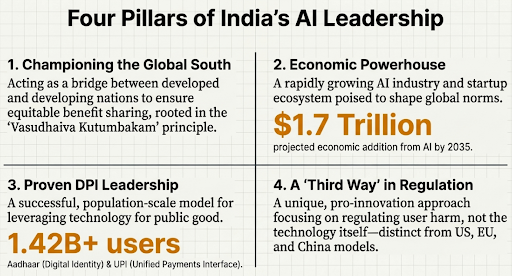
Championing the Global South
India seeks to be a bridge ensuring equitable AI benefits between developed and developing nations, aligning with foreign policy of 'Vasudhaiva Kutumbakam' (One Earth, One Family, One Future).
Economic Powerhouse
AI is projected to add up to $1.7 trillion to India's economy by 2035. Shaping global norms will help promote a favorable environment for India's growing AI industry and startup ecosystem. (Source: PIB)
Digital Public Infrastructure (DPI) Leadership
India's successful creation of population-scale Digital Public Infrastructures (DPIs) like Aadhaar (digital identity for over 1.42 billion citizens) and UPI (Unified Payments Interface) provides a model for using technology for public good, which it is now exporting globally.
A 'Third Way' in Regulation
India is developing a unique regulatory approach that is distinct from the US (market-led), China (state-controlled), and EU (comprehensive rights-based) models. India's strategy is pro-innovation and focuses on a risk-based framework that regulates user harm rather than the technology itself.
The IndiaAI Mission, approved in 2024 with a ₹10,371 crore five-year budget, strengthens India's global AI leadership. It aims to create a comprehensive domestic AI ecosystem.
The Seven Pillars of the IndiaAI Mission
|
Case Studies: AI for Public Good in India Bhashini: AI for Linguistic Inclusion
|
Lack of a Dedicated AI Law
India's current regulatory approach is fragmented. It relies on extending existing laws like the Information Technology Act, 2000, which were not designed to address the complexities of self-learning AI systems.
Data Governance and Privacy
While the Digital Personal Data Protection (DPDP) Act, 2023, provides a framework, it has limitations. For example, it does not apply to personal data that is made publicly available, creating a potential loophole for scraping data to train AI models without consent.
Algorithmic Bias and Opacity
AI models can perpetuate existing societal biases related to caste, gender, or religion. The "black box" nature of many algorithms makes it difficult to audit their decisions, posing challenges for fairness and accountability.
Institutional and Skill Gaps
Regulatory bodies need to build techno-legal capacity to effectively audit AI systems, assess risks, and enforce compliance in a rapidly evolving technological landscape.
Enact a Risk-Based AI Law
India needs an adaptive, risk-based AI legal framework. It should support low-risk innovation while strictly requiring transparency and liability for high-risk applications (e.g., healthcare, law enforcement).
Strengthen Data Governance
The proposed India Data Management Office (IDMO) must be fully operationalized by the Government to set standards for data quality and ethical sourcing. Strengthening the DPDP Act is vital for public trust.
Invest Aggressively in Skilling and R&D
Goals of the IndiaAI Mission, especially in expanding compute infrastructure and AI education, must be pursued with urgency to create a talent pool capable of driving innovation.
Global Cooperation
India should lead the upcoming AI Impact Summit by promoting frameworks for financial and technological aid for developing nations, open-source AI for public good, and shared ethical standards.
India positions itself to harness AI for sustainable development and shape a human-centric AI future globally by executing its domestic AI strategy and advocating an inclusive global vision.
Source: THEHINDU
|
PRACTICE QUESTION Q. "Examine India’s role as a bridge between the Global North and Global South in the context of emerging technologies and global AI governance." (250 words) |
India hosting the AI Impact Summit 2026 is the first global AI summit in the Global South. It signals India's ambition to shift the global AI narrative from "safety" and "action" to tangible "impact," positioning itself as a leader and a voice for developing nations in technological governance.
India’s regulatory approach is distinct from the market-driven US model, the state-led China model, and the comprehensive EU AI Act. It is a pro-innovation strategy that focuses on regulating user harm caused by AI applications rather than the technology itself, aiming to strike a balance between promoting growth and ensuring accountability.
The IndiaAI Mission, with a budget of over ₹10,000 crore, aims to build a robust AI ecosystem in India. Its key objectives include creating large-scale GPU-based computing infrastructure, developing indigenous AI models, creating high-quality datasets, skilling the workforce, financing AI startups, and developing frameworks for safe and trusted AI.






© 2026 iasgyan. All right reserved