India faces a severe heatwave crisis, impacting health and millions of jobs. While Heat Action Plans offer hope, structural gaps remain. For climate resilience, India must prioritize green cooling, nature-based urban planning, and official national disaster status for heatwaves.
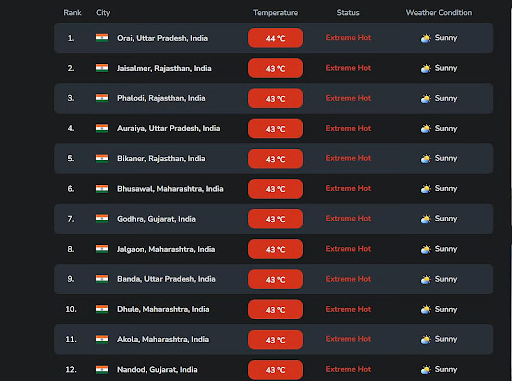
Real-time weather data from AQI.in and other monitoring agencies confirms that 98 of the world's 100 hottest cities are currently located in India.
A heatwave is a period of abnormally high temperatures, hotter than the normal climate of a region. The India Meteorological Department (IMD) defines a heatwave based on specific temperature thresholds:
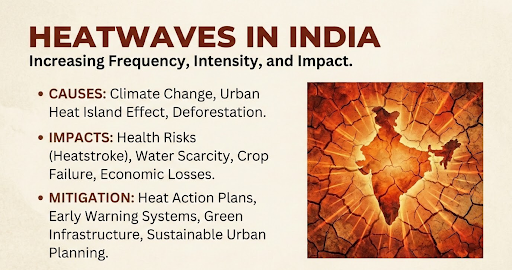
A heatwave is formally declared if these criteria are met at two stations in a meteorological subdivision for at least two consecutive days.
Global Warming and Climate Change
Primary Driver: Human-induced climate change is the leading cause of more frequent and intense heatwaves in South Asia. (Source: Intergovernmental Panel on Climate Change)
Rising Baseline Temperatures: India's mean temperature rose by 0.7°C between 1901 and 2018, leading to a surge in daily extreme temperatures.
Future Projections: If current emission trends continue, heatwaves in India are projected to last 25 times longer by 2036–2065. (Source: G20 Climate Risk Atlas)
The "Urban Heat Island" (UHI) Effect
Urban Heat Island Effect: Major cities like Delhi and Mumbai are hotter than rural regions as concrete surfaces trap daytime heat and release it slowly at night.
Rising Night Temperatures: "Very warm nights" are increasing rapidly; Mumbai recorded 15 extra warm nights per summer over the last decade.
Vegetation Loss: Declining urban green cover reduces natural cooling from evapotranspiration, further driving up city temperatures.
Meteorological Factors
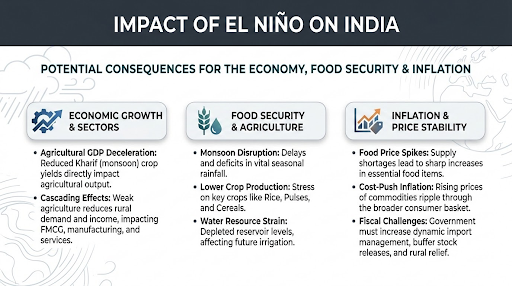
El Niño Events: Years with El Niño conditions (warming of the Pacific Ocean) disrupt the Indian monsoon, leading to drier soil and reduced cloud cover, which causes sharper spikes in temperature.
Anti-Cyclonic Formations: High-pressure systems (anti-cyclones) over regions like Western India, pushing air downward (subsidence), which compresses and heats it while preventing cooling winds from entering.
Early Summer Onset: Shifting weather patterns have caused summer-like temperatures to arrive as early as February, as seen in 2026, extending the duration of heat stress.
Increasing Humidity and "Wet Bulb" Temperature
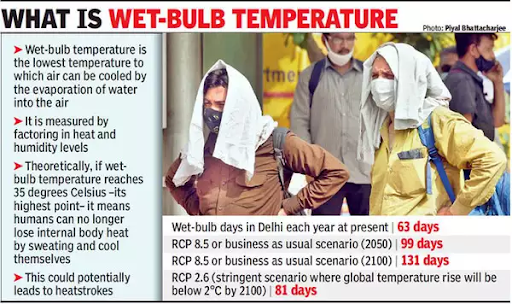
Humid Heat Stress: Dry heat traditionally defines heatwaves, but rising humidity in coastal areas and the Indo-Gangetic Plain now elevates risks via high wet-bulb temperatures, even when absolute temperatures are lower.
Compound Events: The co-occurrence of droughts and heatwaves has increased, leaving soils dry and unable to cool the air through evaporation.
Severe Health Crisis and Mortality
Rising Mortality: Heatwaves increase the risk of death. A study across 10 Indian cities found that heatwaves were associated with a 14.7% increase in daily all-cause mortality.
Heat-Related Illnesses: Prolonged exposure leads to a spectrum of disorders including heat exhaustion, heat stroke, severe dehydration, and acute kidney injury.
Vulnerable Groups: High-risk groups include children, the elderly, and individuals with respiratory or cardiovascular issues. In India, heatwave exposure for those over 65 rose by 15% between 1990 and 2019. (Source: The Lancet)
Economic Loss and Labor Productivity
GDP at Risk: The Reserve Bank of India (RBI) has warned that up to 4.5% of India's GDP could be at risk by 2030 due to lost labor hours caused by extreme heat and humidity.
Lost Working Hours: India is projected to lose the equivalent of 34 million full-time jobs by 2030 due to heat stress, particularly in agriculture and construction. (Source: ILO).
Productivity Decline: Heavy labor sectors like construction and farming are hit hardest. India currently loses around 100 billion labor hours annually due to heat, the highest in the world. (Source: Nature)
Impact on Agriculture and Food Security
Crop Yield Reduction: Heatwaves, especially during the grain-filling stage, severely damage crops. In 2022, the heatwave reduced India's wheat yield by 15-25% in affected states like Punjab and Haryana. (Source: ICAR)
Horticulture Damage: Fruit crops suffer from "sunburn" and fruit drop. For example, mango and citrus yields have seen significant reductions due to thermal stress.
Livestock and Dairy: Heat stress reduces the appetite and fertility of livestock. Milk production in cattle can drop by 15% or more during severe heatwaves due to physiological stress.
Strain on Energy and Water Infrastructure
Power Surges: High temperatures spike cooling demand, frequently breaking peak power records in North India and straining the electrical grid.
Water Scarcity: Heatwaves intensify reservoir and soil evaporation. Simultaneous heat and drought create "compound extreme" events that jeopardize irrigation and drinking water supplies.
Implementation of Heat Action Plans (HAPs)
National Framework: The National Disaster Management Authority (NDMA) issued guidelines for heatwave prevention, with 23 states now operating tailored Heat Action Plans (HAPs).
City-Level Success: Ahmedabad launched South Asia's first HAP in 2013, preventing an estimated 1,190 annual deaths through early warnings and community outreach.
Advanced Early Warning Systems (EWS)
IMD Alerts: IMD Issues impact-based heatwave warnings using a color-coded system (Green, Yellow, Orange, Red) to alert local authorities and the public up to 5 days in advance.
Digital Dissemination: Warnings are broadcast via radio, SMS, and mobile apps like 'MAUSAM' and 'UMANG' to ensure they reach remote populations.
Sector-Specific Forecasts: The IMD now provides specialized heat guidance for the power sector (to manage grid load) and health sector (to prepare hospitals).
Infrastructure and "Cool Roof" Policies
Telangana's Cool Roof Initiative: Launched in 2023, India’s first "Cool Roof Policy (2023–2028)" seeks to apply heat-reflective materials across 300 sq. km of rooftops in Telangana. The goal is lowering indoor temperatures by 2.1°C to 4.3°C.
Urban Retrofitting: To combat the "Urban Heat Island" effect, cities like Ahmedabad now mandate white-painted reflective roofs for schools and government buildings.
Public Health and Labor Safety Measures
Workplace Adjustments: Several states have mandated changes in working hours for outdoor laborers (e.g., banning work between 12 PM and 3 PM) to prevent heatstroke during peak sun intensity.
Medical Preparedness: Hospitals are now required to maintain "heat stroke rooms" with ice packs and dedicated cooling equipment during the summer months.
Policy and Legal "Vacuums"
Non-Disaster Status: Heatwaves aren't "notified disasters" under the Disaster Management Act, 2005. States are thus blocked from the NDRF and limited to using 10% of SDRF for relief.
Weak Action Plans: The Centre for Policy Research (CPR) notes that most Heat Action Plans are merely advisory, lacking funding, legal authority, or departmental accountability.
Labor Gaps: The Factories Act, 1948 does not cover outdoor workers in construction or agriculture, leaving millions without legal "heat break" protections.
The "Thermal Injustice" & Inequality Gap
Zero Cooling Autonomy: Research indicates the extreme poor—vendors, riders, and slum residents—lack thermal control and cannot stop working without sacrificing vital daily income.
Housing Vulnerability: Nearly 17% of urban Indians reside in heat-trapping tin-roofed slums. These dwellings often record indoor temperatures 5-8°C higher than outdoors, preventing nocturnal body recovery.(Source: SEEDS India)
Data and Measurement Flaws
Humidity and Wet-Bulb Risks: Official warnings often overlook "humid heatwaves" by focusing only on dry temperatures (e.g., 40°C). High humidity can make lower temperatures (e.g., 34°C) lethal, particularly in coastal India. (Source: CEEW)
Localized Data Gaps: An analysis of 37 Heat Action Plans shows a reliance on regional forecasts rather than ward-level data, leaving specific neighborhood "hotspots" without adequate warnings.
Urban Planning Failures
Diminishing Greenery: Concrete construction has displaced vegetation, intensifying the Urban Heat Island (UHI) effect as urban parks succumb to encroachment.
Strategic Deficits: Current initiatives prioritize reaction (emergency aid) over long-term prevention like updated building codes or expanded urban forests.
Policy and Governance Reforms
Officially Notify as Disaster: Declaring heatwaves a "notified disaster" under the Disaster Management Act, 2005 would grant states access to the National Disaster Response Fund (NDRF) for long-term heat-proofing infrastructure.
Enforce Mandatory HAPs: Transition from advisory to mandatory Heat Action Plans with localized budgets at the district or ward level to address specific geographical needs.
Urban Planning and "Cooling" Infrastructure
Expand "Cool Roof" Initiatives: Scale Telangana’s Cool Roof Policy nationally. Mandating reflective paint on public and low-income housing can lower indoor heat by 2°C to 5°C passively.
Strengthen Blue-Green Infrastructure: Protect urban water bodies and forests. Increasing tree cover to 30% can mitigate the Urban Heat Island effect and reduce surface temperatures.
Data-Driven and Hyper-Local Warning Systems
Humidity-Integrated Alerts: Shift to "Wet-Bulb Global Temperature" (WBGT) warnings to factor in humidity and sun angle, accurately measuring heat stress for coastal areas.
Hotspot Monitoring: Utilize dense sensor networks to pinpoint neighborhood hotspots, enabling authorities to deploy targeted interventions like cooling shelters where most required.
Protection for the Vulnerable Workforce
Legal "Right to Cool": Mandate labor law amendments for heat breaks, water, and shade for outdoor workers. Pilot income replacement for extreme heat work stoppages.
Parametric Insurance: Launch heat-linked insurance for farmers and wage earners with automatic payouts triggered by temperature thresholds to offset income loss.
Passive Design and Sustainable Housing
Traditional Architecture: Incorporate passive cooling methods like jaalis, courtyards, and high ceilings into modern affordable housing (e.g., PMAY) to lower AC dependency.
Heatwaves, now a public health crisis, threaten 4.5% of India’s GDP. To build structural resilience, India must legally notify heatwaves as disasters, scale Cool Roof policies, and implement labor reforms to protect outdoor workers from rising global and urban temperatures.
SOURCE: NEWINDIANEXPRESS
|
PRACTICE QUESTION Q. Heatwaves in India are no longer mere meteorological anomalies but profound socio-economic hazards. Discuss. 150 words |
The IMD declares a heatwave when the maximum temperature reaches at least 40°C in the plains, 37°C in coastal regions, or 30°C in hilly regions. It can also be declared if the temperature departs from normal by 4.5°C to 6.4°C, or if the actual maximum temperature crosses 45°C.
The Urban Heat Island effect occurs when natural vegetation is replaced by dense concrete and asphalt infrastructure. These materials absorb and trap solar radiation, causing built-up city centers to record temperatures 3°C to 4°C hotter than their surrounding rural peripheries.
Wet-Bulb Temperature is a combined measurement of both heat and humidity. When this metric reaches dangerously high levels, the air is too saturated with moisture for human sweat to evaporate. This disables the body's natural cooling mechanism, making heat exposure potentially lethal.


© 2026 iasgyan. All right reserved