India must shift to Wet-Bulb Temperature metrics, as humidity-linked heat kills even at lower dry-bulb readings. Driven by Supreme Court climate rulings, the IMD must integrate the Heat Index into Action Plans to protect labor rights and urban infrastructure.
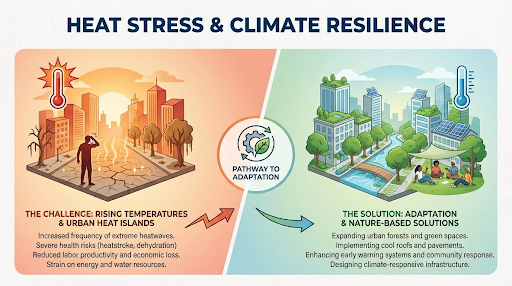
A Nature Communications study reveals the human heat stress safety limit is 31°C wet-bulb temperature, not 35°C as previously thought, necessitating a revision of climate resilience strategies.
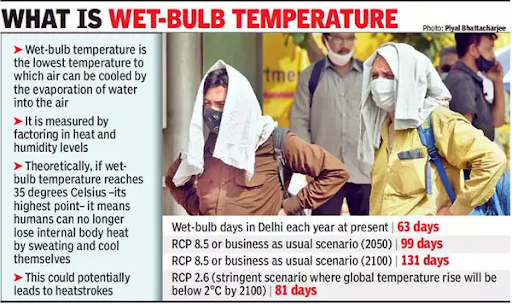
Wet-Bulb Temperature (WBT) is the lowest temperature to which an object can be cooled by the evaporation of water into the air at constant pressure.
For humans, it is the most critical measure of heat stress because it represents the limit of the body's ability to cool itself through sweating.
It is measured by wrapping a wet cloth around the bulb of a thermometer and blowing air over it. As the water evaporates, it cools the bulb.
Impact on Labour Force: Over 75% of India's workforce (agriculture, construction, street vending) is exposed to heat.
Gig Economy Risks: Delivery agents and gig economy workers often lack formal occupational safety nets, facing prolonged heat exposure without mandatory rest or cooling facilities.
Urban Heat Islands (UHI): Concrete structures and asphalt roads in cities absorb and retain heat, making urban areas several degrees hotter than surrounding rural areas. This prevents night-time cooling, increasing the risk of heat stress.
Blindness to Humidity: The India Meteorological Department (IMD) declares heatwaves based on dry-bulb temperature thresholds (e.g., 40°C in plains).
Lack of Local Context: A study of 37 HAPs found that most are generic and do not account for local vulnerabilities, such as slum populations or specific humidity patterns. (Source: CPR Report)
Poor Implementation: The majority of HAPs are underfunded, advisory in nature, and not legally binding, leaving implementation at the discretion of employers and local bodies.
Redefine Heatwave Metrics: Adopt the Heat Index (which includes humidity) for declaring heatwaves. HAPs must be updated to use the 31°C WBT as a critical danger threshold.
Enact Legally Binding Safety Standards: Implement the Occupational Safety, Health and Working Conditions Code (2020) to mandate paid breaks during peak heat hours (12 PM - 4 PM), shaded rest areas, and access to hydration for all outdoor workers.
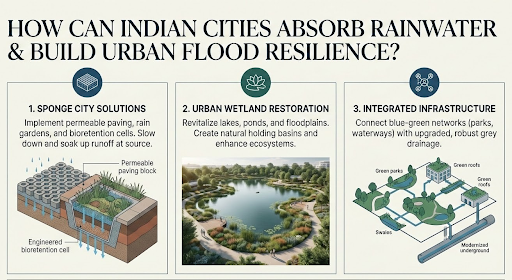
Design Cooler Cities: Urban planning must prioritize green-blue infrastructure, such as green roofs, urban forests, and wetlands. Building codes should mandate features that ensure cross-ventilation and reduce heat absorption.
Ensure Dedicated Funding: National Disaster Management Authority (NDMA) must allocate specific, ring-fenced budgets for HAP implementation, shifting the focus from post-disaster relief to pre-disaster mitigation.
Learn from Best Practices
India must adopt a proactive, humidity-aware heat strategy by legally protecting workers, mandating NDMA funding for HAPs, and implementing climate-resilient urban design best practices.
Source: INDIANEXPRESS
|
PRACTICE QUESTION Q. Highlighting the socio-economic vulnerabilities exacerbated by Heatwaves, discuss the need for a comprehensive legal framework for climate-resilient urban planning in India. 250 word |
Dry-bulb temperature is the standard thermometer reading of ambient air temperature, ignoring humidity. Wet-bulb temperature factors in both heat and humidity, representing the lowest temperature an object can reach through evaporation. It is a more accurate measure of actual heat stress on the human body.
UHIs occur when concrete, asphalt, and dense urban structures absorb and trap solar radiation, making cities significantly hotter than surrounding rural areas. They are especially dangerous because they prevent night-time cooling, denying the human body a vital chance to recover from daytime heat stress.
Cities can adopt "green-blue infrastructure" like urban wetlands and green roofs, implement the proactive "Ahmedabad Model" for early warnings, use cool roofs/reflective paints like Singapore, and establish legally binding occupational safety standards with mandatory shaded breaks for outdoor workers.


© 2026 iasgyan. All right reserved