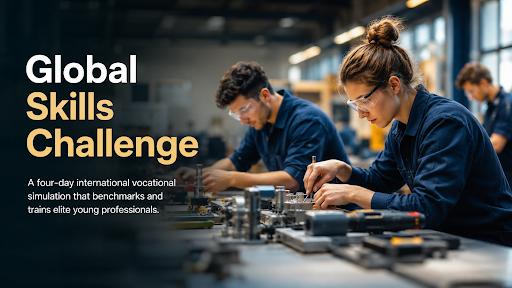
The Global Skills Challenge prepares India’s youth for the biennial WorldSkills Competition. By participating in these elite platforms, India benchmarks its vocational training against global standards, driving initiatives like PMKVY and the Skill India Mission to harness its massive demographic dividend effectively.
Why In News?
The Ministry of Skill Development and Entrepreneurship (MSDE) dispatches a 15-member Indian youth contingent to the Global Skills Challenge 2026 in Australia.
What is the Global Skills Challenge?
It is an international preparatory competition, providing a high-pressure, timed environment for national champions to execute tasks and identify performance gaps.
The event simulates the exact WorldSkills environment, requiring competitors to utilize advanced machinery and software that strictly adhere to WorldSkills Occupational Standards (WSOS).
The platform evaluates Indian talent on speed, accuracy, and real-world problem-solving, ensuring domestic vocational education aligns with global industry benchmarks.
What is WorldSkills?
Earlier known as the "Olympics of Skills," WorldSkills inspires youth to pursue technical careers and addresses global sectoral skills shortages.
WorldSkills International (WSI): This organization manages the biennial competition, uniting members from over 85 countries to promote Vocational Education and Training (VET).
Global Platform for Skill Excellence: The competition assists member nations in building industry connections and establishing world-class training academies.
India’s Participation in WorldSkills
Skill India Mission: Participation reinforces the Skill India Mission’s vision to prepare a future-ready workforce and establish India as a leader in the global skills ecosystem.
Previous Achievements: At the WorldSkills Competition (WSC) 2024, Team India secured the 13th position globally, earning 4 Bronze Medals and 12 Medallions of Excellence.
Areas of Competition: India selects representatives via the IndiaSkills Competition to compete in high-tech categories such as 3D Digital Game Art, Cloud Computing, Additive Manufacturing, and Bricklaying.
Key Sectors Covered
Manufacturing Skills: Competitions evaluate competencies in Industrial Mechanics, Additive Manufacturing, and Mechatronics.
Information Technology: Candidates participate in Cloud Computing, Web Technologies, and Cyber Security to meet digital economy demands.
Construction Trades: The event integrates infrastructure skills including Bricklaying, Plumbing, Wall and Floor Tiling, and Electrical Installations.
Emerging Technologies: The challenge tests youth in Industry 4.0, Unmanned Aerial Systems (Drones), and Optoelectronic Technology.
Significance for India
Demographic Dividend: With 65% of the population in the working age and 26% aged 10 to 24, India must upskill its youth to convert this demographic bulge into a productive economic force, per the Economic Survey 2024-25.
Workforce Competitiveness: While only 4.1% of the Indian population (aged 15-59) is formally skilled, global competitions push India to match the 60-70% formal training rates seen in developed economies.
Industry 4.0 Preparedness: Participation integrates robotics, 3D printing, and AI into domestic training to prepare for the automation-driven landscape.
Employment Generation: Globally certified skills reduce youth unemployment, attract Foreign Direct Investment (FDI), and position India as a premier global talent supplier.
Government Initiatives for Skill Development
Skill India Mission: The government utilizes the Skill India Digital Hub (SIDH) to monitor real-time skilling and issue QR-coded digital certificates.
PMKVY: The Pradhan Mantri Kaushal Vikas Yojana (PMKVY) 4.0 mandates On-the-Job Training (OJT), having trained over 64 crore candidates since 2015.
National Education Policy 2020: The NEP 2020 mandates Skill Hubs in schools and colleges to integrate vocational training into the formal academic curriculum.
National Skill Development Corporation (NSDC): The NSDC acts as the Program Implementing Agency (PIA), designing competition frameworks and collaborating with Sector Skill Councils (SSCs).
Source: DDINDIA
|
PRACTICE QUESTION Q. Under the Pradhan Mantri Kaushal Vikas Yojana (PMKVY) 4.0 framework, the "Recognition of Prior Learning (RPL)" component primarily targets: A) Providing specialized drone pilot training to prison inmates. B) Integrating vocational training into the formal education system for secondary school students. C) Assessing and certifying the existing skills of workers currently employed in the informal or unregulated sectors. D) Guaranteeing overseas employment to highly skilled IT professionals. Answer: C Explanation: Under the Skill India Digital Hub, the Recognition of Prior Learning (RPL) component of PMKVY aims to validate the knowledge and experience of individuals who have acquired skills informally. It evaluates their competencies against the National Skills Qualification Framework (NSQF) to help them secure formal employment and better livelihoods. |
The Global Skills Challenge is a full-scale, four-day international vocational simulation organised by WorldSkills Australia that serves as a high-intensity benchmarking and training platform for elite young professionals.
WorldSkills is the premier global hub for vocational excellence that hosts the world's largest biennial skills competition, bringing together over 1,500 contestants under the age of 25 to showcase top-tier technical and digital competencies.
Skill development is absolutely vital to harness India’s massive demographic dividend, resolve severe structural unemployment mismatches, bridge the gap between formal degrees and market competencies, and satisfy the immense workforce demands of the expanding manufacturing sector.
The Skill India Mission enhances international competitiveness by upgrading vocational training parameters to global benchmarks, introducing advanced specialisations like Cloud Computing and Additive Manufacturing, and using international simulations to position Indian youth as the preferred workforce supplier for an aging industrialized world.


© 2026 iasgyan. All right reserved