The Supreme Court's 2025 Amlesh Kumar vs State of Bihar ruling upheld the Selvi precedent: forced narco-analysis violates Articles 20(3) and 21. While test results are inadmissible, evidence discovered through the test may be admissible, emphasizing mental privacy and adherence to rights.
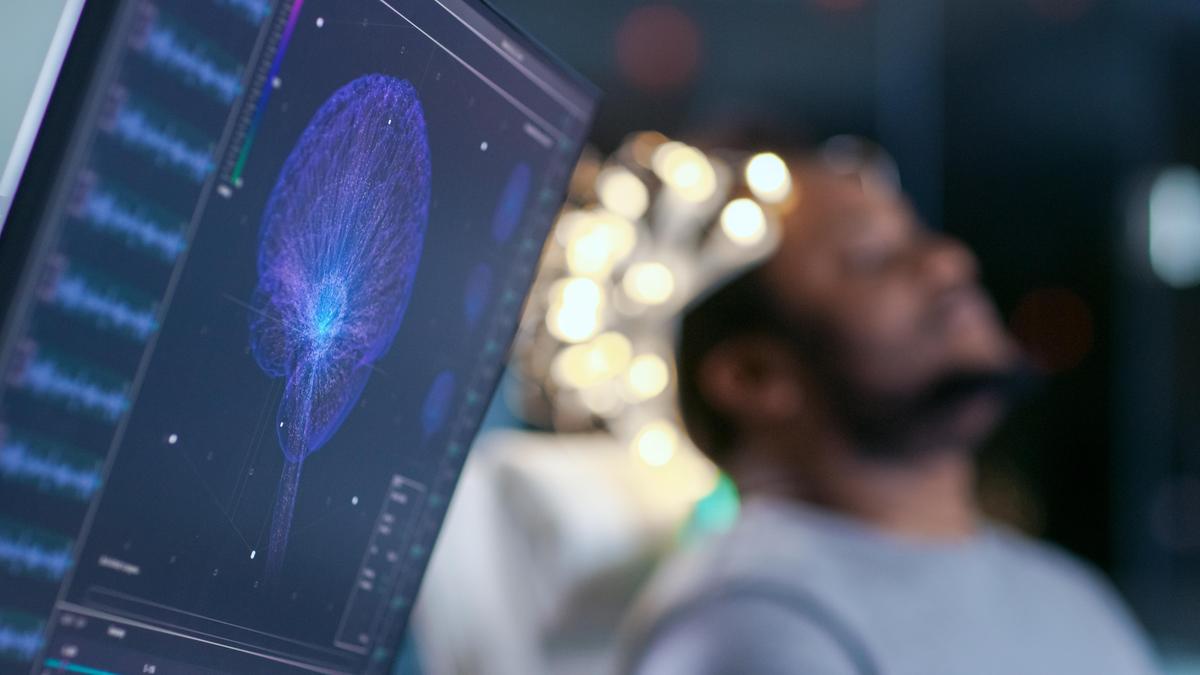
Copyright infringement not intended
Picture Courtesy: thehindu
The Supreme Court, in the case of Amlesh Kumar vs State of Bihar (2025), declared that forcing an individual to take a narco test is unconstitutional and invalid.
|
Read all about: NARCO TEST l INVOLUNTARY NARCO TESTS AN INTRUSION INTO A PERSON'S MENTAL PRIVACY |
Narco-analysis is an investigative technique that involves administering a psychoactive substance, commonly known as a "truth serum," to an individual to induce a hypnotic or sedated state.
The objective is to lower the subject's inhibitions, making them more likely to share information they might otherwise conceal.
Substance Used: A barbiturate like Sodium Pentothal or Sodium Amytal is injected intravenously.
Mechanism: The drug sedates the central nervous system, slowing down the subject's cognitive functions and imagination.
Purpose: It is used as an interrogation tool to extract information and is not a confession, as the statements are made in an unconscious state.
The compulsory administration of narco-analysis tests directly conflicts with several fundamental rights guaranteed by the Constitution.
Article 20(3): Right Against Self-Incrimination: Forcing an individual to make statements under the influence of a drug is a clear form of testimonial compulsion and a direct violation of the right that "no person accused of any offence shall be compelled to be a witness against himself."
Article 21: Right to Life and Personal Liberty: Supreme Court considers involuntary narco-tests a severe violation of the Right to Privacy, protected under Article 21, as they intrude upon an individual's mental privacy, bodily autonomy, and right to silence.
The 'Golden Triangle' (Articles 14, 19 & 21): Principle of the Golden Triangle, established in Maneka Gandhi vs Union of India (1978), dictates that Articles 14 (right to equality), 19 (freedoms), and 21 (personal liberty) are interlinked, meaning a procedure violating one is likely to be arbitrary, unreasonable, and violative of the others.
In Selvi & Ors. vs State of Karnataka (2010) case, the Supreme Court delivered a comprehensive verdict on the legality of narco-analysis, polygraph, and Brain Electrical Activation Profile (BEAP) tests in this foundational case.
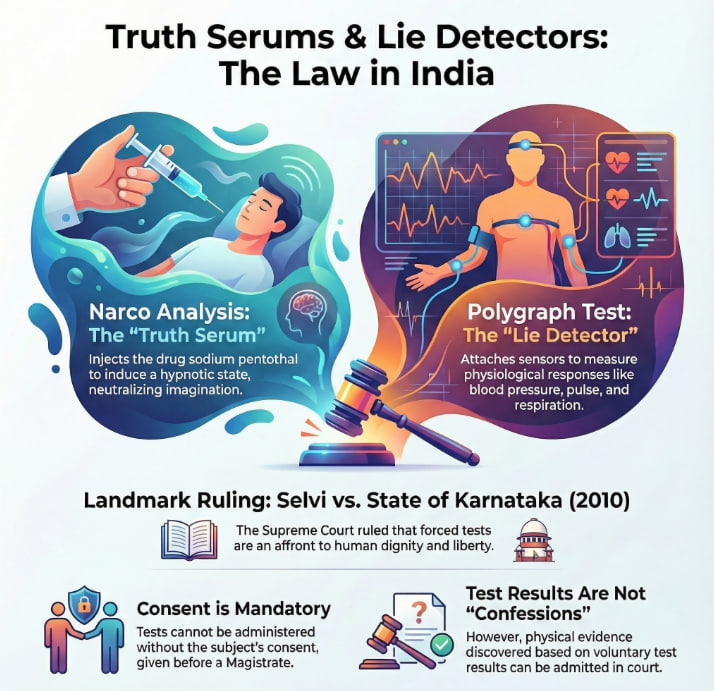 The principles laid down in the Selvi judgment are applied by High Courts and the Supreme Court in cases, reinforcing that fundamental rights cannot be overridden for investigative convenience.
Guidelines for Conducting Voluntary Tests
These are largely based on the National Human Rights Commission (NHRC) Guidelines for the Administration of Polygraph Test (2000).
Forced narco-analysis violates fundamental rights like liberty and the right against self-incrimination. The judiciary limits its use, prioritizing individual rights and a fair justice process over the technique's intrusive and potentially unreliable nature.
Source: thehindu
|
PRACTICE QUESTION Q."The quest for truth in the criminal justice system cannot come at the cost of fundamental rights." Critically analyze. 150 words |
It is an investigative technique where a drug like Sodium Pentothal is injected to induce a semi-conscious state, making the person less inhibited and more likely to share information. It is often called a "truth serum" test.
It primarily violates two fundamental rights: Article 20(3), the Right against self-incrimination, and Article 21, the Right to Life and Personal Liberty, which includes the Right to Privacy and bodily autonomy.
Statements made during the test are not admissible as primary evidence to convict a person. However, if any material evidence (like a weapon) is discovered based on information from a voluntary test, that discovery may be considered admissible under Section 27 of the Indian Evidence Act.



© 2026 iasgyan. All right reserved