White Gut Disease severely threatens lucrative Vannamei shrimp farming, causing massive crop losses and economic distress. Tackling this silent epidemic requires strict biosecurity, bioremediation, and robust policy interventions under frameworks like PMMSY to safeguard seafood export targets.
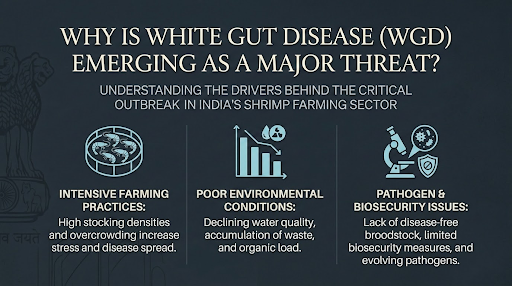
Why In News?
The Andhra Pradesh State Agriculture and Fisheries Ministry launched surprise inspections of hatcheries and laboratories in West Godavari district following detections of White Gut Disease (WGD).
What is White Gut Disease?
White Gut Disease (WGD), also known as White Feces Syndrome (WFS) or White Feces Disease (WFD), is a severe gastrointestinal disorder affecting farmed shrimp, primarily the Pacific white shrimp (Litopenaeus vannamei).
Target Organisms: Pacific white shrimp (Litopenaeus vannamei) and Black tiger shrimp (Penaeus monodon).
Primary Vectors: A combination of Vibrio bacteria species (e.g., Vibrio parahaemolyticus) and the microsporidian parasite Enterocytozoon hepatopenaei (EHP).
Type of Disease: Multifactorial syndrome (not caused by a single pathogen alone, but triggered by an interplay of infectious agents and environmental stress).
Major Indian Hotspot: Coastal aquaculture farms, notably in Andhra Pradesh (India's leading fish and shrimp producer) and the eastern coast.
Etiology and Causes
The disease manifests due to a combination of biological, environmental, and management hazards:
Pathophysiology and Symptoms
Socio-Economic Impact
Currently, there is no specific curative drug or novel treatment to reverse an advanced infection, making prevention paramount:
Source: THEHINDU
|
PRACTICE QUESTION Q. Consider the following statements regarding White Gut Disease (WGD) in aquaculture:
Which of the statements given above is/are correct? (a) 1 and 2 only (b) 2 and 3 only (c) 1 and 3 only (d) 1, 2, and 3 Answer: b Explanation: Statement 1 is incorrect: White Gut Disease (WGD), or White Feces Syndrome (WFS), primarily affects marine or brackishwater shrimp cultivation (such as Litopenaeus vannamei and Penaeus monodon), rather than freshwater carp cultivation in landlocked states. Statement 2 is correct: The disease is largely linked to the uncontrolled proliferation of Vibrio species bacteria (such as Vibrio parahaemolyticus and Vibrio alginolyticus), which disrupt the digestive tract and hepatopancreas of aquatic animals. Statement 3 is correct: The use of bioremediation and probiotics—specifically the application of Bacillus subtilis—is a widely recognized preventive and therapeutic measure used to inhibit pathogenic Vibrio strains and improve pond ecology. |



© 2026 iasgyan. All right reserved