India Post’s Dhruva framework will assign a Digital Address Code to every location using ISRO’s Bhuvan platform to fix vague addressing. It can boost logistics, governance, and planning, but faces hurdles of massive data collection, privacy under Puttaswamy, digital divide, and inter-agency coordination.

Copyright infringement not intended
Picture Courtesy: THE HINDU
Context
India Post has proposed a new framework known as 'Dhruva' to create a unique Digital Address Code (DAC) for every address in the country.
What is DHRUVA?
The Department of Posts, under the new Post Office Act, 2023, has proposed creating a national Digital Public Infrastructure (DPI) named DHRUVA (Digital Hub for Reference and Unique Virtual Address).
This initiative aims to standardize physical addresses into a shareable digital format, functioning much like a UPI ID, to enhance governance and service delivery.
Key Components of DHRUVA
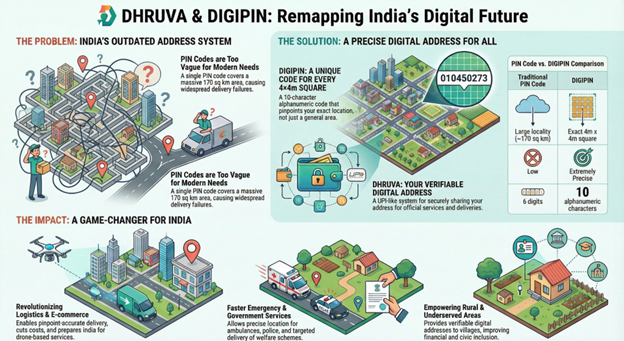
DIGIPIN (Digital Postal Index Number)
Developed by India Post with ISRO and IIT Hyderabad, DIGIPIN is a 10-digit alphanumeric code that represents a specific geospatial location.
It divides the country into grids of approximately 4m x 4m, providing hyper-local accuracy, useful in rural and semi-urban areas with ambiguous addresses.
DHRUVA Labels
It enables individuals and businesses to create a simple, unique virtual address (e.g., myhome@dhruva). This label is a digital proxy for the physical address and its DIGIPIN, sharable with service providers via consent.
Proposed DHRUVA Ecosystem
The framework will be managed by multiple entities, similar to the UPI model, to ensure a decentralized and robust system.
|
Entity |
Role and Function |
|
Address Service Providers (ASPs) |
Entities responsible for issuing DHRUVA labels to users and managing their accounts. |
|
Address Validation Agencies (AVAs) |
Responsible for verifying and authenticating the accuracy of physical addresses linked to a DHRUVA label. |
|
Address Information Agents (AIAs) |
Intermediaries that will manage the consent framework, allowing users to grant, manage, and revoke access to their address data for specific purposes and durations. |
|
Governance Entity |
A proposed not-for-profit body, similar to the NPCI (National Payments Corporation of India), to oversee the framework, set standards, and ensure interoperability among all players. |
Significance
Enhanced Service Delivery
A verified, machine-readable address will improve the efficiency of last-mile delivery for e-commerce, postal services, emergency response (ambulance, fire), and government schemes.
Simplified KYC Processes
A digital address streamline and accelerate Know Your Customer (KYC) procedures for banks, financial services, and telecom companies, greater financial inclusion.
Improved Governance and Planning
A reliable address database improves the targeting of welfare schemes, enhances disaster management, and supports data-driven policymaking and infrastructure planning.
User Empowerment and Control
The consent-based architecture gives citizens direct control over their personal address data, allowing them to decide who can access it and for how long.
What are the Challenges of the DHRUVA framework?
Legal Compliance
The framework must strictly adhere to the Digital Personal Data Protection Act, 2023 (DPDPA), ensuring purpose limitation, clear consent, and data minimization.
Constitutional Test
Personal data collection systems must align with the principles of legality, necessity, and proportionality established in Justice K.S. Puttaswamy vs Union of India (2017), which recognized the Right to Privacy as a fundamental right.
Risk of Incomplete Data
The voluntary, consent-based system allows citizens to opt out, creating an incomplete address database. This unreliability limits its use for comprehensive macro-level governance and administration.
Accessibility Issues
Only 38% of Indian households are digitally literate (National Sample Survey), risking exclusion for those without literacy, smartphones, or reliable internet access.
Complexity of Consent
Consent-based privacy frameworks are complex; vulnerable populations may grant permissions without understanding implications or navigating the system.
Way Forward
Robust Legal Backing
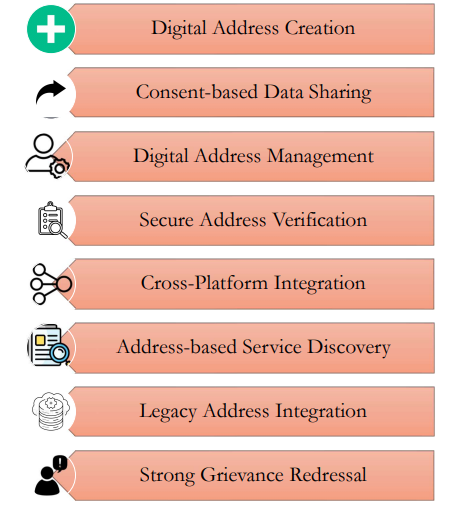
Creating a dedicated legal framework for a National Digital Address System that is fully compliant with the DPDP Act, 2023 and includes strong provisions for data protection and grievance redressal.
Exploring a Hybrid Model
Adopting a two-layer system: a mandatory, property-centric database for administrative and governance purposes, and an optional, person-centric DHRUVA label for commercial and personal use.
Ensuring Inclusivity by Design
Allowing offline and assisted-mode options to bridge the digital divide and running public awareness campaigns to ensure citizens can make informed choices.
Transparent Governance
Establishing the proposed governing body with a multi-stakeholder structure that ensures transparency and public accountability.
Conclusion
DHRUVA represents a transformative vision for India's digital ecosystem. However, its success depends on building a robust framework that balances efficiency with citizen rights.
Source: THE HINDU
|
PRACTICE QUESTION Q. Which of the following best describes the objective of the Digital Address Code (DAC) under the Dhruva framework? A) To create a new system for property tax collection by municipal bodies. B) To provide a unique, machine-readable, and precise location identifier for every address. C) To replace physical addresses with a completely digital system for all communication. D) To track the movement of citizens for security purposes. Answer: B Explanation: The objective of the Digital Address Code (DAC) under the DHRUVA framework is to create a standardized, geocoded, and interoperable digital addressing system for the entire country. |
The Dhruva framework is a proposal by India Post to create a 'One Nation, One Address' system. It aims to assign a unique Digital Address Code (DAC) to every address in the country to make them precise, machine-readable, and easy to locate.
A Digital Address Code (DAC) is a unique alphanumeric code that will be assigned to each individual address, such as a home or business. This code will be linked to the precise geographic coordinates (latitude and longitude) of the property's entrance.
A PIN Code identifies a broad geographic area, like a post office delivery zone, which can contain thousands of addresses. A DAC, on the other hand, identifies a single, specific address down to the doorstep, providing a much higher level of precision. The DAC will complement the PIN code, not replace it.






© 2026 iasgyan. All right reserved