Description
Copyright infringement not intended
Picture Courtesy: The Hindu
Context:
Astronomers have, for the first time, detected a coronal mass ejection (CME) on a star other than the Sun. The finding was published in Nature (2025) and marks a major advancement in stellar space weather studies.
Key findings of CMEs detected on another star:
- The CME originated from StKM 1-1262, a red dwarf star whose distance from Earth is 133 light-years.
- Discovery made using LOFAR (Low Frequency Array) — a European radio telescope network which typically studies extreme cosmic events (e.g., black holes).
- The CME lasted only 1 minute and it was 10,000 times more violent than any CME recorded on the Sun.
What is Coronal Mass Ejection (CMEs)?
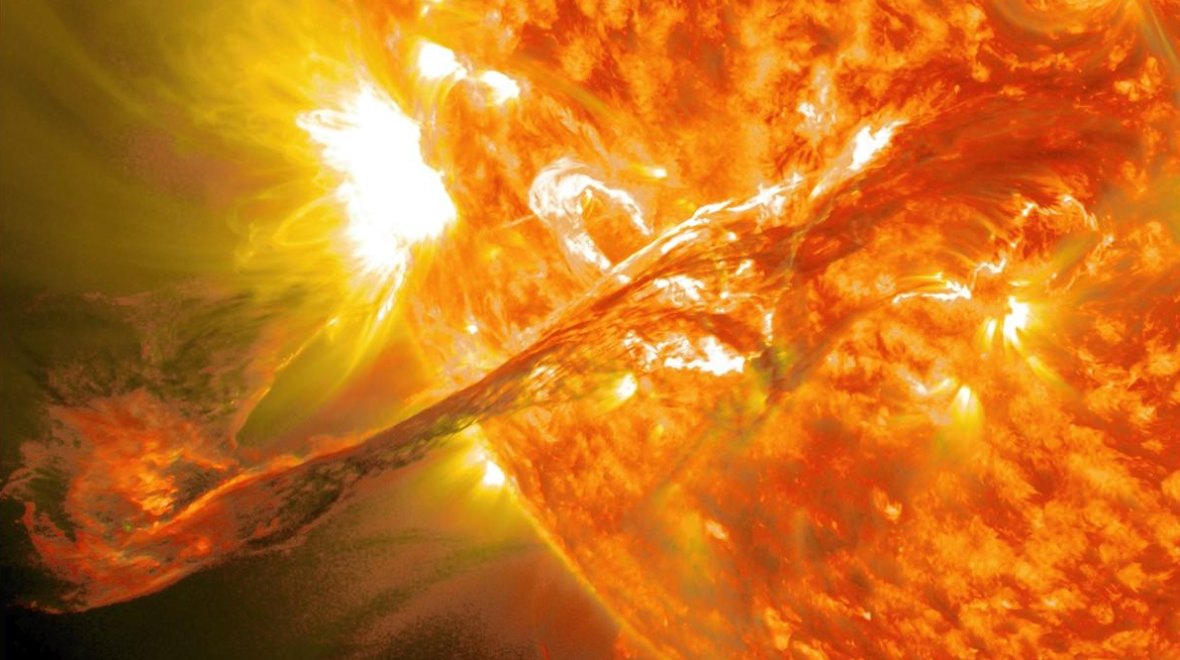
Coronal Mass Ejections (CMEs) are massive expulsions of magnetised plasma released from the Sun’s outer layers into interplanetary space. These high-energy events can interfere with both terrestrial and space-based technological systems, including satellites, communication networks and navigation signals.
As CMEs travel through space, different forms of energy, such as kinetic, electrical, potential and thermal are constantly exchanged, resulting in heating or cooling of the plasma.
How are coronal mass ejection are formed?
Magnetic field buildup in the corona
- The Sun’s surface (photosphere) has constantly shifted magnetic fields due to convection and solar rotation.
- These magnetic fields twist, stretch and shear over time.
Formation of magnetic loops
- Twisted magnetic structures called flux ropes or magnetic loops form above sunspots.
- Plasma becomes trapped inside these magnetic structures.
Magnetic instability
- If the magnetic field becomes excessively twisted or stressed, it becomes unstable.
- This can occur due to:
- Emergence of new magnetic flux
- Interaction between opposite magnetic polarities
- Shearing and rotation of sunspots
Magnetic reconnection
- A sudden rearrangement of magnetic field lines—called magnetic reconnection—occurs.
- This process rapidly releases vast amounts of stored magnetic energy.
Plasma Explosion
- The reconnected field lines propel the trapped plasma outward, causing a massive ejection from the corona.
- The plasma carried outward includes:
- electrons
- protons
- helium ions
- This forms the Coronal Mass Ejection.
Propagation Through Space
- The CME travels through the solar wind at speeds ranging from 250 km/s to 3000+ km/s.
Importance of understanding the formation of Coronal mass ejection:
- Understanding the Sun as a Dynamic Star: CMEs are a direct expression of the Sun’s magnetic nature. Studying their formation helps us understand: how magnetic energy is stored in the solar atmosphere, how it becomes unstable, and how it is explosively released.
- Part of the Larger Space Weather System: CMEs are central drivers of space weather. Knowing how they form allows us to grasp: how the Sun influences interplanetary space, how the solar wind varies, and how disturbances propagate through the heliosphere.
- Link Between Stars and Planetary Environments: CMEs shape the space environments of planets. Understanding their formation helps us see how: magnetic storms arise, atmospheres are eroded, magnetospheres respond, and radiation levels change.
- Foundation for Predicting Solar Activity: Predicting CMEs requires knowing why and how they form. This conceptual understanding helps build models that anticipate: when magnetic energy reaches a critical threshold, when solar regions become unstable, and when eruptions are likely.
- Protecting Technological Civilisation: While the immediate effects are practical—protecting satellites, grids, communication—understanding CME formation is conceptually about: recognising human dependence on stable space conditions, acknowledging vulnerability to natural cosmic events, and building resilience against them.
- Broadening Perspectives on Life in the Universe: Stars other than the Sun produce CMEs too.
Understanding their formation helps us assess: whether planets around active stars can hold atmospheres, whether life can survive intense stellar storms, how stellar magnetism shapes habitability.
What are the impacts of Coronal mass ejection on earth?
- Disturbances in Earth’s Magnetic Field (Geomagnetic Storms): When a CME strikes Earth’s magnetosphere, it compresses and distorts it, leading to geomagnetic storms. These storms cause rapid changes in Earth’s magnetic field, strong electric currents in the magnetosphere and ionosphere and disruption of geospace equilibrium.
- Collision with atmospheric molecules: Energetic particles from the CME collide with atmospheric molecules, producing auroras (Northern and Southern Lights). During strong CMEs, auroras can be seen far beyond polar regions and sometimes reaching mid-latitudes
- Disruption of Satellite Systems: CMEs inject high-energy particles into near-Earth space, affecting satellites by damaging electronic circuits, degrading solar panels and increasing drag on low-Earth-orbit satellites due to atmospheric expansion
- Effects on Navigation and Communication: CMEs disturb the ionosphere, which is crucial for radio wave propagation, leading to High-frequency (HF) radio communication breaks down, GPS signals become inaccurate and Airplanes on polar routes face communication blackouts
- Impact on Power Grids: Geomagnetic storms created by CMEs induce large electric currents in long conductors on Earth, such as power lines and this can cause transformer overheating, voltage instability, blackouts across regions
- Radiation Hazards: While Earth’s atmosphere protects people on the ground, CMEs pose risks to: astronauts in space, passengers in high-latitude flights, aviation electronics.
|
What are geomagnetic storms?
Geomagnetic storms are major disturbances in Earth’s magnetosphere caused by enhanced solar wind and intense bursts of charged particles—usually from Coronal Mass Ejections (CMEs) or high-speed solar wind streams from coronal holes.
When a CME or fast solar wind arrives at Earth, it compresses and distorts the magnetosphere. If the magnetic field carried by this solar plasma is oriented southward (opposite Earth’s magnetic field), strong magnetic reconnection occurs, injecting large amounts of energy into Earth’s magnetic environment.
|
Conclusion:
Coronal Mass Ejections are powerful solar eruptions that significantly influence space weather and Earth’s technological systems. Understanding their behaviour is essential for accurate forecasting and protecting critical infrastructure.
Source: The Hindu
|
Practice Question
Q. Coronal Mass Ejections (CMEs) are considered one of the most powerful drivers of space weather. Explain the formation, effects on Earth, and importance of studying CMEs. (250 words)
|
Frequently Asked Questions (FAQs)
A CME is a massive eruption of magnetized plasma from the Sun’s corona into interplanetary space. It carries billions of tons of charged particles and a strong magnetic field.
CMEs form when the Sun’s magnetic field becomes twisted or unstable, creating flux ropes. Magnetic reconnection releases stored energy, propelling plasma into space.
When a CME interacts with Earth’s magnetosphere, it disturbs the magnetic field, creating geomagnetic storms, auroras, and disruptions in satellites and power systems.