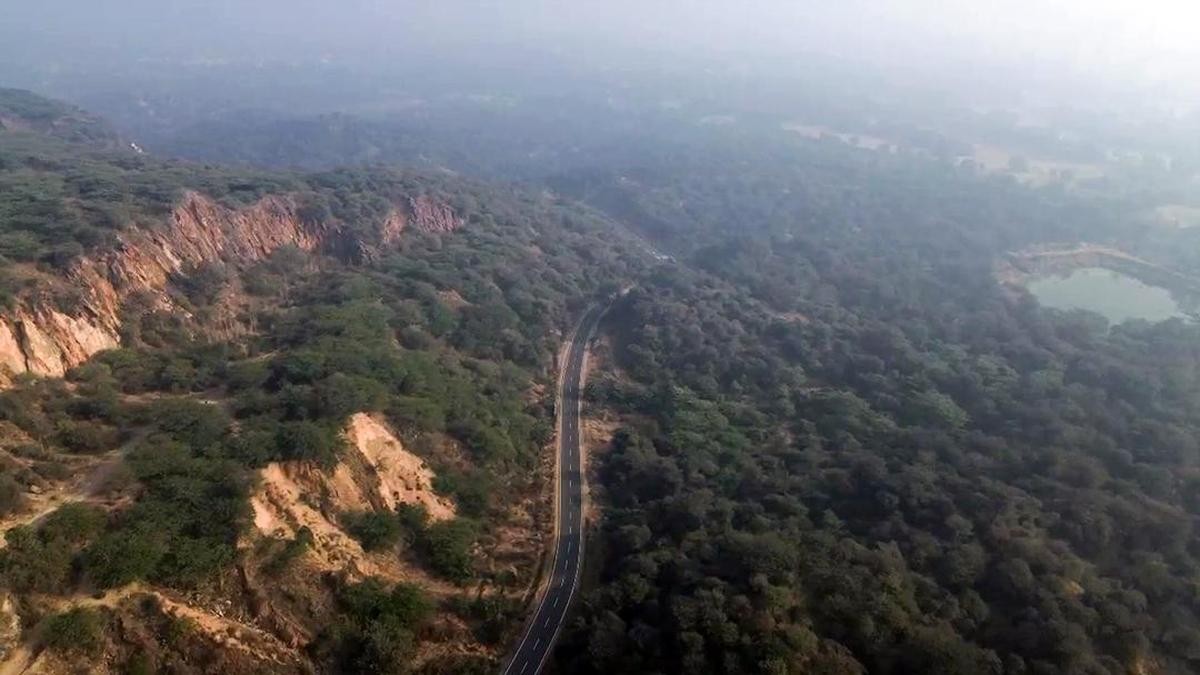
The Supreme Court has stayed its earlier judgment that accepted a uniform definition of the Aravalli hills based on height and cluster criteria. It took this step after concerns that the definition could reduce protection for large parts of the Aravalli range and encourage mining and construction. The Court has paused the grant or renewal of mining leases in the region without its permission and proposed setting up a high-powered expert committee to scientifically reassess the definition. The order emphasises the precautionary principle and underscores that the Aravallis must be protected as an integrated ecological system until a final decision is reached.
Copyright infringement not intended
Picture Courtesy: The Hindu
The Supreme Court has stayed (paused) its own November 20, 2025 judgment that defined Aravalli hills as only those 100 metres or more in height, and within 500 metres of each other.
|
Must Read: Aravali Hills | ARAVALLIS| ARAVALLI RANGE | FOREST SURVEY & IMPORTANTCE OF ARAVALI HILLS | |
|
Period |
Case |
What the Supreme Court did |
Significance |
|
1990s |
Early PILs on Aravalli degradation |
Took cognisance of illegal mining, deforestation and quarrying in Haryana and Rajasthan |
Recognised Aravallis as ecologically fragile and important for preventing desertification |
|
1996 |
T.N. Godavarman Thirumulpad case |
Expanded definition of “forest” to include recorded forests, not just notified ones |
Brought large parts of Aravallis under Forest (Conservation) Act, 1980 |
|
2002 |
M.C. Mehta vs Union of India |
Imposed ban on mining in Aravallis of Haryana after finding severe ecological damage |
Stated economic gains cannot outweigh environmental protection |
|
2004–2009 |
Continuous monitoring phase |
Ordered closure of illegal quarries; criticised regulatory failure of states |
Strengthened enforcement and supervision over Aravalli mining |
|
2009 |
Order on 448 sq km area of Haryana Aravallis |
Halted mining activities in a large contiguous stretch of Aravallis |
Prevented ecological collapse, groundwater depletion and habitat loss |
|
2018–2019 |
Renewed intervention after reports of large-scale destruction |
Directed states to stop illegal mining, restore damaged areas and prosecute violators |
Linked Aravalli loss to Delhi–NCR pollution and climate vulnerability |
|
2020–2024 |
Cases on construction and real estate permissions |
Questioned attempts to dilute protection for Aravallis in planning and development laws |
Reaffirmed Article 21 right to environment; applied sustainable development and inter-generational equity |
|
Nov 2025 |
Judgment defining Aravallis by height and cluster criteria |
Initially upheld definition: hills ≥100 m and within 500 m clusters |
Raised concern that many lower hill ranges may lose protection |
|
Dec 2025 |
Stay on its own November 2025 judgment |
Paused implementation; proposed high-powered expert panel; stopped new/renewed mining leases without SC approval |
Aimed to avoid regulatory vacuum and ensure scientific, ecologically sound definition of Aravallis |
Stay on earlier Supreme Court decision: The Supreme Court has put on hold its earlier order of November 20 that had approved a single, uniform definition of what constitutes the Aravalli hills.
Reason for granting the stay: The Court acted after widespread criticism and concern expressed by environmental experts and civil society groups that the earlier definition could weaken protection and harm the fragile Aravalli ecosystem.
Constitution of a fresh expert panel: A Bench headed by the Chief Justice of India has directed the creation of a new high-level expert committee, which will reconsider how the Aravalli range should be scientifically identified and demarcated.
Directions relating to mining activities: The Court has made it clear that no new mining leases or renewals in the Aravalli region will be permitted unless specific approval is obtained from the Supreme Court, thereby strengthening the application of the precautionary approach in environmental matters.
Notices to centre and Aravalli states: The Supreme Court has also issued notices to the Union government and the governments of Rajasthan, Gujarat, Haryana, and Delhi, asking them to respond in the suo motu proceedings concerning the protection and definition of the Aravalli hills.
Immediate protection status strengthened: By staying its earlier definition and halting new mining leases, the Court has temporarily reinforced legal protection over large parts of the Aravalli range that might otherwise have lost coverage.
Prevention of irreversible environmental damage: The order prevents potentially irreversible ecological harm such as landscape fragmentation, loss of biodiversity, groundwater depletion, and worsening air quality while the issue is re-examined.
Check on unregulated and opportunistic mining: Since no new or renewed mining leases are allowed without Supreme Court permission, the judgment acts as a strong brake on mining expansion, particularly in lower and fragmented hill patches.
Recognition of ecological integrity over technical definitions: The Court signals that the Aravallis should not be defined merely by height or distance criteria, but by their overall ecological continuity and function, shifting focus from technical thresholds to ecosystem integrity.
Application of the precautionary principle: The judgment reinforces the precautionary principle by insisting that economic or administrative actions must wait until scientific clarity is achieved on environmental consequences.
Reopening the debate on the definition of Aravallis: The constitution of a new expert committee implies that the earlier “100-metre height and 500-metre cluster” definition is not final, opening space for a broader, science-based and conservation-oriented demarcation.
Empowerment of scientific and expert input: By insisting on independent expert assessment and multi-stakeholder consultation, the Court is shifting decision-making toward technical expertise, not merely administrative committees.
Implications for urbanisation and real estate projects: Projects planned on the assumption of reduced protection—especially in Haryana, Rajasthan and Delhi-NCR—now face uncertainty, tighter scrutiny, and possible restriction.
Signal to state governments on dilution attempts: The order sends a strong message that dilution of environmental safeguards through definitional changes or zoning relaxations will face strict judicial review.
Stronger linkage between Aravallis and NCR environmental health: By acknowledging the Aravallis’ role in blocking desert expansion, regulating temperature and improving air quality, the Court implicitly ties the issue to public health and Article 21 (right to life).
Ecological barrier against desert expansion: The Aravalli range acts as a natural wall that prevents the eastward spread of the Thar Desert. It protects regions such as Haryana, Delhi–NCR, western Uttar Pradesh and parts of the Indo-Gangetic plains, and its degradation accelerates desertification, dust storms and land degradation.
Regulator of Climate and Groundwater Recharge: The Aravallis are crucial for groundwater recharge and local climate regulation. They help moderate temperature extremes, but unchecked quarrying and land clearance have reduced infiltration and contributed to falling groundwater levels in NCR and western India.
Habitat for Biodiversity and Wildlife Movement: The Aravallis serve as an important biodiversity refuge and wildlife corridor. They support dry deciduous forests and scrub ecosystems and enable wildlife movement between Rajasthan and Madhya Pradesh landscapes.
Hydrological importance: The Aravalli system is linked to the origin and flow of several major rivers. It influences rivers such as the Sabarmati, Luni and Chambal, making it vital for regional water availability and hydrological stability.
Mineral Resources: The Aravallis are among the world’s oldest mountain ranges and possess rich mineral resources. However, decades of poorly regulated mining for minerals like copper, zinc, marble and granite have caused serious ecological degradation.
The recent Supreme Court order prioritises ecological protection over narrow technical definitions by pausing new mining approvals and reopening the Aravalli definition to expert scientific review. It prevents irreversible damage for now and signals that any dilution of safeguards for the Aravallis will face strict judicial scrutiny.
|
Practice Question Q. Critically analyse the implications of the recent Supreme Court order staying its earlier judgment on the definition of the Aravalli Hills. How does this decision balance environmental protection with mining and developmental concerns? (250 words) |
The Supreme Court has stayed its previous order that approved a uniform definition of the Aravalli hills and has paused new or renewed mining leases until further directions.
The Court did so because of concerns that the earlier definition might exclude many hill areas, weaken protection and enable environmentally harmful activities such as unregulated mining.
The earlier definition treated only hills above 100 metres in height and within 500 metres of each other as Aravalli, which risked removing protection from lower or scattered hill features.






© 2026 iasgyan. All right reserved