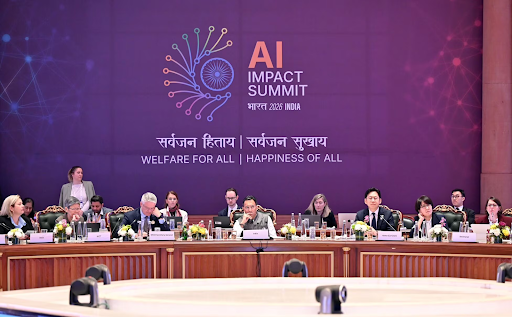
The AI Impact Summit 2026 marked adoption of the New Delhi Declaration by 89 nations, shifting AI governance toward a development-first Global South vision rooted in “Sarvajan Hitaya.” Its 7 pillars promote equity, DPI export, and Global AI Commons, while challenges include compute gaps, energy costs, and voluntary compliance.
Copyright infringement not intended
Picture Courtesy: hindustantimes
The AI Impact Summit 2026 concluded with the New Delhi Declaration on AI Impact to utilize AI for fair economic growth and social development.
|
Read all about: India AI Impact Summit 2026 |
What is the New Delhi Declaration on AI Impact?
It is an international agreement adopted at the India AI Impact Summit 2026, to shift the global AI focus from safety to practical impact, equitable access, and inclusive growth.
Signatories: Endorsed by 89 countries and international organisations, including major powers like the US, UK, China, the EU.
Core Philosophy: Guided by the principle of "Sarvajan Hitaya, Sarvajan Sukhaya" (Welfare for all, Happiness for all) and the ethos of "Vasudhaiva Kutumbakam" (The world is one family).
Nature: It is a voluntary and non-binding framework, prioritising international cooperation over rigid regulatory mandates to avoid hindering innovation.
It is built on three core objectives:
The "7 Chakras": A Holistic Framework for Action
The declaration outlines its action plan through seven key pillars, termed "Chakras," to ensure a comprehensive approach to AI governance and development.
|
Chakra (Pillar) |
Key Objective |
|
1. Democratizing AI Resources |
Make high-performance computing power and large datasets affordable and accessible for developing nations. |
|
2. Economic Growth & Social Good |
Utilize AI to boost GDP and solve societal challenges in health, agriculture, and education. |
|
3. Secure & Trusted AI |
Establish robust safety protocols and standards to mitigate risks like bias, misinformation, and deepfakes. |
|
4. AI for Science |
Create shared AI networks to accelerate scientific research and discovery globally. |
|
5. Access for Social Empowerment |
Leverage AI to bridge the digital divide and ensure inclusive access to services and opportunities. |
|
6. Human Capital Development |
Focus on skilling, reskilling, and upskilling the global workforce to prepare for an AI-driven economy. |
|
7. Resilient & Efficient AI Systems |
Promote the development of energy-efficient and sustainable AI (Green AI) to minimize environmental impact. |
What are the Key Global Deliverables Announced?
To translate vision into concrete action, the summit announced several voluntary and collaborative mechanisms:
Why is this Summit Geopolitically Significant For India?
Shifting the Global Narrative
The New Delhi Declaration, unlike the Bletchley Park Summit (UK, 2023), aligns AI with Global South priorities and UN SDGs, framing it as a tool for development.
Exporting the "India Stack" Model
India is globalizing its successful Digital Public Infrastructure (DPI) model. The Global AI Impact Commons aims to democratize AI intelligence, mirroring how UPI democratized payments.
Countering the "Compute Divide"
The declaration addresses the concentration of computing hardware (GPUs). It calls for an International Network of AI for Science Institutions for shared access to high-performance computing, similar to CERN.
Challenges Ahead
The "Voluntary" Trap
The framework is "voluntary and non-binding." Without enforcement, powerful actors might ignore its principles, echoing Paris Agreement implementation issues.
The Energy Conundrum
The massive energy needs of AI systems clash with the goal of "Resilient & Efficient AI." The International Energy Agency (IEA) Report projects electricity consumption by data centers will double by 2026, challenging Net Zero goals.
Disparity in AI Readiness
The call for global collaboration is challenged by a deep technological divide, as the production of advanced Foundation Models is concentrated in the USA, China, and the UK.
Way Forward
The New Delhi Declaration establishes India as a global norm-setter in the AI era. Success depends on concrete action: operationalizing the "Global AI Impact Commons" with scalable solutions (like UPI, Aadhaar), bridging the Global North-South divide, and ensuring AI respects fundamental rights, as mandated by the Puttaswamy Judgement.
Source: PIB
|
PRACTICE QUESTION Q. The New Delhi Declaration on AI Impact 2026 marks a pivot from 'regulating AI risks' to 'democratizing AI benefits'. Analyze. 150 words |
The main objective is to shift the global AI narrative from solely regulating risks to leveraging AI for equitable economic growth and social welfare, focusing on the needs of the Global South ("Sarvajan Hitaya").
The 7 Chakras are pillars of action: 1. Democratizing AI Resources, 2. Economic Growth & Social Good, 3. Secure & Trusted AI, 4. AI for Science, 5. Access for Social Empowerment, 6. Human Capital Development, and 7. Resilient & Efficient AI Systems.
It is a collaborative repository proposed at the summit to share and replicate successful AI use cases (Digital Public Goods) across nations, ensuring that innovations in one developing country can benefit others.



© 2026 iasgyan. All right reserved