

Copyright infringement not intended
Picture Courtesy: impact
The India-AI Impact Summit 2026, organized by the Ministry of Electronics and Information Technology (MeitY), concluded in New Delhi on February 20, 2026.
The India-AI Impact Summit 2026 is the first global AI summit hosted in the Global South, following safety-focused summits in the UK, South Korea, and France.
The summit, organized by the Ministry of Electronics and Information Technology (MeitY) under the IndiaAI Mission, is anchored in the "Sarvajana Hitaya, Sarvajana Sukhaya" (Welfare and happiness for all).
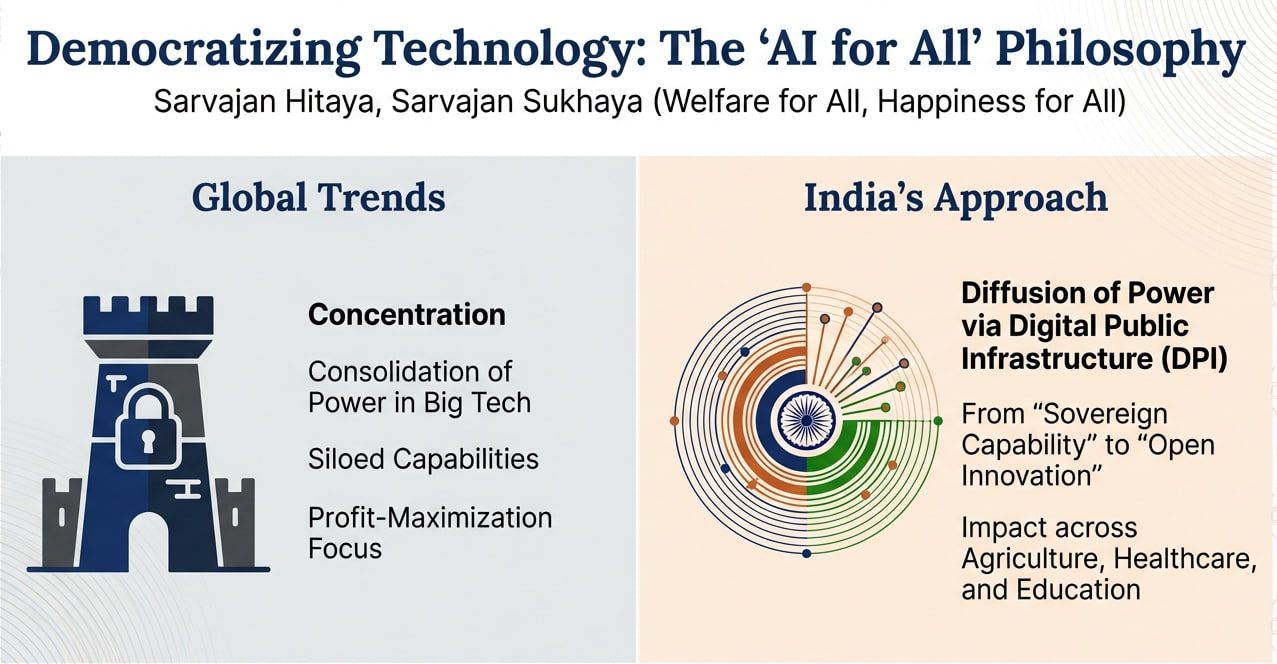
The summit shifted focus from "AI Safety" to "AI for Development and Impact," highlighting AI's role in solving real-world challenges in emerging economies.
Key Pillars & Themes
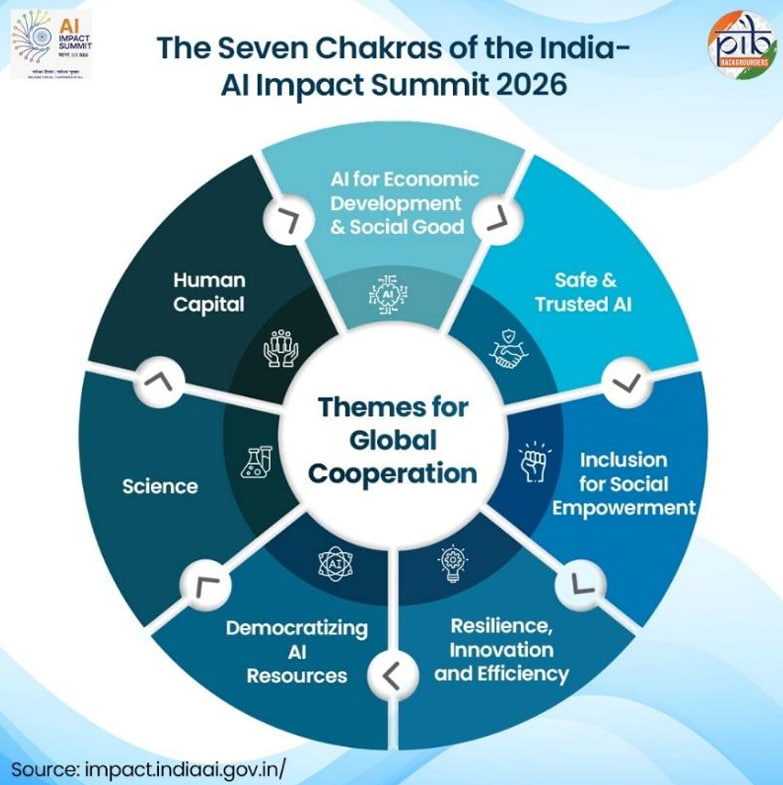
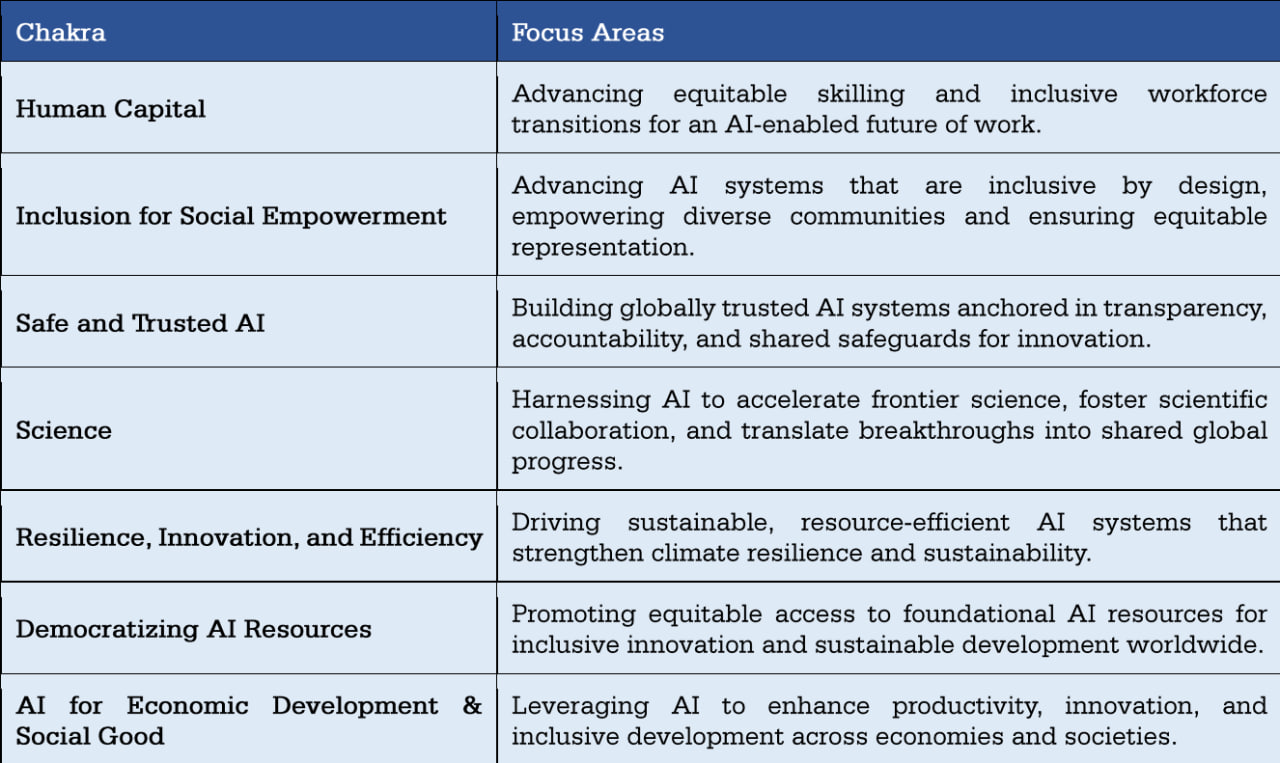 What are the Key Highlights of the Summit?
Global Participation: Attended by over 20 Heads of State, 60 Ministers, and 500 global AI leaders.
The MANAV Governance Framework
The Indian Prime Minister introduced the MANAV framework, a comprehensive governance model balancing AI innovation, national sovereignty, and ethical considerations. Its components are:
Strategic Initiatives and Agreements
Bridging the Healthcare Deficit
AI is being used as a force multiplier to address the shortage of medical professionals, especially in rural areas.
Creating the "AI Commons"
India democratizes AI infrastructure access via the IndiaAI Mission to prevent Big Tech monopolization, providing affordable high-performance computing.
Dismantling the Language Barrier
AI is being used to strengthen social inclusion by breaking down linguistic divides.
Economic Impact of the Summit
The summit highlighted AI's transformative potential for the Indian economy.
|
Sector |
Impact |
|
Global & National GDP |
AI has the potential to lift global growth by 0.8%, which will accelerate India’s journey towards its Viksit Bharat goal. (Source: IMF) |
|
Agriculture |
Tools like MausamGPT and Kisan E-Mitra use AI for weather and soil analysis. According to McKinsey, AI-powered precision agriculture can increase crop yields by 10-20% while reducing input costs by up to 15%. |
|
Electronics & Semiconductors |
The Pax Silica alliance links India's design talent with global chip supply chains, supporting India's ambition to become a $500 billion electronics market by 2030. (Source: MEITy) |
Data Sovereignty vs Digital Colonization
There are concerns that collaborations like the Pax Silica deal could lead to a "Digital Raj," where Indian data is exploited by foreign entities.
A robust regulatory framework is needed to ensure that data sharing does not compromise national security or citizen privacy.
The Risk of De-skilling
Over-reliance on AI can erode human expertise. The Lancet study showed a 20% drop in tumor detection accuracy among doctors who became too dependent on AI without applying their own critical judgment.
The Deepfake Dilemma
The proliferation of AI-generated misinformation poses a serious threat to democracy. The Prime Minister proposed mandatory watermarks or digital signatures on AI-generated content to combat misinformation and protect democracy.
Robust Regulation: Strictly enforce the MANAV framework to ensure that open data initiatives do not lead to data exploitation.
Future-Ready Workforce: Reorient skilling programs like FutureSkills PRIME from basic coding to advanced "AI-management" and critical thinking skills, preparing the workforce for a future where 27% of jobs could be impacted by AI. (Source: IMF)
Strategic Autonomy: While the Pax Silica alliance is beneficial, India must accelerate its own domestic semiconductor fabrication (fab) capabilities to achieve true self-reliance in this critical technology.
The India-AI Impact Summit 2026 positioned India as a "Bridge Power," linking Western tech with the Global South's needs. India promotes inclusive global tech governance centered on People, Planet, and Progress.
Source: indianexpress
|
PRACTICE QUESTION Q. The term 'Pax Silica', recently seen in the news, best relates to: A) A peace treaty between India and China regarding border disputes. B) A US-led coalition to build resilient supply chains for critical minerals and semiconductors. C) A new ISRO mission to explore silicon deposits on the Moon. D) A global agreement to ban deepfake technology. Answer: B Explanation: India formally signed the agreement to join the US-led Pax Silica coalition, which aims to build resilient supply chains for critical minerals and semiconductors. |
The summit aims to shift the global AI narrative from "Existential Risks" to "AI for Development and Impact," focusing on the needs of the Global South and leveraging AI for welfare under the ethos of “Sarvajana Hitaya, Sarvajana Sukhaya.”
MANAV is a governance model unveiled by the Prime Minister to balance AI innovation with sovereignty. The acronym stands for Moral and Ethical Systems, Accountable Governance, National Sovereignty, Accessible and Inclusive, and Valid and Legitimate.
Pax Silica is a US-led strategic coalition that India has joined. It focuses on building resilient supply chains for critical minerals and semiconductors, which are essential hardware components for powering AI infrastructure.
© 2026 iasgyan. All right reserved