Description
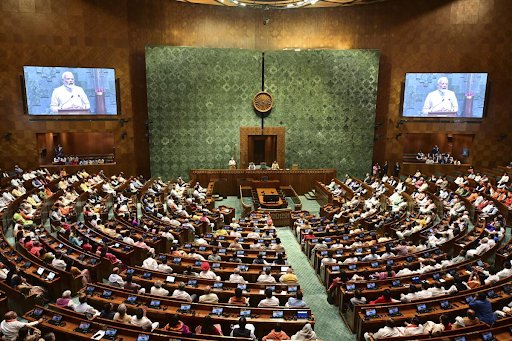
The Centre is set to introduce in Parliament three Bills for the purpose of providing women’s reservation in the Lok Sabha and state Assemblies as early as 2029.
Why in News?
On April 16, 2026, the government introduced three key bills: the Constitution (131st Amendment) Bill, the Delimitation Bill, 2026, and the Union Territories Laws (Amendment) Bill. This move seeks to bypass the original 2023 provision, which stated that reservation would only kick in after the first Census conducted after the law's enactment—a process that would have delayed implementation until the 2030s.
Key Highlights of the Proposed Bills
- Delinking from fresh Census: The new amendment allows the use of 2011 Census data for the delimitation exercise, enabling the reservation to be rolled out by March 31, 2029.
- Significant Seat Expansion: The bills propose increasing the strength of the Lok Sabha from 543 to 816 seats. Under this new structure, 273 seats will be reserved for women.
- Vertical Reservation: The 33% quota will include a sub-reservation for women belonging to Scheduled Castes (SC) and Scheduled Tribes (ST), ensuring intersectional representation.
- Rotation of Seats: Reserved seats will be rotated after every delimitation exercise to provide fair opportunities across different constituencies.
- Duration: The reservation is mandated to stay in effect for an initial period of 15 years, after which Parliament can review its continuation.
Objectives of the Reform
- Ending Legislative Gridlock: By expanding the total number of seats, the government aims to accommodate women without reducing the absolute number of seats available for male candidates, reducing political friction.
- Correcting Representation Deficit: Currently, women make up only about 14-15% of the Lok Sabha. The bill aims to bridge this gap between high female voter turnout and low legislative presence.
- Democratic Maturity: To transition from women as a mere voting bloc to women as active policymakers and stakeholders in the highest levels of governance.
Challenges and Concerns
- North-South Divide: Southern states, which have successfully stabilized their populations, fear that a delimitation based on population (even using 2011 data) might disproportionately increase the number of seats in northern states, diluting the South's political voice.
- Federal Balance: Critics argue that a 50% increase in Lok Sabha seats requires a broader consensus on the One Person, One Vote, One Value principle to ensure that smaller states are not marginalized.
- Lack of OBC Sub-quota: Several opposition parties have raised concerns over the absence of a specific sub-quota for women from Other Backward Classes (OBCs) within the 33% reservation.
Way Forward
- The government must address the concerns of regional imbalance by ensuring that the delimitation process includes a formula that protects the relative representation of states that have performed well on social indicators.
- A robust all-party consultation during the special session will be critical to achieving the two-thirds majority required for these constitutional amendments.
- Furthermore, political parties should proactively begin grooming women leaders at the grassroots level to ensure a high-quality pool of candidates for 2029.
Conclusion
The proposed delinking of women's reservation from the next Census is a pragmatic step toward making gender parity a reality in Indian politics. While the expansion of the Lok Sabha presents logistical and federal challenges, it offers a historic opportunity to reshape the Indian legislature into a more inclusive and representative body.
Source: Indian Express
|
PRACTICE QUESTION
Q. "The linkage of Women’s Reservation to the delimitation exercise creates a structural delay in gender parity." Critically examine this statement in light of the Constitution (131st Amendment) Bill, 2026. (150 words)
|