OPEC influences oil prices by setting production quotas to manage supply. By cutting output, they raise prices; by increasing it, they lower them. They also use spare capacity and market signaling to stabilize global markets and defend floor prices.
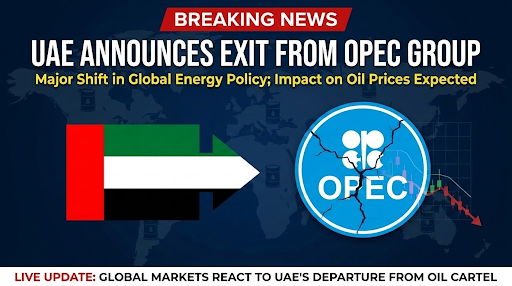
The United Arab Emirates has announced its withdrawal from OPEC and the OPEC+ alliance effective May 1, 2026.
OPEC (Organization of the Petroleum Exporting Countries) is a permanent intergovernmental organization aimed at coordinating oil policies to stabilize global oil markets and influence prices.
Core Purpose
Membership
OPEC manages global oil supply to influence prices. Since demand is inelastic, even minor supply adjustments trigger price fluctuations.
Production Quotas
Spare Capacity
Market Signaling
The "OPEC Put"
Source: REUTERS
|
PRACTICE QUESTION Q. Consider the following statements: 1. OPEC was established in 1960 to unify petroleum policies, while OPEC+ was formed in 2016 to combat plummeting oil prices. 2. The expanded OPEC+ alliance currently commands over 80% of proven global oil reserves. Which of the statements given above is/are correct? a) 1 only b) 2 only c) Both 1 and 2 d) Neither 1 nor 2 Answer: c Explanation: Statement 1 is correct: The Organization of the Petroleum Exporting Countries (OPEC) was founded in 1960 (Baghdad Conference) to unify petroleum policies. The OPEC+ alliance was formed in late 2016 (comprising OPEC members and other oil-producing nations like Russia) to address plunging oil prices caused by increased US shale production. Statement 2 is correct: OPEC member countries alone hold roughly 80% of the world's proven crude oil reserves. Combined, the expanded OPEC+ alliance controls roughly 90% of global oil supplies, confirming the assertion that they command over 80% of proven global oil reserves. |
OPEC (Organization of the Petroleum Exporting Countries) is a cartel formed in 1960 by five founding nations to unify petroleum policies. OPEC+ is an extended alliance created in 2016 that includes the original OPEC members plus 10 additional oil-producing nations, spearheaded by Russia, to better control global oil prices and combat the rise of non-OPEC producers.
Because India imports around 87% of its crude oil, OPEC+ production cuts and resulting price hikes severely damage India's balance of payments. A $10 per barrel increase in international crude prices widens India's current account deficit by about 0.4% of its GDP and creates domestic inflationary pressure on logistics, agriculture, and manufacturing.
India is radically restructuring its supply chain by reducing its dependence on the Middle East. It has drastically scaled up imports of discounted crude from Russia (reaching 35.8% of total imports in FY 24-25) and increased imports from the United States and Brazil.


© 2026 iasgyan. All right reserved