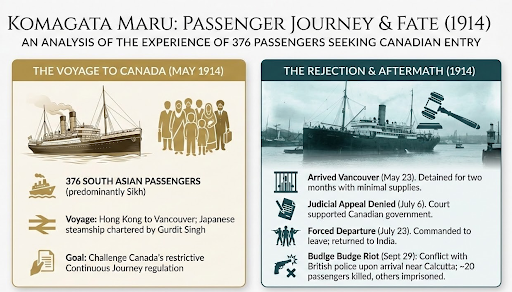
In 1914, the Japanese ship Komagata Maru, carrying 376 Indian passengers, was denied entry by Canada under racist immigration laws. Forced to return, a clash with police at Budge Budge, Kolkata, killed 20 passengers.
Why In News?
The Komagata Maru incident was recently mentioned by singer Diljit Dosanjh during an International show.
What was the Komagata Maru incident?
During the early 20th century, Indians migrating to countries like Canada faced severe restrictions, as colonial governments passed immigration laws specifically designed to prevent their entry and maintain racial exclusion.
In 1908, Canada prohibited immigrants who did not arrive via a continuous, non-stop journey from their country of birth.
In 1914, a Japanese steamship named the Komagata Maru was chartered by a Sikh businessman, Baba Gurdit Singh, carrying 376 passengers of Sikh, Muslim, and Hindu origin.
The Standoff in Canada (May–July 1914)
The ship arrived in Vancouver in May 1914.
The Budge Budge Riot (September 1914)
The return journey was even more tragic. With World War I having started, the British government viewed the passengers not as rejected immigrants, but as Ghadarite revolutionaries returning to start a rebellion.
Political Consequences
Exposed British Hypocrisy
It shattered the illusion that Indians, as "British subjects," had equal rights within the Empire. It proved that the British government would support white colonies (like Canada) over Indian interests.
Fuel for the Ghadar Movement:
The incident enraged Indians in North America (the Ghadar Party). Leaders like Barkatullah and Tarak Nath Das used the incident to recruit volunteers for an armed rebellion in India.
Unity of Communities
The passenger list was diverse (Sikhs, Muslims, Hindus), and the Shore Committee in Canada was a mix of various faiths, showcasing secular unity against colonial racism.
How is the Komagata Maru incident remembered today?
The incident remains a sensitive issue in Indo-Canadian relations and is frequently in the news.
Source: THEHINDU
|
PRACTICE QUESTION Q. "Budge Budge Ghat" is historically significant in the context of the Indian freedom struggle due to: a) The first raising of the Indian National Flag by Bhikaji Cama. b) The violent clash between Komagata Maru passengers and British police. c) The site where Mahatma Gandhi launched the Salt Satyagraha. d) The location of the Chittagong Armoury Raid. Answer: b Explanation: "Budge Budge Ghat" near Kolkata is historically significant because it was the site where the Japanese steamship Komagata Maru, carrying 376 passengers (mostly Sikh immigrants who were denied entry into Canada), docked upon its forced return to India in 1914. British police attempted to arrest the leaders, leading to a riot and police firing that killed approximately 20 passengers |
The Komagata Maru was a Japanese steamship chartered in 1914 by Gurdit Singh to carry 376 British Indian subjects to Canada. Passengers were denied entry under discriminatory Canadian laws, leading to a two-month standoff. Forced to return to India, the passengers were fired upon by British police in the fatal Budge Budge riot.
Enacted by Canada in 1908, the Continuous Journey Regulation was a discriminatory law mandating that immigrants could only enter the country if they traveled on a single, unbroken voyage from their birth nation. It acted as a covert legal mechanism to enforce a "White Canada" policy and bar Indian immigrants.
The blatant racism and denial of entry shattered the colonial illusion of "equal British subjecthood." Ghadar activists used the incident to distribute revolutionary literature, transforming the passengers' economic desperation into political militancy, which boosted recruitment for the armed overthrow of British rule in India.




© 2026 iasgyan. All right reserved