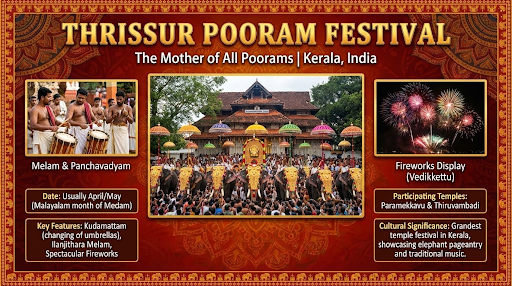
Thrissur Pooram is Kerala's premier cultural festival, founded by Sakthan Thampuran in 1797. It unifies diverse communities through spectacular elephant processions, rhythmic percussion ensembles, and traditional craftsmanship, driving regional economic growth while serving as a global symbol of communal harmony.
A massive explosion at a Mundathikode fireworks unit in Thrissur killed at least 13 and injured over 40 during Thrissur Pooram festival preparations.
Thrissur Pooram, recognized as the mother of all temple festivals in Kerala, is annually celebrated in the Malayalam month of Medam (April-May) at the Vadakkunnathan Temple in Thrissur.
Historical Evolution
The festival was institutionalized by Raja Rama Varma, popularly known as Sakthan Thampuran (1775–1805), the Maharaja of Cochin.
This 36-hour event is defined by artistic excellence and strict traditions.
Communal Harmony: Materials for the Kudamattom (silk, umbrellas) are traditionally crafted through the participation of various communities, including Muslims and Christians.
Economic Engine: The festival attracts millions of tourists, significantly boosting the local handicrafts, hospitality, and transport sectors in Central Kerala.
Artistic Preservation: It provides a global platform for traditional Kerala art forms and percussion music, ensuring the livelihood of thousands of hereditary artists.
Source: HINDUSTANTIMES
|
PRACTICE QUESTION Q. With reference to the "Thrissur Pooram" festival, consider the following statements:
Which of the statements given above is/are correct? (a) 1 only (b) 1 and 3 only (c) 2 and 3 only (d) 1, 2 and 3 Answer: b Explanation: Statement 1 is correct: The festival was initiated by Sakthan Thampuran (Raja Rama Varma), the Maharaja of Cochin (1790–1805). Statement 2 is incorrect: The festival is not historically older than the Arattupuzha Pooram. Thrissur Pooram was established in 1798 after temples from Thrissur were denied access to the Arattupuzha Pooram (which was already an established major festival) due to arriving late caused by heavy rains. Statement 3 is correct: The Kudamattom ceremony involves the swift and rhythmic changing of brightly colored and sequined parasols (umbrellas) atop caparisoned elephants. |
Thrissur Pooram is an annual Hindu temple festival held in Kerala, widely regarded as the mother of all temple festivals. It was institutionalized in 1797 by Rama Varma IX (popularly known as Sakthan Thampuran), the Maharaja of Cochin, who unified 10 local temples to create a distinct and egalitarian celebration.
The Vadakkunnathan Temple serves as the focal point of the festival. The participating local temples, divided into the Paramekkavu and Thiruvambadi factions, converge around this historic temple, fostering a healthy artistic competition rather than hierarchical dominance.
The festival currently faces strict judicial and regulatory scrutiny over two main issues: the welfare of captive elephants (who often suffer from overwork and poor health) and pyrotechnic safety, which is now heavily regulated by the Petroleum and Explosives Safety Organization (PESO) to prevent tragedies.

© 2026 iasgyan. All right reserved