Recent armed clashes between Thailand and Cambodia over the Preah Vihear temple revive a colonial-era border dispute despite ICJ rulings affirming Cambodian sovereignty. Nationalism fuels tensions, testing ASEAN’s conflict-resolution role, destabilizing the region. De-escalation and respect for law are essential.
Copyright infringement not intended
Picture Courtesy: THE GUARDIAN
Context
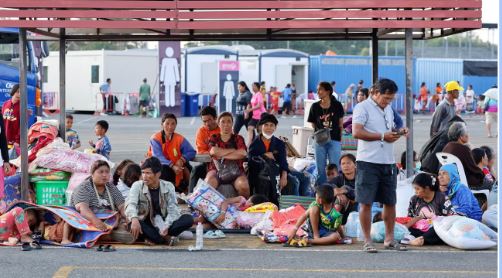
Armed clashes, including airstrikes, have recently broken out between Thailand and Cambodia due to escalating tensions along their disputed border region.
|
Read all about: Cambodia-Thailand Border Dispute |
What is Thailand-Cambodia Border Dispute?
The border dispute stems from disagreements over the French colonial-era border, mainly concerning the sovereignty of land near ancient Hindu temples.
Historical Roots of the Dispute
Colonial Legacy: The core of the dispute lies in a 1907 map drawn by France (the colonial power in Cambodia) as part of a border treaty with Siam (now Thailand).
Thailand's Counterclaim: Thailand does not accept the 1907 map's boundary line. It argues that the map violates a 1904 treaty principle, which states the border should follow the natural watershed of the Dângrêk Mountains.
Key Disputed Sites
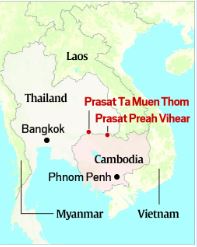
The conflict centers on two ancient Khmer temple complexes located in the Dângrêk Mountains, which form a natural border between the two countries.
Preah Vihear Temple
Ta Muen Temple Complex
Role of the International Court of Justice (ICJ)
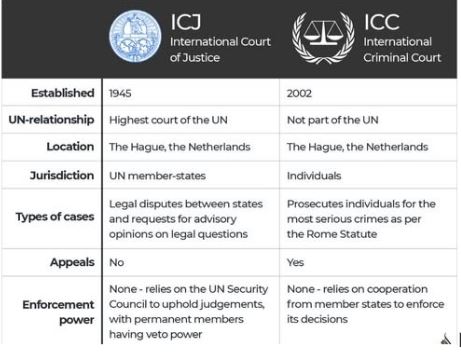
The ICJ, the principal judicial organ of the United Nations, has played a critical role in adjudicating the dispute over the Preah Vihear Temple.
|
Year |
ICJ Judgement |
|
1962 Judgement |
The Court ruled that the Temple of Preah Vihear belongs to Cambodia, requiring Thailand to remove its military and police forces from the temple and its surrounding area on Cambodian territory. |
|
2013 Interpretation |
The ICJ unanimously clarified that its 1962 ruling means the entire Preah Vihear promontory belongs to Cambodia. Thailand was ordered to withdraw its military and guards from this territory. |
Source: THEGUARDIAN
|
PRACTICE QUESTION Q. With reference to the Preah Vihear Temple dispute, consider the following statements: 1. The dispute originates from a colonial-era map that deviated from the agreed-upon watershed principle. 2. The International Court of Justice (ICJ) in its 1962 judgment ruled in favour of Thailand's claim to the temple. 3. The temple is a UNESCO World Heritage Site dedicated to the Hindu deity Vishnu. Which of the statements given above is/are correct? A) 1 only B) 1 and 3 only C) 2 and 3 only D) 1, 2 and 3 Answer: A Explanation: Statement 1 is correct: The dispute originated from a colonial-era map (the 1907 Annex I map) drawn by French officials, which placed the temple on the Cambodian side, deviating from the watershed principle agreed upon in the 1904 treaty. Thailand later argued that the true watershed line would put the temple on its territory. Statement 2 is incorrect: The International Court of Justice (ICJ), in its 1962 judgment, ruled in favour of Cambodia's claim to the temple. The Court found that the Temple of Preah Vihear was situated on Cambodian territory and obligated Thailand to withdraw its forces. Statement 3 is incorrect: The temple is an ancient Hindu shrine and a UNESCO World Heritage Site. It was dedicated to the Hindu deity Shiva (as Sri Sikharisvara, "Glorious Lord of the Mountain"). |
The core issue is a territorial dispute over the sovereignty of the ancient Preah Vihear temple and the surrounding 4.6 square kilometers of land. The dispute originates from conflicting interpretations of colonial-era border treaties and maps from the early 20th century.
The temple is a masterpiece of 11th-12th century Khmer architecture dedicated to the Hindu deity Shiva. It holds immense cultural and religious significance for both nations and has become a powerful symbol of national pride and sovereignty. It was listed as a UNESCO World Heritage Site in 2008.
The ICJ has ruled on the dispute twice. In 1962, it ruled that the temple is situated in territory under the sovereignty of Cambodia. In 2013, it clarified its earlier judgment, stating that Cambodia has sovereignty over the "whole territory of the promontory of Preah Vihear" and ordered Thailand to withdraw its forces from that area.






© 2026 iasgyan. All right reserved