Tiger population growth has increased conflicts, necessitating sustainable coexistence. The Tadoba-Andhari model mitigates this through financial decentralization, community revenue-sharing, and alternative livelihoods. Scaling such frameworks balances biodiversity with socio-economic needs via rapid compensation.
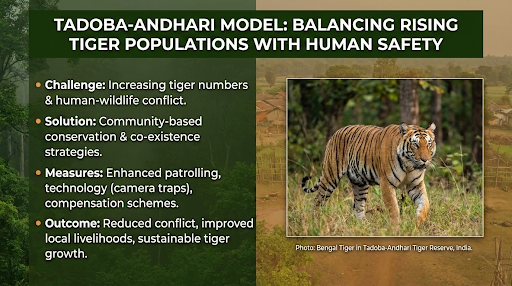
Rising tiger numbers in India have intensified human-wildlife conflict. Maharashtra's Tadoba-Andhari Tiger Reserve (TATR) offers a successful model for co-existence.
|
Read all about: HUMAN-WILDLIFE CONFLICT IN INDIA l HUMAN - WILDLIFE CONFLICT AS A NATURAL DISASTER l BALANCING LIVES AND CONSERVATION l HUMAN-WILDLIFE CONFLICT IN KERALA'S HILLS |
Human-Wildlife Conflict (HWC) is escalating due to a combination of ecological, developmental, and climatic factors that force wild animals and humans into the same physical spaces.
Habitat Fragmentation and Loss
Ecological and Population Dynamics
Climate Change and Environmental Stress
Changing Agricultural Patterns
The Tadoba-Andhari Model is a "coexistence" framework focused on reducing human-tiger conflict by transforming local communities from victims of wildlife into economic stakeholders in conservation.
Institutional and Financial Autonomy
Reducing Forest Dependency
Conflict Mitigation and Compensation
Key Outcomes
Tiger Density: The TATR landscape (including the Chandrapur district) now hosts over 200 tigers, one of the highest densities globally. (Source: Status of Tigers Report)
Conflict Stabilization: Despite the high density, the model has kept human-wildlife conflict rates lower than other high-density landscapes by reducing forest dependency by nearly 40% in target villages. (Source: Wildlife Institute of India)
Economic Value: The ecosystem services provided by TATR (water purification, carbon storage) are valued at several billion rupees annually.
Source: INDIANEXPRESS
|
PRACTICE QUESTION Q. Human-wildlife conflict is not merely a conservation issue but a complex socio-economic challenge that threatens rural livelihoods and food security in India. Critically analyze. 150 words |
It is a successful conservation framework implemented in the Tadoba-Andhari Tiger Reserve (TATR) in Maharashtra. The model focuses on financial decentralization, sharing eco-tourism revenue with local communities, providing rapid compensation for losses, and generating alternative livelihoods to mitigate human-wildlife conflict.
As India's tiger population grows within geographically restricted core areas, there is a "spill-over effect." Young and dispersing tigers are forced to migrate into buffer zones that are heavily populated by human settlements and agriculture, leading to deadly encounters.
TATR treats locals as active stakeholders by redirecting a significant portion of its Rs 40 crore annual tourism revenue back into the local economy. This funds direct employment (like safari guides), non-timber forest produce (NTFP) ventures, agrotourism, and local manufacturing initiatives.




© 2026 iasgyan. All right reserved