The Supreme Court’s December 2025 ruling recalibrated the Green Energy Corridor by balancing renewable expansion with Great Indian Bustard conservation. By replacing a blanket ban with priority zones, it ensured regulatory clarity for meeting India’s 500 GW non-fossil target, while highlighting challenges of land, finance, and coordination.
Copyright infringement not intended
Picture Courtesy: DOWNTOEARTH
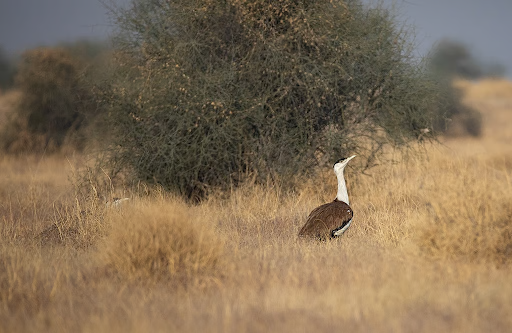
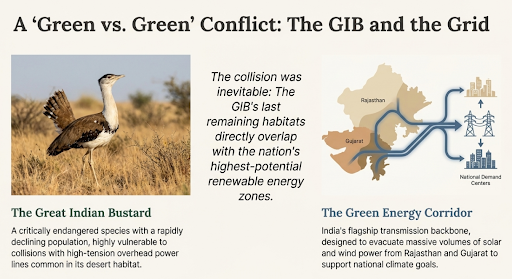
The Supreme Court revised the Green Energy Corridor framework in Rajasthan and Gujarat to balance renewable energy goals with the protection of the Great Indian Bustard (GIB).
It was launched in 2015, to create a dedicated transmission network for integrating electricity from renewable sources like solar and wind into the national grid.
It aims to transport large-scale renewable power from energy-rich states to high-demand areas, ensuring grid stability and minimizing energy wastage.
The project is implemented through two main systems: Intra-State (within states, led by state utilities) and Inter-State (across states, led by POWERGRID).
Main Objectives & Significance
Judicial intervention
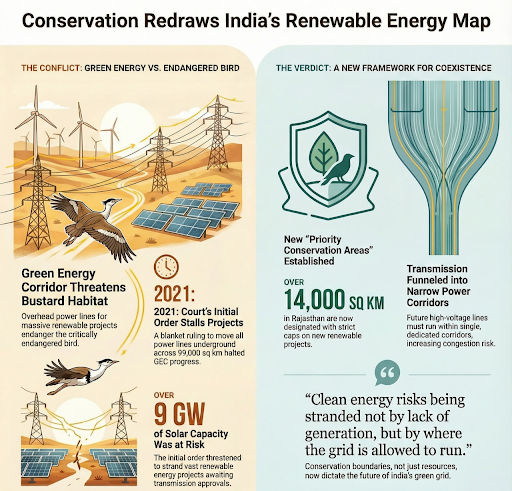
The Supreme Court's intervention has been a multi-year process, evolving from a blanket ban to a more calibrated approach.
|
|
Key Directive |
Impact on GEC |
|
April 2021 |
Ordered all overhead power lines in a vast GIB habitat (nearly 99,000 sq. km) to be placed underground. |
GEC project approval and commissioning delays created uncertainty, threatening to strand almost 9 GW of solar capacity. |
|
March 2024 |
Acknowledging universal undergrounding was practically and financially infeasible, the 2021 order was modified. An Expert Committee was appointed to recommend a balanced solution. |
Granted interim relief and established a more scientific, practical framework for conservation and energy transmission. |
|
Recent Framework (Based on Committee Recommendations) |
The Court accepted the committee’s "zonal approach," which replaces universal bans with location-specific mandates. |
|
Key Directives of the Final Judgement
Conservation in Priority & Potential Areas
The Expert Committee, whose recommendations the court has largely accepted, has demarcated GIB habitats into priority and potential zones, with specific rules for each.
Source: DOWNTOEARTH
|
PRACTICE QUESTION Q. The recent Supreme Court judgment on the Green Energy Corridor exemplifies the complex challenge of balancing infrastructural development with environmental conservation. Critically analyze. 250 words |
The GEC is a nationwide project to create a dedicated transmission network for electricity generated from renewable sources like solar and wind. It aims to connect renewable-energy-rich states with high-demand states, ensuring seamless integration of clean energy into the national grid.
The RPA is a specific zone covering approximately 13,000 sq. km in Rajasthan and Gujarat. It is legally recognized as the most critical habitat for the remaining GIBs. Within this zone, the installation of new overhead lines is strictly regulated and subject to expert committee approval.
Firefly Bird Flight Diverters are reflective flaps installed on overhead wires. They shine and rotate in the wind, making the wires visible to birds from a distance to prevent collisions. Their installation is now mandatory in specific "Priority Areas".



© 2026 iasgyan. All right reserved