Ram Prasad Bismil was a towering revolutionary, poet, and founder of the Hindustan Republican Association (HRA). Masterminding the 1925 Kakori train robbery to fund armed resistance, he utilized patriotic literature and supreme sacrifice to awaken India's youth against British colonialism.
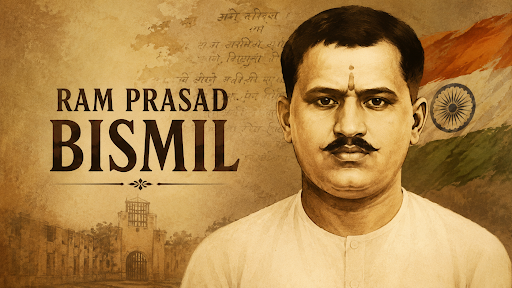
The nation observes the 129th birth anniversary of Pandit Ram Prasad Bismil.
Early Life and Ideological Foundations
Bismil was born on 11 June 1897 in a Rajput family in Shahjahanpur, Uttar Pradesh to Murlidhar (father) and Moolmati Devi (mother).
He masters Hindi at home, learns Urdu from a local Maulvi, and later enrolls in an English-medium school despite his father's initial objections.
He joins the Arya Samaj (established by Swami Dayananda Saraswati) in the 9th grade, which shapes his ideological foundation, infusing him with strict discipline, spiritual resilience, and a deep-rooted sense of nationalist duty.
The death sentence of Hindu Mahasabha leader Bhai Parmanand triggered his patriotic awakening at age 18, prompting him to compose his first revolutionary Hindi poem 'Mera Janm' under the pen name "Bismil".
Revolutionary Activities and the HRA
Underground Mobilization: He forms the underground youth organization Matrivedi and partners with school teacher Genda Lal Dixit to organize armed resistance against British rule.
Mainpuri Conspiracy (1918): He participates in the Mainpuri Conspiracy of 1918, distributes proscribed nationalist literature, and evades British police by jumping into the Yamuna River.
Founding the HRA: He co-founds the Hindustan Republican Association (HRA) in 1924 alongside Sachindra Nath Sanyal and Jadugopal Mukherjee.
Drafting the Manifesto: He drafts the HRA constitution and publishes its manifesto, "The Revolutionary", in 1925 to advocate armed rebellion over moderate petitions.
Youth Recruitment: He acts as a master recruiter, bringing dynamic youth like Chandrashekhar Azad (whom he nicknames "Quick Silver") and Bhagat Singh into the revolutionary fold.
The Kakori Train Action
Financial Objectives: The HRA orchestrates the Kakori action to resolve a severe funding crisis, acquire weapons, print revolutionary propaganda, and challenge British invincibility by seizing government treasury funds.
The Execution: On 9 August 1925, Bismil, Ashfaqulla Khan, Rajendra Lahiri, and other comrades halted the 8 Down Saharanpur–Lucknow passenger train near Kakori, looting using semi-automatic pistols.
Colonial Crackdown: The British government launches a brutal manhunt, arrests over 40 revolutionaries within a month, bans revolutionary literature, and aggressively expands colonial intelligence networks across Northern India.
Revolutionary Ideology and Literary Arsenal
Rejection of Non-Violence: The HRA rejects Gandhian non-violence, advocating instead for organized, armed confrontation to instill fear in colonial administrators and awaken mass resistance.
Vision of a Federal Republic: The HRA constitution advocated progressive ideals, seeking to establish a Federal Republic of the United States of India based on universal suffrage and the absolute abolition of human exploitation.
Nationalist Literature: Bismil publishes influential works like Deshwasiyon ke Naam, Swadeshi Rang, and Man Ki Lahar, and translates radical texts such as the Bengali book Bolshevikon Ki Kartoot (1918).
Sarfaroshi Ki Tamanna: He immortalizes the Urdu ghazal "Sarfaroshi Ki Tamanna" (originally penned by Bismil Azimabadi in 1921), transforming it into a national war cry recited on his way to the gallows.
Prison Writings: During his incarceration in Gorakhpur Jail, he writes his iconic autobiography (Atmakatha) and composes the celebrated patriotic song, "Mera Rang De Basanti Chola".
Trial, Execution, and Historical Legacy
Kakori Conspiracy Trial: Bismil defends himself and sends mercy petitions to the Governor and Viceroy solely to expose the hypocrisy of British justice.
Martyrdom: The colonial court sentences Bismil to death for waging war against the King, executing him at Gorakhpur Central Jail on 19 December 1927 at the age of 30.
Evolution into HSRA: His sacrifice inspired Bhagat Singh and Chandrashekhar Azad to reorganize the HRA into the Hindustan Socialist Republican Association (HSRA) in 1928.
Call for Unity: His final letter from prison issues a powerful plea for Hindu-Muslim unity as an essential prerequisite for achieving India's freedom.
While Bismil lays the organizational foundation, Ashfaqulla Khan represents secular unity, Chandrashekhar Azad ensures operational continuity, and Bhagat Singh infuses the movement with Marxist and socialist ideologies.
Source: NAVBHARATLIVE
|
PRACTICE QUESTION Q. Consider the following statements regarding the revolutionary leader Ram Prasad Bismil:
Which of the statements given above are correct? (a) 1 and 2 only (b) 2 and 3 only (c) 1 and 3 only (d) 1, 2, and 3 Answer: (b) Explanation: Statement 1 is incorrect. Ram Prasad Bismil was a founding member of the Hindustan Republican Association (HRA) in 1924, not the Hindustan Socialist Republican Association (HSRA). The HSRA was formed in 1928 by revolutionaries like Chandrasekhar Azad and Bhagat Singh at Feroz Shah Kotla, Delhi. Ram Prasad Bismil had already been hanged on December 19, 1927, so could not have founded the HSRA in 1928. Statement 2 is correct. During his time underground (around 1919-1920), Ram Prasad Bismil translated several works to spread revolutionary ideas. He translated the Bengali book 'Bolshevikon Ki Kartoot' (The Bolsheviks' Deeds) into Hindi. He also translated 'Catherine' from English and wrote 'Man Ki Lahar'. Statement 3 is correct. Ram Prasad Bismil wrote his autobiography, often titled Atmakatha or Kakori Ke Shaheed, while he was imprisoned in the condemned cell of the Gorakhpur Central Jail awaiting his execution. He completed it shortly before he was hanged there on December 19, 1927. |
Ram Prasad Bismil was an iconic Indian revolutionary leader, poet, and freedom fighter who fiercely organized armed resistance against British colonial rule during the 1920s.
The Kakori Conspiracy of August 9, 1925, was a strategic revolutionary train robbery executed near Lucknow to seize British government treasury funds to purchase weapons for the freedom struggle.
The Hindustan Republican Association (HRA) functioned as the core underground revolutionary organization that Bismil co-founded to launch an armed rebellion to establish a federal republic in India.
He is immortalized for his supreme martyrdom at Gorakhpur Jail on December 19, 1927, and for composing patriotic Urdu poems like Sarfaroshi Ki Tamanna that inspired generations of freedom fighters.


© 2026 iasgyan. All right reserved