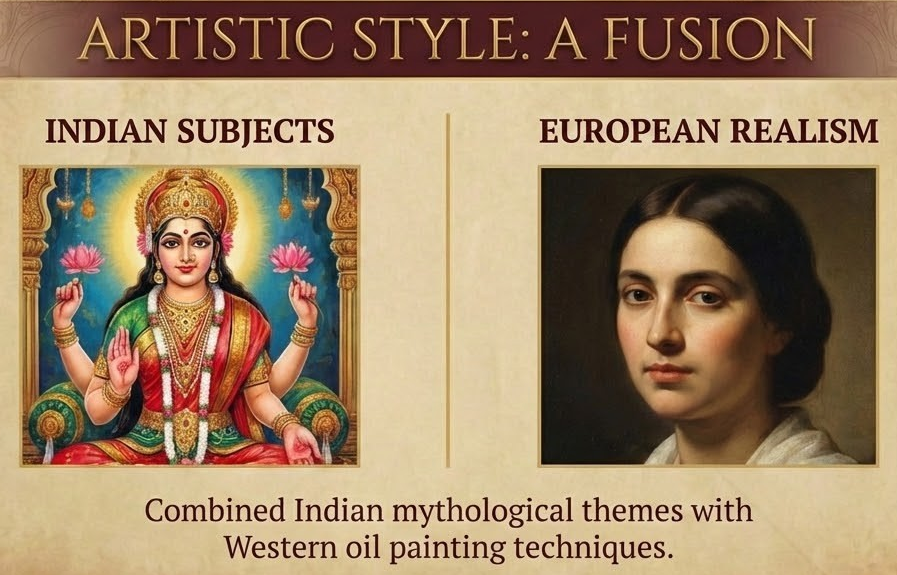
Raja Ravi Varma revolutionized Indian art by blending Western realism with Hindu mythology. By mass-producing affordable oleographs, he democratized divine imagery for all castes. Despite stylistic criticism, his work forged a national visual identity that later inspired modern Indian cinema.
Raja Ravi Varma’s ‘Yashoda and Krishna’ set a new record for modern Indian art by fetching ₹167.2 crore at auction.
Raja Ravi Varma (1848–1906) is widely regarded as the "Father of Modern Indian Art."
He is credited with bridging the gap between traditional Indian iconography and Western academic realism.
His work fundamentally changed how Indian deities and mythological characters were visualized, creating a pan-Indian visual language that persists to this day.
Early Life & Royal Patronage
Birth: Born in Kilimanoor Palace, Travancore (present-day Kerala), into an aristocratic family.
Training: He received early patronage from Ayilyam Thirunal, the Maharaja of Travancore.
Painting Style
Technique: He was one of the first Indian artists to master oil painting and lithography.
Subject Matter: While the technique was Western, the soul of his work was deeply Indian. He focused heavily on Hindu mythology (Puranas, Mahabharata, Ramayana) and portraits of Indian royalty.
 Lithographic Revolution & Democratization of Art
The Press: In 1894, he established the Raja Ravi Varma Fine Arts Lithographic Press in Mumbai (later shifted to Lonavala).
Impact: Before this, art was the exclusive domain of the wealthy upper class and royalty. His press mass-produced oleographs (chromolithographs) of Hindu gods and goddesses.
Social Change: These affordable prints brought deities like Lakshmi and Saraswati into the homes of ordinary people, bypassing caste and class barriers that restricted entry to temples. This played a powerful role in unifying the Hindu community's visual identity.
Major Works
Shakuntala: Depicts Shakuntala pretending to remove a thorn from her foot to look back at King Dushyanta.
Hamsa Damayanti: Damayanti conversing with a swan (messenger) about Nala.
Galaxy of Musicians: A group of Indian women from diverse backgrounds playing instruments, symbolizing the "Unity in Diversity" of India.
Jatayu Vadham: The dramatic scene of the vulture King Jatayu fighting Ravana to save Sita.
Lady in the Moonlight: Highlighted his mastery over lighting and shadow.
There Comes Papa: A portrait of his daughter Mahaprabha, noted for its domestic realism.
Contribution to Nationalism
National Icon: In 1904, the British Colonial Government awarded him the Kaiser-i-Hind Gold Medal for his contribution to the arts.
Criticism
The "Calendar Art" Critique: While popular, his work faced severe criticism from the Bengal School of Art (led by Abanindranath Tagore and Nandalal Bose).
Legacy
Cinema: His dramatic framing and visualization of mythological stories heavily influenced Dadasaheb Phalke, the father of Indian cinema, who worked at Varma's press before making movies.
Modern Recognition: In 2013, a crater on the planet Mercury was named "Varma" in his honor by the International Astronomical Union.
Source: BBC
|
PRACTICE QUESTION Q. Discuss how Raja Ravi Varma helped in the democratization of art and the formation of a national visual identity in 19th-century India. 150 words |
Raja Ravi Varma (1848–1906) is widely regarded as the Father of Modern Indian Art due to his groundbreaking efforts in fusing Western academic realism with traditional Indian mythological themes.
Academic Realism is a European art methodology that utilizes advanced perspective, anatomical accuracy, and *chiaroscuro* (the dramatic play of light and shadow). Varma mastered this technique through oil painting to create lifelike, three-dimensional depictions of Indian deities and epics.
By establishing a Fine Arts Lithographic Press in 1894, Varma mass-produced affordable oleographs (prints) of Hindu deities. This technological disruption broke the upper-class and royal monopoly on fine art, allowing marginalized and lower-caste communities to bring divine imagery into their homes for private worship, effectively bypassing orthodox caste barriers in temples.

© 2026 iasgyan. All right reserved