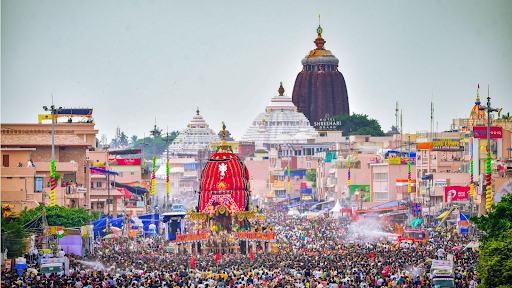
Located in Odisha, this sacred Hindu temple is dedicated to Lord Jagannath. Renowned for its stunning Kalinga architecture, it hosts the world-famous Ratha Yatra chariot festival. It remains one of India’s holiest Char Dham pilgrimage sites.
Copyright infringement not intended
Picture Courtesy: INDIANEXPRESS
The Jagannath Temple in Puri is in the news for the reopening of the Ratna Bhandar (treasury) after four decades.
Historical Background
Builder: The present temple was initiated by King Anantavarman Chodaganga Deva of the Eastern Ganga Dynasty in the 12th Century AD.
Completion: It was completed by his successor, Anangabhima Deva III, in 1230 AD.
Significance: It is one of the Char Dhams (four holiest pilgrimage sites) defined by Adi Shankaracharya, the other three being Badrinath, Dwarka, and Rameswaram.
The "White Pagoda": Early European sailors called it the "White Pagoda" due to its white plaster, distinguishing it from the "Black Pagoda" (Konark Sun Temple).
Architectural Features (Kalinga Style)
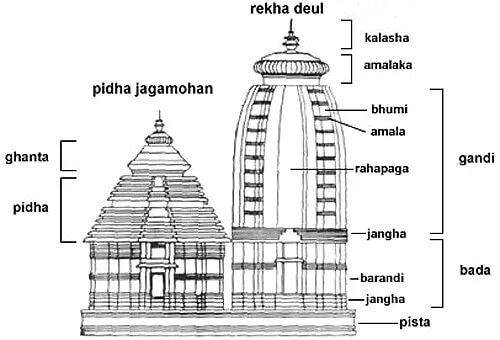
The temple is a masterpiece of the Kalinga School of Architecture, which is a sub-style of the Nagara order.
The Four Structures
The temple complex is a linear alignment of four distinct structures:
Vimana (Sanctum Sanctorum): The main tower housing the deities. It is a Rekha Deula (curvilinear tower) rising to 65 meters.
Jagamohana (Assembly Hall): A Pidha Deula (pyramidal roof) where devotees gather.
Natamandapa: The Dancing Hall, added later for devadasis (Maharis) to perform.
Bhogamandapa: The Hall of Offerings.
Boundary Walls
The Four Gates
Singhadwara (Lion Gate): The main eastern entrance.
Ashwadwara (Horse Gate): Southern gate.
Vyaghradwara (Tiger Gate): Western gate.
Hastidwara (Elephant Gate): Northern gate.
Aruna Stambha
A monolithic chlorite pillar standing in front of the Singhadwara. It was originally located at the Konark Sun Temple but was moved to Puri by the Marathas in the 18th century.
The Nila Chakra
The "Blue Wheel" made of eight metals (Ashtadhatu) sits atop the Vimana. A unique feature is that the temple flag (Patitapaban Bana) is changed daily by a climber, a ritual that has continued for 800 years.
The Deities and Unique Rituals
Unlike most Hindu temples where idols are stone or metal, the deities here are made of Neem Wood (Daru Brahma).
Key Facts
Source: INDIANEXPRESS
|
PRACTICE QUESTION Q. The term 'Nabakalebara' recently seen in the news is associated with: a) A traditional water harvesting structure in Odisha. b) The ritual replacement of wooden idols at the Jagannath Temple. c) A classical dance form dedicated to Lord Shiva. d) A conservation technique used by the ASI for stone monuments. Answer: b Explanation: The term 'Nabakalebara' is associated with the ritual replacement of wooden idols at the Jagannath Temple in Puri, Odisha. |
Early European sailors navigating the Bay of Bengal used the temple's towering, whitewashed exterior as a visual landmark. They named it the "White Pagoda" to easily distinguish it from the nearby Konark Sun Temple, which they called the "Black Pagoda."
Built in the Kalinga style, the temple features a linear quadripartite structure: the Vimana (a 65-meter Rekha Deula or curvilinear spire), the Jagamohana (a Pidha Deula or pyramidal assembly hall), the Natamandapa (Dancing Hall), and the Bhogamandapa (Hall of Offerings).
Derived from Odia, 'Naba' means new and 'Kalebara' means body. It is a sacred ritual associated with the Jagannath Temple in Puri, Odisha, where the old wooden idols of Lord Jagannath, Balabhadra, Subhadra, and Sudarshana are replaced with new ones. It symbolizes the cycle of death and rebirth, demonstrating that the soul is eternal even if the physical form changes.


© 2026 iasgyan. All right reserved