The PM Dhan-Dhaanya Krishi Yojana (2025) aims to transform 100 low-performing agri-districts through convergence of 36 existing schemes across 11 ministries, backed by an annual outlay of ₹24,000 crore for six years. The scheme focuses on improving productivity, crop diversification, irrigation, post-harvest infrastructure, and credit access while integrating allied sectors like horticulture, fisheries, and animal husbandry. Implementation is driven by district-level planning, three-tier governance, NITI Aayog’s technical support, and a digital dashboard with 117 KPIs. Targeted to benefit 1.7 crore farmers, PMDDKY seeks to create resilient, sustainable, and market-oriented agricultural ecosystems aligned with Atmanirbhar Bharat.
Copyright infringement not intended
Picture Courtesy:PIB
Context:
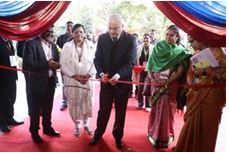
The Ministry of Agriculture & Farmers’ Welfare successfully concluded Day 1 of the PM Dhan-Dhaanya Krishi Yojana – FPO Sangam, held at the NCUI Auditorium and NCDC Complex.
|
Must Read: PM DHAN DHANYA KRISHI YOJANA | PRADHAN MANTRI DHAN DHANYA KRISHI YOJANA: SIGNIFICANCE AND WAY FORWARD | |
What is PM Dhan-Dhaanya Krishi Yojana (PMDDKY)?
PM Dhan-Dhaanya Krishi Yojana seeks to transform 100 low-performing agricultural districts by converging 36 schemes across 11 ministries, with an annual allocation of ₹24,000 crore for six years starting FY 2025–26. Instead of launching new programmes, the Yojana strengthens last-mile delivery of existing schemes through coordinated planning with states, agricultural universities, and the private sector. Modelled on the Aspirational Districts Programme (2018), it is expected to directly benefit 1.7 crore farmers.
Objectives of PMDDKY:
The scheme focuses on five integrated goals aimed at restructuring agricultural ecosystems:
District Selection Criteria:
Institutional Structure:
District-Level Implementation
Each selected district will form a District Dhan-Dhaanya Krishi Yojana (DDKY) Samiti, chaired by the District Collector, and supported by progressive farmers, line department officials, and technical institutions. The committee will design a District Agriculture & Allied Activities Plan through consultations, crop-pattern analysis, and alignment with national priorities like soil conservation, diversification, and natural farming.
Progress will be tracked through 117 Key Performance Indicators (KPIs) displayed on a central digital dashboard, enabling monthly reviews and accountability.
Multi-Tier Governance
Implementation will be monitored through three coordinated layers:
Each district will be assigned a Central Nodal Officer for regular field visits and monitoring. Districts and nodal officers will be finalised by July 2025, with training beginning in August to enable rollout by the Rabi season in October.
Knowledge Support
The scheme integrates academic and governance institutions for technical depth:
Digital Support
A strong digital platform supports transparency and farmer engagement:
Expected Outcomes:
By prioritising not only crop agriculture but also horticulture, fisheries, beekeeping, animal husbandry, and agroforestry, the scheme will generate broader rural growth. Expected gainsinclude:
|
Aspirational Districts Programme (2018) · Launched in January 2018 by NITI Aayog to transform 112 most under-developed districts across India. · Focuses on improving governance and service delivery in critical social sectors. · Based on the principle of "Sabka Saath, Sabka Vikas, Sabka Vishwas" through district-level performance improvement. · Targets five core themes with 49 indicators: o Health & Nutrition o Education o Agriculture & Water Resources o Financial Inclusion & Skill Development o Basic Infrastructure · Uses a data-driven ranking system through the Delta Ranking, updated monthly to track improvements. · Encourages competition among districts to improve outcomes. · Supports districts through handholding by Central Prabhari Officers, line ministries, and development partners. · Emphasises convergence of central and state schemes for optimum resource use. · Promotes collaboration between government, civil society, and private sector. · Stresses competition and real-time monitoring using the ADP dashboard. · Led to significant improvements in immunisation, institutional deliveries, school attendance, drinking water access, and financial inclusion in many districts. · Recognised globally as a model for targeted, outcome-based governance. |
Conclusion
The PM Dhan-Dhaanya Krishi Yojana represents a paradigm shift in agricultural development through convergence, decentralised planning, and technology-enabled monitoring. With a strong financial commitment and institutional backing from 11 ministries, NITI Aayog, and agricultural universities, it aims to uplift 100 low-performing districts by improving productivity, diversifying livelihoods, and strengthening rural resilience.
Source: PIB
|
Practice Question With reference to the Aspirational Districts Programme (ADP), consider the following statements: 1. The programme identifies districts based on a composite index of socio-economic indicators. 2. The Delta Ranking under the programme is updated annually. 3. NITI Aayog is the nodal agency coordinating the implementation of the programme. Which of the statements given above is/are correct? Answer: C Explanation: · Statement 1 is correct – Districts were selected using indicators related to health, education, agriculture, and basic infrastructure. · Statement 2 is incorrect – Delta Ranking is updated monthly, not annually. · Statement 3 is correct – NITI Aayog is the nodal coordinating body. |
It is a major agricultural transformation initiative approved in July 2025 to uplift 100 low-performing agri-districts through convergence of 36 schemes across 11 ministries.
The scheme will run for 6 years (FY 2025–26 to 2030–31) with an annual outlay of ₹24,000 crore.
It will directly benefit approximately 1.7 crore farmers, especially those in districts with low productivity, low cropping intensity, and poor credit access.




© 2026 iasgyan. All right reserved