The UAE's 2026 exit from OPEC and OPEC+ signifies a major shift from cartel-managed oil supplies to strategic autonomy. For India, which imports 85% of its crude, this fragmentation presents opportunities for independent negotiation but requires immediate expansion of strategic reserves and alternative payment mechanisms amidst Middle Eastern conflicts.
Why In News?
The United Arab Emirates (UAE) officially exits the OPEC and OPEC+ alliances in May 2026, now Iraq threatens a similar withdrawal unless the cartel raises its production quota.
What is OPEC?
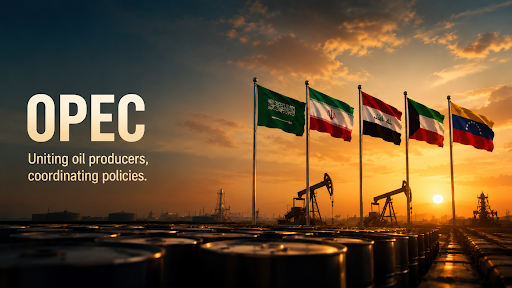
Origin: Founded in 1960, at the Baghdad Conference, the original cartel members include Iran, Iraq, Kuwait, Saudi Arabia, and Venezuela.
Headquarters: The organization maintains its secretariat in Vienna, Austria, having relocated from Geneva, Switzerland, in 1965.
Core Objectives: The cartel unifies petroleum policies to stabilize global markets, ensures fair financial returns for producers, and guarantees a regular supply of petroleum to global consumers.
Member Countries and Market Dynamics
Membership Exodus: Following the UAE's exit in May 2026, the cartel faces a mass departure trend, including Qatar (2019), Ecuador (2020), and Angola (2024).
Dominant Producers: Saudi Arabia acts as the de-facto leader, historically absorbing production cuts to maintain price floors.
Global Influence: The bloc traditionally controls 40% of global oil production and holds the majority of proven crude reserves.
The OPEC+ Framework
Origin: Established in 2016, this coalition integrates OPEC members with 10 non-OPEC nations—including Azerbaijan, Bahrain, Kazakhstan, Mexico, and Oman—under the Declaration of Cooperation (DoC).
Strategic Purpose: The group counters the rapid expansion of U.S. shale oil production.
Russian Role: Russia serves as the primary non-OPEC heavyweight, though geopolitical sanctions now drive members like the UAE to distance themselves from Moscow.
Market Share: The UAE's departure projects a permanent decline in OPEC+ global production control from 50% to 45%.
Mechanisms of Influence
Production Quotas: OPEC mandates legally binding caps based on historical baselines to artificially induce supply scarcity and inflate prices.
Supply Management: The cartel adjusts collective output targets based on global economic data to prevent price crashes during demand dips.
Reference Basket: The organization utilizes an official Reference Basket to benchmark and mitigate price volatility.
Spare Capacity: The UAE's exit depletes the cartel's spare production capacity, which previously allowed for rapid supply increases during global shortages.
|
Importance of Production Quotas Revenue Protection: Quotas prevent market flooding; for example, Saudi Arabia requires oil prices near $80 per barrel to fund its Vision 2030 diversification projects. Market Share Balance: Quotas prevent excessive cuts that would allow non-OPEC nations, such as the United States (producing over 13 million barrels/day), to capture market share. Energy Security: Regulated quotas provide a predictable baseline for global industries, preventing sudden supply shocks. |
Geopolitical and Economic Implications
Internal Cohesion: The UAE's exit prioritizes resource nationalism over cartel discipline, highlighting deep rifts between Saudi Arabia and the UAE regarding the Yemen civil war and the US-Iran conflict.
Price Volatility: Abu Dhabi plans to reach a 5 million bpd target by 2027, introducing massive supply pressure that threatens long-term price stability.
Petrodollar Resilience: The UAE threatens to sell crude in Chinese Yuan if the US-Iran conflict continues to restrict dollar liquidity, challenging the US dollar's role in 48% of global payments.
Source: INDIATODAY
|
PRACTICE QUESTION Q. Consider the following statements regarding the Organization of the Petroleum Exporting Countries (OPEC) and global oil markets: 1. OPEC was established in 1960 by five founding members, which included the United Arab Emirates (UAE). 2. The United Arab Emirates recently exited both the OPEC and OPEC+ groupings to pursue independent energy production strategies. 3. India's Strategic Petroleum Reserves (SPR) currently hold enough capacity to sustain the country's crude oil requirements for 90 days. Which of the statements given above is/are correct? A) 1 and 2 only B) 2 only C) 2 and 3 only D) 1, 2, and 3 Answer: B Explanation: Statement 1 is incorrect: The Organization of the Petroleum Exporting Countries (OPEC) was established at the Baghdad Conference on September 14, 1960. It was founded by five original member nations: Iran, Iraq, Kuwait, Saudi Arabia, and Venezuela. The United Arab Emirates (UAE) did not join until 1967. Statement 2 is correct: The UAE announced its complete departure from both OPEC and OPEC+ groupings. The exit was triggered by continuous friction over restricted production quotas, as the UAE sought strategic autonomy to aggressively ramp up its independent production capacity to monetize its natural resources. Statement 3 is incorrect: India’s Strategic Petroleum Reserves (SPRs), managed by Indian Strategic Petroleum Reserves Limited (ISPRL), have an established total capacity of 5.33 Million Metric Tonnes (MMT). At maximum capacity, this holds enough crude oil to fulfill only 9.5 days of domestic requirements—far short of the 90-day benchmark. (Even factoring in commercial reserves held separately by domestic oil companies and refineries, total combined cover sits around 65 to 74 days, not the SPR capacity alone). |
The Organization of the Petroleum Exporting Countries (OPEC) is a permanent intergovernmental organization established in 1960 by five founding nations to coordinate and unify petroleum policies among its members.
OPEC+ is a powerful loose alliance formed in 2016 that combines the 12 core OPEC member countries with 10 major non-OPEC oil-producing nations, most notably Russia, to exercise greater collective control over the global crude market.
The cartel manipulates global crude prices by assigning binding production quotas to its member nations, effectively tightening or loosening the global oil supply to match demand and defend their desired price floors.
OPEC is highly critical for India because the nation imports over 80% of its crude oil requirements, meaning any production cuts or price hikes engineered by the cartel directly trigger domestic inflation, widen the current account deficit, and strain fiscal stability.

© 2026 iasgyan. All right reserved