ZSI researchers discovered three new Boghawker dragonfly species in Northeast India. These vital bio-indicators face severe threats from habitat loss and pollution, highlighting the urgent need to protect the region's wetlands.
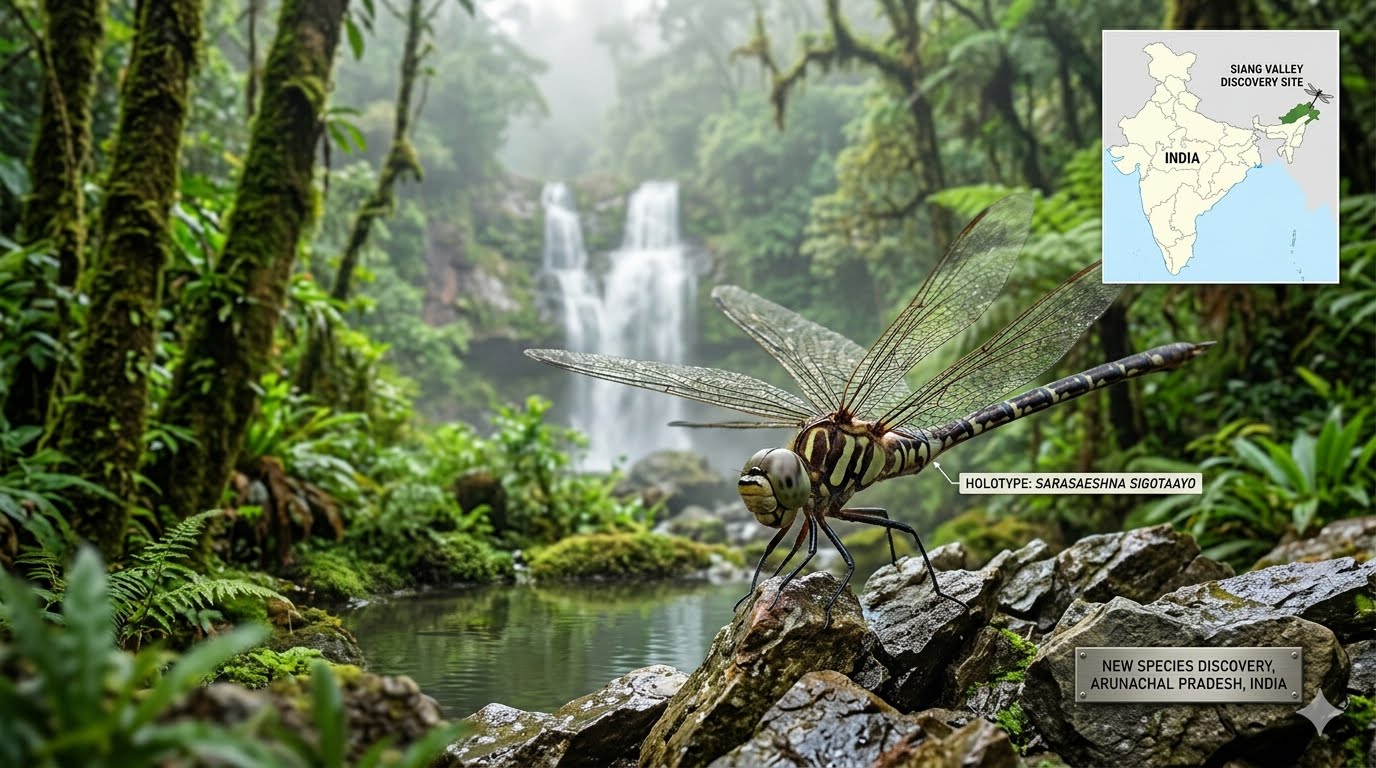
Three new dragonfly species, all within the rare Sarasaeschna genus, were discovered in the Siang Valley of Arunachal Pradesh and the Karimganj district of Assam.
Scientists from the Zoological Survey of India (ZSI) and independent researchers identified three new species belonging to the genus Sarasaeschna.
|
Species Name |
Common Name |
Location Found |
Habitat Detail |
|
Sarasaeschna nuboides |
Clouded Boghawker |
Arunachal Pradesh (Siang Valley) |
Shallow forest ponds; rapid fliers. |
|
Sarasaeschna sigotaayo |
Siang Boghawker |
Arunachal Pradesh (Siang Valley) |
Perching close to water in remote valleys. |
|
Sarasaeschna dosdewaensis |
Long-tailed Boghawker |
Assam (Karimganj District) |
Forest trails in recognized odonate (dragonflies and damselflies) hotspots. |
Ancient Survivors: Dragonflies are living fossils, predating dinosaurs by over 100 million years.
Biological Indicators: They are excellent bio-indicators of water quality. Their presence indicates a healthy freshwater ecosystem, as their larvae (nymphs) are sensitive to pollution.
Apex Predators of the Insect World: They are voracious predators of mosquitoes and flies, acting as a natural biological control for diseases like Malaria and Dengue.
360-Degree Vision: Their eyes contain up to 30,000 facets, allowing them to see in almost every direction simultaneously.
Independent Wing Movement: They can fly in any direction—up, down, backward, and hover—making them one of the fastest and most agile insects.
Most Odonate species in India are currently listed under "Least Concern" on the IUCN Red List, but habitat destruction in Northeast is a rising threat.
Source: EASTMOJO
|
PRACTICE QUESTION Q. Consider the following statements regarding Odonates: 1. They are considered crucial bio-indicators because their larvae are highly sensitive to chemical pollutants. 2. Dragonflies are exclusively found in the Western Ghats of India. 3. When at rest, damselflies fold their wings straight up and together above their abdomen. Which of the statements given above is/are correct? a) 1 and 2 only b) 1 and 3 only c) 2 and 3 only d) 1, 2, and 3 Answer: b) Explanation: Statement 1 is correct: Odonates are considered crucial bio-indicators of aquatic ecosystem health because their larvae are highly sensitive to chemical pollutants and water quality changes. Statement 2 is incorrect: While the Western Ghats are a rich habitat for Odonates, including many endemic species, dragonflies are found worldwide and are not exclusive to the Western Ghats of India. Statement 3 is correct: When at rest, most damselflies fold their wings together, upward, and hold them parallel to their body, unlike dragonflies, which typically rest with their wings spread horizontally. |
In April 2026, Zoological Survey of India (ZSI) researchers discovered three new dragonfly species belonging to the Sarasaeschna genus: the Clouded Boghawker, Siang Boghawker, and Long-tailed Boghawker. They were primarily found in the Siang Valley of Arunachal Pradesh and the Karimganj district of Assam.
Odonates require unpolluted, oxygen-rich freshwater to breed. Their larvae (nymphs) are highly sensitive to chemical pollutants and heavy metals. Therefore, a thriving dragonfly population mathematically correlates to high water quality, making them excellent natural indicators of freshwater health.
Dragonflies are apex insect predators that voraciously consume mosquitoes and black flies. Introducing dragonfly nymphs into water storage tanks acts as a biological control mechanism to eradicate mosquito larvae, drastically reducing the transmission of vector-borne diseases like Malaria and Dengue without harmful chemicals.





© 2026 iasgyan. All right reserved