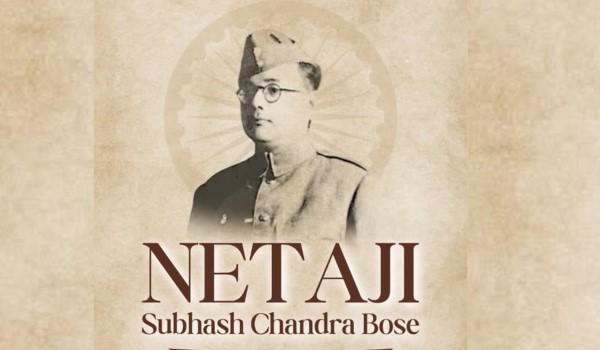
Subhas Chandra Bose, popularly known as Netaji, was one of the most dynamic and radical leaders of India’s freedom struggle. Born in 1897 in Cuttack, he resigned from the Indian Civil Services to join the national movement and later rose to become President of the Indian National Congress in 1938 and 1939. Due to ideological differences with Mahatma Gandhi, he formed the Forward Bloc and pursued a more militant path to independence.
During World War II, Bose reorganized the Indian National Army (INA) and established the Provisional Government of Azad Hind with foreign support, inspiring Indians with slogans like “Delhi Chalo” and “Give me blood, and I will give you freedom.” His courage, leadership, and spirit of sacrifice gave a powerful international and military dimension to India’s struggle for freedom, leaving behind an enduring legacy of patriotism and determination.
Copyright infringement not intended
Picture Courtesy: News on Air
Home Minister Amit Shah paid tribute to Netaji Subhas Chandra Bose on his birth anniversary.
|
Must Read: NETAJI BOSE | |
Background:
Subhas Chandra Bose was born on January 23, 1897, in Cuttack, Odisha. The city, often referred to as the Silver City, is famous for its traditional Tarakashi (silver filigree) craftsmanship, a significant part of Odisha’s cultural heritage.
Early career:
Bose completed his early education in Cuttack before moving to Kolkata for higher studies at Presidency College. He later went to Cambridge University in England, where he prepared for and successfully cleared the Indian Civil Services (ICS) examination. However, his nationalist convictions led him to resign from the prestigious service in 1921 to actively participate in India’s struggle for independence.
Role in the Indian National Congress (INC):
Congress leadership: Bose rose rapidly within the Congress ranks and was elected President of the Indian National Congress at the Haripura Session (1938) and again at the Tripuri Session (1939). During his tenure, he strongly advocated for complete independence (Swaraj) and opposed British plans such as the proposed Indian Federation.
Formation of the Forward Bloc: After differences with the Congress high command, Bose stepped down from the presidency in 1939 and founded the Forward Bloc. The aim was to consolidate left-wing and radical nationalist groups within the Congress framework.
Indian National Army (INA) and the Azad Hind Government
Revival of the INA: The Indian National Army (INA) was initially formed from Indian prisoners of war captured by Japan. Bose assumed its leadership in 1943, reorganizing and energizing it into a disciplined fighting force dedicated to ending British rule.
“Delhi Chalo” Campaign: Bose inspired his troops with the rallying cry “Delhi Chalo” (March to Delhi). INA forces advanced toward India’s northeastern frontiers, reaching areas near Imphal and Kohima before being forced to retreat due to strong Allied resistance in 1944–45.
Azad Hind Government: With support from Japan, Bose established the Provisional Government of Azad Hind in exile. This government symbolized India’s claim to sovereignty and coordinated military operations alongside Axis powers in Southeast Asia.
Major Contributions to India’s Freedom Movement
Inspirational leadership: Bose’s bold vision and call for immediate independence energized many Indians, particularly youth and soldiers, offering an alternative path to freedom beyond non-violent protest.
International diplomacy with military strategy: He actively sought assistance from foreign powers such as Germany, Japan, and the Soviet Union to strengthen India’s liberation struggle. His efforts gave the independence movement a global dimension and challenged British authority both politically and militarily.
Qualities of Netaji Subhas Chandra Bose:
Unwavering patriotism: Netaji Subhas Chandra Bose’s life was defined by intense patriotism and personal sacrifice. In 1921, despite clearing the prestigious Indian Civil Services (ICS) examination in England, he resigned from the service because he did not want to serve under British rule, choosing instead to dedicate himself completely to India’s freedom struggle.
Remarkable courage: Bose displayed exceptional courage throughout his political journey, often taking grave risks in pursuit of independence. A striking example was his daring escape from house arrest in Calcutta in 1941, when he disguised himself and secretly traveled across Afghanistan and Europe to seek international support against British colonialism.
Firm determination: Determination was one of Bose’s most defining traits, as he refused to abandon the goal of complete independence despite repeated setbacks. Even after resigning from the Congress presidency in 1939 due to ideological differences, he continued his mission by founding the Forward Bloc to consolidate radical nationalist forces.
Visionary leadership: Subhas Chandra Bose was a forward-looking leader who believed that political freedom must be accompanied by economic strength and modern development. During the 1938 Haripura Session of the INC, he emphasized national planning, industrial growth, and scientific advancement as essential pillars of a free India.
Organizational skill: Bose possessed strong organizational and administrative abilities, which became evident when he took charge of the Indian National Army (INA) in 1943. He transformed it into a disciplined fighting force and established structured divisions, including the Rani Jhansi Regiment, an all-women combat unit, reflecting both efficiency and progressive thinking.
Inspirational oratory: Netaji had a powerful command over words, which he used to inspire mass participation in the freedom movement. His famous slogan, “Give me blood, and I will give you freedom,” electrified Indians across regions and motivated many to join the INA and contribute to the liberation struggle.
Commitment to unity and equality: Netaji strongly believed in social unity and inclusiveness, rejecting divisions based on religion, caste, or gender. The INA embodied this principle by bringing together soldiers from diverse communities, and his support for the Rani Jhansi Regiment under Captain Lakshmi Sahgal highlighted his belief in women’s active role in nation-building.
Conclusion:
Netaji Subhas Chandra Bose remains a symbol of fearless patriotism, bold leadership, and uncompromising dedication to India’s freedom. His belief in action, sacrifice, and national unity gave a militant edge and global dimension to the independence movement. Even today, his life continues to inspire generations to serve the nation with courage, discipline, and selfless commitment.
Source: News on Air
|
Practice Questions Q. “Netaji Subhas Chandra Bose represented the militant and internationalist face of India’s freedom struggle.” Discuss. (150 words) |
Although he successfully cleared the ICS examination, he resigned in 1921 because he did not want to serve under British rule and wished to dedicate himself to India’s freedom struggle.
The Forward Bloc was a political group founded by Bose in 1939 after he resigned from the Congress presidency. It aimed to unite left-wing and radical nationalist elements.
The INA was a military force formed with Indian prisoners of war and civilians in Southeast Asia to fight British rule. Bose took its leadership in 1943 and reorganized it into a powerful symbol of resistance.



© 2026 iasgyan. All right reserved