India’s LIGO-India project in Hingoli, Maharashtra, aims to detect gravitational waves as part of the global observatory network. Despite a 2030 target, procedural delays in awarding construction contracts persist. Its success could enhance scientific research, high-tech manufacturing, human capital, and regional socio-economic development.

Copyright infringement not intended
Picture Courtesy: INDIANEXPRESS
Context
The LIGO-India project, approved in 2023 for a gravitational wave observatory in Maharashtra, is delayed due to an unfinalized civil works contract.
What is LIGO-India Project?
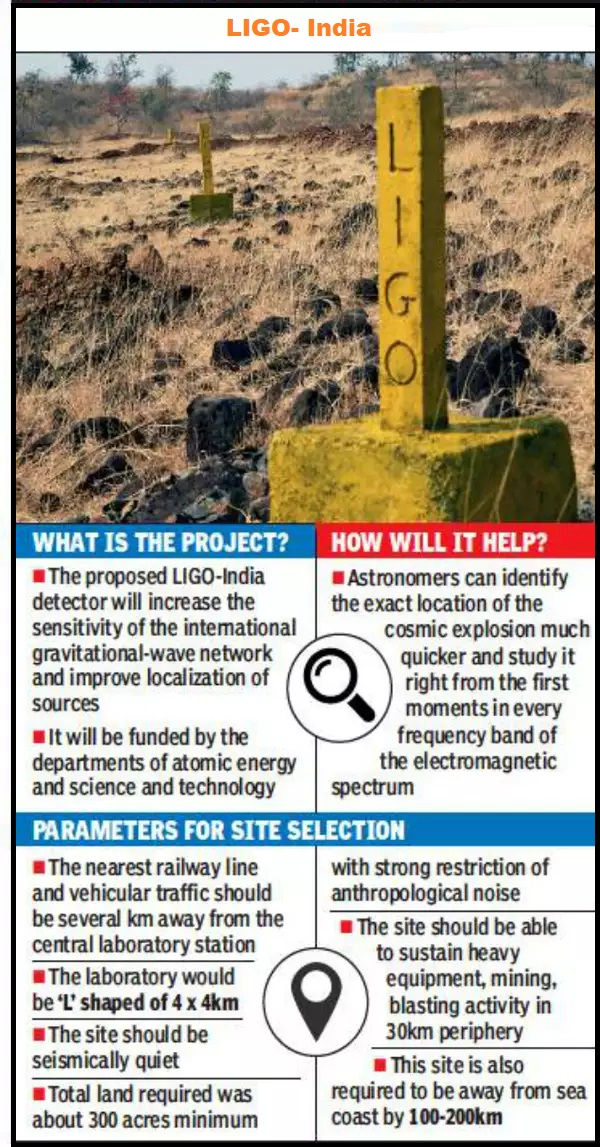
LIGO-India (Laser Interferometer Gravitational-Wave Observatory) is an advanced gravitational-wave observatory being built in Hingoli, Maharashtra.
It is a Mega-Science Project approved by the Union Cabinet in April 2023 with a budget of ₹2,600 crore.
Technical Specifications
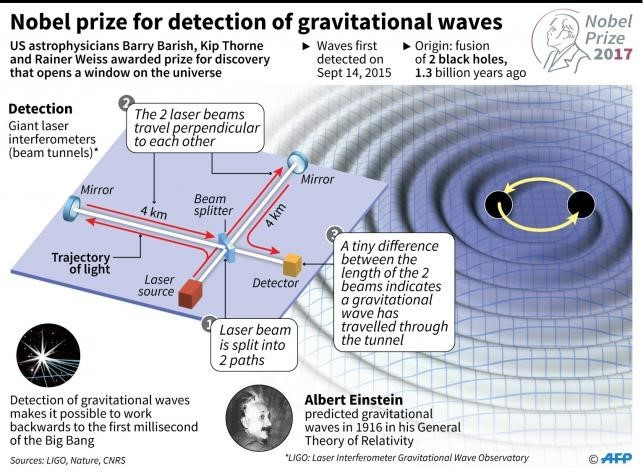
Design: It is an L-shaped interferometer with two 4-km-long vacuum arms.
Working Principle: It uses Laser Interferometry to measure minute changes (less than the diameter of a proton) in the arm lengths caused by passing gravitational waves.
Global Integration: It is technically identical to the two LIGO detectors in the USA (Hanford and Livingston) and will function as part of a global network including Virgo (Italy) and KAGRA (Japan).
Institutional Framework
Nodal Agencies: A joint venture of the Department of Atomic Energy (DAE) and the Department of Science and Technology (DST).
Lead Institutes:
International Partner: LIGO Laboratory, USA (Caltech and MIT), which provides the design and key components.
Scientific Significance
Sky Localization: Adding a detector in India improves the triangulation of gravitational wave sources, pinpointing their location in the sky with high precision.
Multi-Messenger Astronomy: Better localization allows optical and X-ray telescopes to quickly find and study the electromagnetic counterparts of events like neutron star mergers.
Testing Physics: It allows for testing of Einstein’s General Theory of Relativity and provides insights into the nature of Black Holes and the Early Universe.
Strategic & Economic Impact
Industrial Growth: The project requires ultra-high vacuum (UHV) systems and high-precision optics, boosting the capabilities of Indian high-tech industries .
Academic Leadership: It positions India as a global leader in Fundamental Physics, attracting international researchers and preventing "brain drain".
Inertial Navigation: The technology used (vibration isolation and stable lasers) has spin-off applications in seismology and precision navigation.
Source: INDIANEXPRESS
|
PRACTICE QUESTION Q. With reference to the LIGO-India project, consider the following statements: 1. It is an L-shaped interferometer with two arms, each 4 kilometres long. 2. It is being constructed in the Hingoli district of Maharashtra. 3. The project is exclusively funded and managed by the Department of Science and Technology (DST). Which of the statements given above is/are correct? A) 1 and 2 only B) 2 and 3 only C) 1 and 3 only D) 1, 2, and 3 Answer: A Explanation: Statement 1 is correct: LIGO (Laser Interferometer Gravitational-Wave Observatory) is a L-shaped interferometer. It uses two perpendicular "arms," each exactly 4 kilometres long, to detect minute changes in distance caused by passing gravitational waves. Statement 2 is correct: The LIGO-India project is being constructed in the Hingoli district of Maharashtra, specifically near Aundha Nagnath. This site was selected based on its seismic stability and suitability for the high-precision observatory. Statement 3 is incorrect: The project is a collaborative mega-science project piloted and funded jointly by the Department of Atomic Energy (DAE) and the Department of Science and Technology (DST) on the Indian side. Additionally, it involves a Memorandum of Understanding (MoU) with the National Science Foundation (NSF) of the USA, which provides the technical design and hardware. |
LIGO-India is an advanced gravitational-wave observatory being built in the Hingoli district of Maharashtra. It is a collaborative project between Indian research institutions and the US-based LIGO Laboratory, designed to detect tiny ripples in spacetime called gravitational waves.
It will be the fifth observatory in a global network, significantly enhancing the world's ability to precisely locate the sources of gravitational waves, such as merging black holes and neutron stars. This opens a new window to observe the universe, complementing traditional telescopes.
The primary reason for the delay is procedural hurdles in awarding the Rs 1,600-crore Engineering, Procurement, and Construction (EPC) tender. The complexity and unprecedented nature of this mega-science project in India have contributed to a lengthy and cautious tender process.



© 2026 iasgyan. All right reserved