India’s National Statistical Office (NSO) revised the GDP base year from 2011–12 to 2022–23 to reflect structural economic changes and improve data credibility. The rebasing slightly reduces overall GDP size, raises agriculture and industry shares, lowers services, and aligns India’s statistics with global standards.
Copyright infringement not intended
Picture Courtesy: THEHINDU
Context
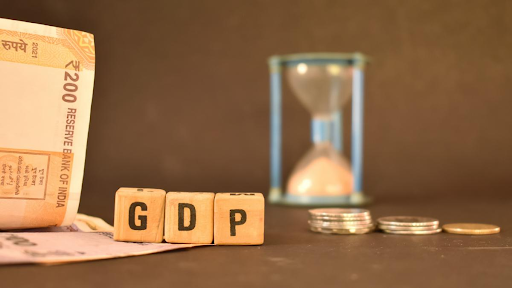
The National Statistical Office (NSO) introduced a new series of National Accounts Statistics, updating the base year from 2011-12 to 2022-23, for accurately reflecting the structural changes in the Indian economy.
What is GDP?
GDP (Gross Domestic Product) is the total monetary or market value of all finished goods and services produced within a country's borders during a specific period, such as a quarter or a year.
Key Types of GDP
Nominal GDP: Measures output at current market prices without adjusting for inflation. It can be misleading if prices rise while actual production remains the same.
Real GDP: Adjusts for inflation by using constant prices from a "base year." This is the most accurate way to measure true economic growth over time.
GDP Per Capita: Divides total GDP by the population. It is often used as an indicator of average living standards and prosperity.
GDP Purchasing Power Parity (PPP): Adjusts for differences in local prices and cost of living, allowing for fairer comparisons between countries.
How GDP is Calculated
GDP is calculated via the Expenditure, Income, and Production (Output) methods, which theoretically yield the same result by measuring the circular flow of income.
Expenditure Approach: The most common method, which sums up all spending in the economy. The formula is:
Income Approach: Sums all incomes earned by factors of production, including wages, rents, interest, and corporate profits.
Production (Value-Added) Approach: Calculates the total value added at every stage of production across all industries.
Common Limitations
Excludes Non-Market Activities: It does not count unpaid work (like childcare at home), volunteer work, or informal "black market" transactions.
Ignores Inequality: A rising GDP doesn't show how wealth is distributed; a few individuals may get much wealthier while others fall behind.
Overlooks Well-being: It doesn't measure happiness, health, or environmental damage caused by production.
Why is GDP Rebasing Necessary?
Capturing Structural Changes
Economies evolve over time. Rebasing adjusts the weights of different sectors (like agriculture, manufacturing, services) to reflect their current contribution to the economy, providing a more realistic picture.
Incorporating New Data
It allows for the integration of new and better data sources. The 2022-23 series aims to better capture the growing digital economy and incorporate data from sources like the Goods and Services Tax (GST).
Aligning with Global Standards
The revision brings India's methodology in line with the latest international standards, such as the UN System of National Accounts (SNA). This improves the comparability and credibility of India's economic data globally.
What are the Challenges with the Previous (2011-12) GDP Series?
Alleged Overestimation of Growth
Many economists argued that the methodology led to an overestimation of GDP growth, creating a disconnect with other weaker economic indicators like low credit growth and stressed corporate balance sheets.
Methodological Flaws
Critics pointed to the problematic use of the Ministry of Corporate Affairs' MCA-21 database, which allegedly included data from inactive firms, and the use of inappropriate deflators to calculate real growth.
Divergence with Other Indicators
The high growth figures often did not align with other high-frequency data like the Index of Industrial Production (IIP) and export growth.
International Scrutiny
The concerns led the International Monetary Fund (IMF) to award India's National Accounts a 'C' grade, highlighting methodological weaknesses and an outdated base year.
What are the Key Changes in the New 2022-23 Series?
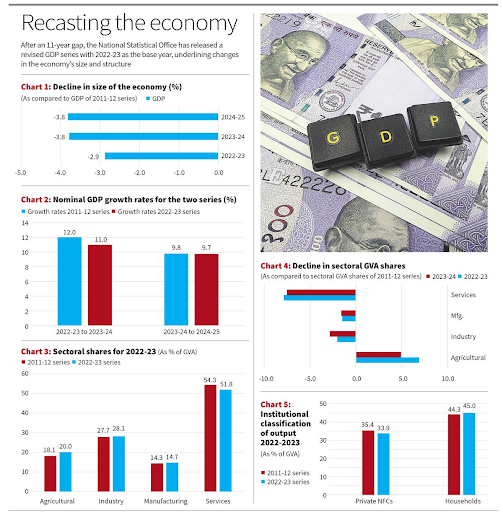
Smaller Absolute GDP Size
The absolute size of the GDP is now estimated to be about 3-4% smaller compared to the previous series. This is seen as a necessary correction of the previous overestimation.
Shifts in Economic Structure
The relative importance of different sectors has changed.
|
Sector |
Change in GDP Share |
|
Agriculture Sector |
Increased |
|
Industry Sector |
Increased |
|
Services Sector |
Declined |
|
Private Corporate Sector |
Declined (by 1.5 to 3.4 percentage points) |
|
Household / Informal Sector |
Increased |
Economic and Policy Implications
Revised Growth Targets: A smaller GDP base may delay the achievement of national goals like the five-trillion-dollar economy target.
Impact on Fiscal Ratios: Key metrics like the fiscal deficit-to-GDP and debt-to-GDP ratios will appear higher due to a smaller denominator (GDP) => limiting government spending.
Investor Confidence: More credible, transparent data, while causing short-term adjustments, can enhance long-term investor confidence in the Indian economy.
Political Implications
Restoring Credibility: This revision is an opportunity for the NSO to rebuild the credibility of India’s official statistics, which had been under question.
Reshaping Economic Narrative: The updated data provides a more realistic baseline for assessing the government's economic performance on growth, employment, and poverty reduction.
Way Forward
Ensure Methodological Transparency: The NSO must publish detailed documents on new methodologies and data sources for complete transparency and stakeholder trust.
Strengthen Data Collection: Invest in improving the data collection infrastructure, especially for the informal sector, to reduce reliance on proxies and assumptions.
Adhere to Regular Revisions: Predictable five-year cycle for base year revisions, as recommended by the UN SNA, to keep the data relevant and avoid disruptive large-scale changes.
Implement Producer Price Index (PPI): A major weakness in the old series was the use of the Wholesale Price Index (WPI) as a deflator. Implementing a comprehensive PPI will improve the accuracy of real GDP calculation.
Conclusion
The 2022-23 GDP rebasing enhances economic accuracy and transparency, providing a reliable foundation for evidence-based policymaking and restoring global confidence in the statistical system.
Source: THEHINDU
|
PRACTICE QUESTION Q. Discuss the key controversies surrounding the 2011-12 GDP series and evaluate the extent to which the new 2022-23 series addresses these concerns. (150 words) |
GDP rebasing is the process of replacing an old base year with a more recent one for calculating a country's Gross Domestic Product. It is done to ensure that the GDP figures accurately reflect the current structure of the economy, including the mix of goods and services produced and their relative prices.
The base year was revised to capture the significant structural changes in the Indian economy over the last decade, incorporate new data sources like GST, and align India's national accounting with the latest global standards (UN SNA 2025). This also aims to address the credibility issues that plagued the previous 2011-12 series.
The key changes include: a reduction in the absolute size of the GDP by 3-4%; an increased share for agriculture and industry sectors; a decline in the share of the services sector; a smaller share for the private corporate sector; and an increased share for the household/informal sector.


© 2026 iasgyan. All right reserved