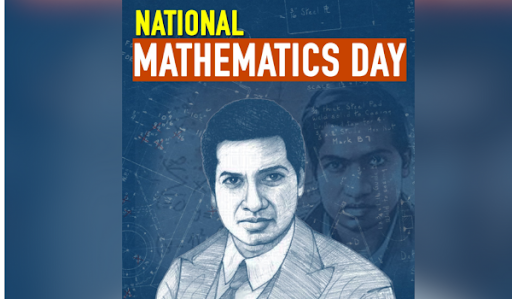
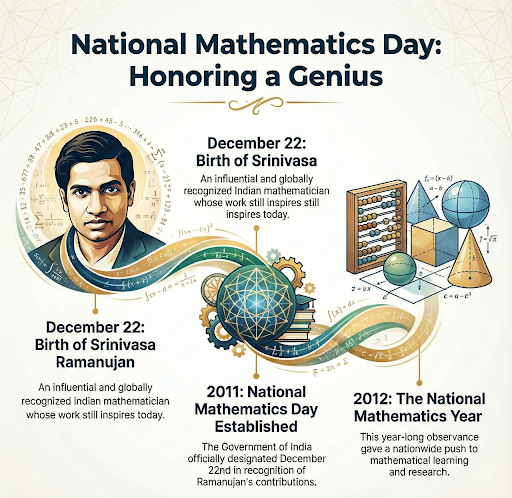
National Mathematics Day, observed on December 22, commemorates Srinivasa Ramanujan. Instituted in 2011, it highlights mathematics in science and daily life. The government also declared 2012 as National Mathematics Year to promote learning and research across India’s academics and institutions.
Copyright infringement not intended
Picture Courtesy: NEWSONAIR
National Mathematics Day is observed every year on 22nd December to commemorate the birth anniversary of Srinivasa Ramanujan.
It was declared by then-Prime Minister Dr. Manmohan Singh in February 2012, during the inaugural ceremony of the celebrations to mark Ramanujan's 125th birth anniversary.
The year 2012 was designated as the 'National Mathematics Year'.
Early Life
Srinivasa Ramanujan was a self-taught mathematical genius born in Erode, Tamil Nadu. Despite lacking formal higher education in mathematics, he developed an extraordinary grasp of the subject.
His journey was shaped by a book, "A Synopsis of Elementary Results in Pure and Applied Mathematics" by G.S. Carr, which he used as a foundation to develop his own theorems and ideas.
His work was characterized by deep intuition and pattern recognition, which he often attributed to divine inspiration.
Ramanujan-Hardy Collaboration
Ramanujan's landmark collaboration with G.H. Hardy began after Hardy, recognizing his extraordinary talent from a 1913 letter, facilitated his journey to Cambridge.
Hardy's mentorship helped Ramanujan's work gain formal recognition, culminating in his election as a Fellow of the Royal Society in 1918, making him one of the youngest and the second Indian to receive this honour.
Major Mathematical Contributions & Their Impact
Ramanujan's work, compiled in his notebooks, contained nearly 3,900 results. His contributions have had a lasting impact on several fields of mathematics and science.
Number Theory
He discovered number properties, including the partition function (ways a number is a sum of positive integers) and the Hardy-Ramanujan number, 1729, the smallest number expressible as the sum of two cubes in two different ways.
Infinite Series for Pi (π)
He developed rapidly converging infinite series for Pi. One of his formulas is now the basis for the fastest computer algorithms to calculate Pi to trillions of decimal places.
Mock Theta Functions
Discovered in the last year of his life, these were initially an enigma. Decades later, they were found to have deep connections to modern physics, including the study of black holes and string theory.
Continued Fractions
His mastery in this area was unparalleled, leading to many original results that are still studied today.
Death and Legacy
Ramanujan's health deteriorated due to England's cold climate and World War I's dietary struggles. He returned to India in 1919 and died on April 26, 1920, at age 32.
He left behind thousands of unproven results in his notebooks. His "lost notebook," rediscovered in 1976, contains many formulas that mathematicians continue to study and prove.
An international journal was established to publish research in all areas of mathematics influenced by his work.
The Man Who Knew Infinity (2015) is a movie based on Robert Kanigel's book, detailing Ramanujan's journey from India to Cambridge, his collaboration with G.H. Hardy, and his battle with prejudice and illness.
Source: NEWSONAIR
|
PRACTICE QUESTION Q. Discuss the contribution of Srinivasa Ramanujan to modern mathematics and evaluate how his work remains relevant in contemporary theoretical physics. (150 Words) |
National Mathematics Day is celebrated on December 22nd to commemorate the birth anniversary of the legendary Indian mathematician, Srinivasa Ramanujan, and to honor his extraordinary contributions to the field.
Srinivasa Ramanujan made significant contributions to mathematical analysis, number theory, infinite series, and continued fractions. His key works include developing novel infinite series for Pi, creating the "circle method" for number partitions with G.H. Hardy, and discovering "mock theta functions."
The NIPUN (National Initiative for Proficiency in Reading with Understanding and Numeracy) Bharat Mission is a government initiative launched in 2021. Its goal is to ensure every child in India achieves foundational literacy and numeracy skills by the end of Grade 3 by the year 2026-27.






© 2026 iasgyan. All right reserved