Launched in 1977, NASA’s Voyager 1 is humanity’s longest-running spacecraft. They explored the outer planets, including Jupiter and Saturn, before entering interstellar space.
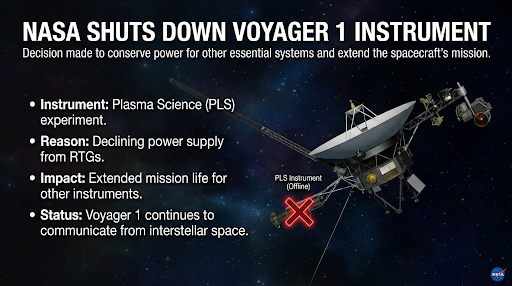
NASA deactivated Voyager 1's Plasma Science instrument to save power, aiming to extend the probe's mission till 2027.
Launched by NASA in 1977 for a five-year study of Jupiter and Saturn, Voyager 1 remains active in interstellar space.
Mission Overview and Historical Milestones
Launch and Primary Mission: Part of the Voyager program alongside Voyager 2, it utilized a rare "Grand Tour" planetary alignment that occurs once every 175 years, allowing gravity assists to visit multiple planets.
Interstellar Breakthrough (2012): In August 012, Voyager 1 became the first spacecraft to cross the Heliopause—the boundary where the solar wind is stopped by the interstellar medium—entering interstellar space.
The Pale Blue Dot (1990): Voyager 1 turned its camera back toward Earth from 6 billion km away, capturing the image that highlights Earth's vulnerability and isolation in the cosmos.
Technical Architecture: Power and Communication
Operating a spacecraft nearly 24 billion kilometres away presents unique engineering challenges.
Scientific Contributions
Current Status (2026)
The spacecraft is in "extended mission" mode. NASA has begun powering down non-essential heaters and instruments to stretch the remaining battery life, hoping to maintain communication until 2027-2030.
Source: SPACE
|
PRACTICE QUESTION Q. With reference to the powering of deep space missions like Voyager 1, consider the following statements regarding Radioisotope Thermoelectric Generators (RTGs): 1. They generate electricity by capturing solar energy using highly sensitive photovoltaic cells. 2. They rely on the heat generated from the natural radioactive decay of elements like plutonium-238. 3. ISRO has successfully collaborated with BARC to test a Radioisotope Heating Unit (RHU) for Chandrayaan-3. Which of the statements given above is/are correct? a) 1 and 2 only b) 2 and 3 only c) 1 and 3 only d) 1, 2, and 3 Answer: b Explanation: Statement 1 is Incorrect: Radioisotope Thermoelectric Generators (RTGs) do not use solar energy or photovoltaic cells. Instead, they use a "thermocouple" to convert heat directly into electricity through the Seebeck effect. Statement 2 is Correct: RTGs rely on the thermal energy produced by the natural radioactive decay of unstable isotopes. Plutonium-238 is the preferred fuel because of its long half-life (87.7 years) and high heat density, providing reliable power for decades. Statement 3 is Correct: In a significant step toward deep-space autonomy, ISRO, in collaboration with the Bhabha Atomic Research Centre (BARC), successfully tested a 1-watt Radioisotope Heating Unit (RHU) on the Propulsion Module of Chandrayaan-3. This technology is a precursor to full-scale Indian RTGs for future planetary missions. |
Launched by NASA in 1977, Voyager 1 is a deep-space probe originally intended to study Jupiter and Saturn. It is now the most distant human-made object, operating in interstellar space nearly 24 billion kilometers from Earth.
Because solar panels are useless in the darkness of deep space, Voyager 1 uses Radioisotope Thermoelectric Generators (RTGs). These devices generate electricity by converting the heat released from the natural radioactive decay of plutonium-238.
The heliopause is the boundary where the solar wind emitted by our Sun is stopped by the interstellar medium. Voyager 1 became the first human-made object to cross this boundary into interstellar space in August 2012.






© 2026 iasgyan. All right reserved