Copyright infringement not intended
Picture Courtesy: PIB
Context:
Indian Railways is undergoing a major safety transformation to manage rising traffic density and higher speeds. The indigenous Automatic Train Protection (ATP) system Kavach, along with AI-based monitoring and predictive technologies, is creating a modern safety ecosystem.
What is Kavach?
Kavach is an indigenously developed, Safety Integrity Level-4 (SIL-4) certified Automatic Train Protection (ATP) system designed by the Research Designs and Standards Organization (RDSO) to enhance operational safety on Indian Railways. It provides continuous real-time in-cab signaling to the loco pilot, displaying critical operational information such as movement authority, target speed, distance to go, and signal aspects, thereby improving situational awareness. The system prevents Signal Passing at Danger (SPAD) and automatically applies brakes whenever a train exceeds permitted speed, approaches a danger signal, or enters a potentially unsafe operating condition. By enabling automatic intervention, Kavach protects trains from head-on, rear-end, and side collisions while ensuring safe operations even at speeds exceeding 120 kmph and under adverse visibility conditions such as fog.
Kavach has been implemented on more than 2,200 route kilometres across the Indian Railways network, with Kavach 4.0 currently operational on approximately 1,306 route kilometres across five railway zones. The upcoming Kavach 5.0 is being developed to meet the requirements of high-frequency suburban operations and is envisaged to be integrated into the advanced safety framework of future Vande Bharat 4.0 trains.
Key components of the Kavach System:
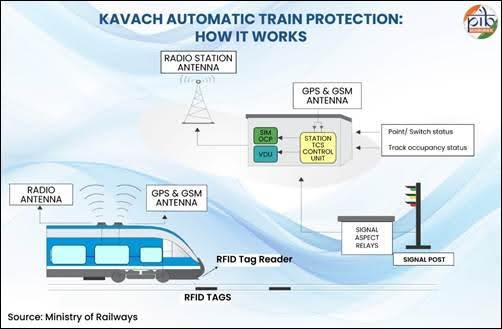
- Onboard equipment (Locomotive Unit): The onboard Kavach unit is installed in the locomotive and continuously monitors train speed, location, and movement authority while displaying real-time operational information such as target speed, distance to go, and signal aspects to the loco pilot. It also computes braking curves and automatically applies brakes when unsafe conditions such as overspeeding, SPAD, or collision risk are detected.
- Trackside equipment (RFID and Radio Infrastructure): Track-mounted RFID tags provide precise train location data at fixed intervals, while Ultra High Frequency (UHF) radio communication towers enable secure, continuous data exchange between the train and ground systems, ensuring real-time situational awareness.
- Station equipment (Wayside Interface Unit): The station-based or wayside unit interfaces with the existing interlocking system to collect critical operational data such as signal aspects, track occupancy, route status, and point positions, and uses this information to calculate and transmit safe movement authority to the train.
- Centralized monitoring system (Network Management System – NMS): All operational events and system data are transmitted to a central control facility through the Network Management System, enabling real-time monitoring, diagnostics, performance analysis, and coordinated traffic management across the railway network.
- Communication backbone: The system is supported by optical fibre communication networks, secure authentication protocols, and reliable power arrangements to ensure uninterrupted and fail-safe operation under diverse field conditions.
Significance of Kavach:
- Addressing limitations of human-dependent operations: The significance of Kavach arises from the fact that traditional train operations on Indian Railways relied primarily on trackside signaling and manual control, where safe movement depended heavily on the loco pilot’s ability to observe line-side signals and regulate speed, making the system vulnerable to human error, missed signals, and misjudgment, which have historically contributed to serious accidents.
- Improving situational awareness and in-cab information: Conventional signaling systems did not provide in-cab information on permitted speed, distance to go, precise train location, or track profile, while signal visibility was often affected by track curvature, obstructions, and adverse weather conditions, leading to limited reaction time and operational uncertainty, especially at higher speeds.
- Enhancing safety in high-density and high-speed operations: With increasing traffic density and the need to operate trains at higher speeds, larger safety margins and block spacing were required under conventional systems, which reduced network capacity and increased operational risk, making continuous monitoring and automatic enforcement of movement authority essential.
- Reducing risks from SPAD and Low Visibility Conditions: Frequent fog and low-visibility conditions, particularly in Northern India, along with the persistent challenge of Signal Passing at Danger (SPAD), highlighted the need for a system that could provide real-time alerts and automatic intervention to prevent unsafe operations.
- Enabling continuous monitoring and automatic intervention: As an Automatic Train Protection (ATP) system, Kavach continuously monitors train location, speed, and movement authority and automatically applies brakes when safety parameters are violated, thereby reducing dependence on manual observation and improving operational discipline.
Picture Courtesy: PIB
Evolution of Kavach:
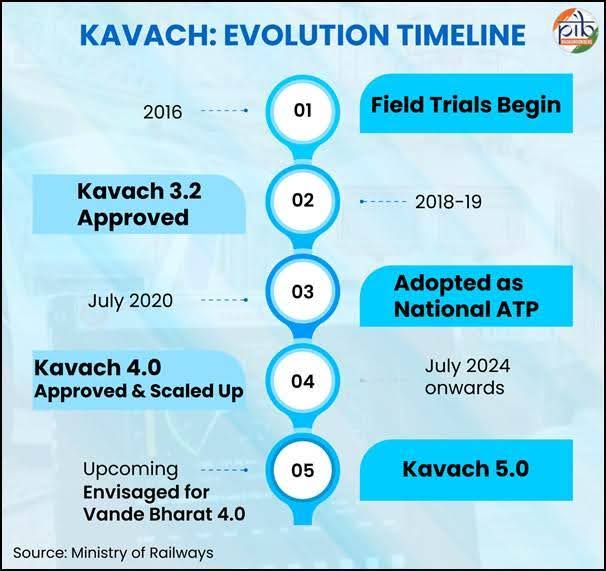
- Field Trials (2016): The evolution of Kavach began with initial field trials on passenger trains in February 2016 to test the system under real operating conditions and assess its safety, reliability, and operational suitability for India’s diverse railway environment.
- Vendor Approval (2018–19): Based on operational experience and Independent Safety Assessment (ISA), standardized specifications were finalized and three firms were approved during 2018–19 for the supply of Kavach Version 3.2, enabling multi-vendor participation and laying the foundation for large-scale implementation.
- System Expansion: With deployment covering more than 1,465 route kilometres on the South Central Railway, the system underwent continuous refinement and technological upgrades, leading to improved functionality, interoperability, and enhanced suitability for wider application across high-density and mixed-traffic routes.
- National Adoption (2020): Recognizing its operational effectiveness and indigenous capability, Kavach was adopted as the National Automatic Train Protection (ATP) system in July 2020, following which implementation expanded to include trackside equipment, station interfaces, onboard locomotive units, and supporting telecommunication and optical fibre infrastructure to ensure reliable operation.
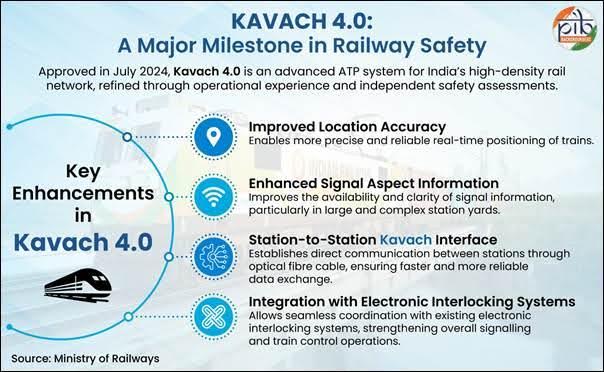
- Kavach 4.0 (2024): Continuous improvements based on field feedback and safety evaluations culminated in the approval of Kavach Version 4.0 in July 2024, marking a major technological milestone with enhanced performance, higher reliability, and certification to global safety standards, making it suitable for large-scale deployment across India’s high-density network.
- Kavach 5.0 (2025 onwards): Building on these advancements, the upcoming Kavach 5.0, announced in April 2025, is being developed specifically for suburban and high-frequency corridors, where it is expected to reduce inter-train headway and increase operational capacity, and is envisaged to be integrated into future Vande Bharat 4.0 trains as part of their advanced safety and technology framework.
Picture Courtesy: PIB
How AI and technology led signalling and telecom measures improve railway safety?
- Real-time risk detection: AI-enabled systems such as Intrusion Detection using Distributed Acoustic Sensing help identify the presence of wild animals, trespassers, or obstacles on tracks and generate real-time alerts to loco pilots and control centres, enabling timely preventive action and reducing collision risks.
- Enhanced station and passenger security: AI-based Video Surveillance Systems with video analytics and facial recognition improve safety at railway stations by automatically detecting suspicious activities such as intrusion, unattended objects, or loitering, thereby strengthening preventive security and emergency response.
- Predictive maintenance of assets: AI-driven monitoring tools such as Online Monitoring of Rolling Stock (OMRS), Wheel Impact Load Detectors (WILD), and Machine Vision Inspection Systems help detect defects in wheels, bearings, and other components at an early stage, allowing maintenance to be carried out before failures occur and preventing accidents caused by equipment malfunction.
- Continuous track and infrastructure monitoring: Advanced inspection technologies, including ultrasonic rail testing, track geometry monitoring, and digital asset management systems, enable continuous assessment of track health, early detection of structural defects, and data-driven maintenance planning to ensure safe train movement.
- Reliable communication for train operations: Modern digital communication systems such as Digital VHF, tunnel communication networks, and an expanded optical fibre backbone ensure uninterrupted voice and data connectivity between loco pilots, guards, and control centres, which is critical for safe and coordinated train operations.
- Improved operations in adverse conditions: Technologies such as GPS-based Fog Safety Devices, thermal imaging, and automated alerts help loco pilots navigate safely during low-visibility conditions, reducing the likelihood of operational errors.
- Network wide monitoring and decision support: Integrated digital platforms enable centralized, real-time monitoring of train movements and system performance, allowing faster decision-making, better traffic management, and coordinated response during emergencies.
Challenges in implementing AI and technology led signalling and telecom for railway safety:
- High cost: The large-scale deployment of AI-enabled surveillance, predictive maintenance systems, and modern signaling infrastructure requires significant financial resources, even though safety expenditure has increased to about ₹1.17 lakh crore in 2025–26, reflecting the heavy capital burden of technology-led modernization across one of the world’s largest rail networks.
- Integration with legacy infrastructure: Indian Railways operates over 68,000 route kilometres with diverse signalling technologies, and integrating advanced AI systems with older mechanical, relay-based, and electronic interlocking systems creates technical complexity and operational challenges.
- Skilled manpower: The operation of AI-driven analytics, digital signalling, and centralized monitoring systems requires trained personnel in data analysis, electronics, and cybersecurity, while the scale of the network with over 13,000 trains running daily demands continuous capacity building and technical training.
- Connectivity gaps: Reliable real-time data transmission remains difficult in remote, forested, hilly, and tunnel sections, despite the expansion of the optical fibre network to around 67,000 route kilometres, affecting the performance of communication-dependent safety systems.
- Data overload: AI based systems such as Video Surveillance at 1,731 stations and multiple wayside monitoring technologies generate massive volumes of operational data, making filtering, prioritization, and real-time decision-making a major challenge for control centres.
- Cyber risk: As railway operations become increasingly digital and network-dependent, the risk of cyberattacks, data breaches, and system disruptions increases, requiring robust cybersecurity architecture to protect critical safety infrastructure.
- Maintenance burden: Advanced equipment such as sensors, cameras, RFID tags, and wayside detectors requires regular calibration, maintenance, and periodic replacement, increasing lifecycle costs and operational workload across the network.
Future strategy for railways safety:
- Faster rollout: The expansion of Kavach and AI-based safety systems should be accelerated on the High-Density and Highly Used Networks, which carry nearly 96% of total railway traffic, to maximize safety impact and operational efficiency.
- Focus on priority corridors: Implementation should be completed at the earliest on major routes such as the Delhi–Mumbai and Delhi–Howrah corridors, where higher speeds of up to 160 kmph and closer train operations increase operational risk.
- Capacity building: Continuous training and skill development programs are needed for railway personnel to handle advanced signalling, AI analytics, cybersecurity, and digital system maintenance across the network.
- Integrated traffic management: The development of unified, real-time traffic management and decision-support platforms can help optimize train operations, reduce congestion, and enable faster response to operational disruptions.
- Strengthening communication: Further expansion and redundancy of the optical fibre and digital communication network will ensure reliable real-time data exchange, particularly in remote, tunnel, and difficult terrain sections.
- Indigenous manufacturing: Promoting domestic production of Kavach equipment, sensors, and digital signalling systems under the Atmanirbhar Bharat initiative will reduce costs, ensure supply stability, and support large-scale deployment.
- Standardization: Uniform technical standards, interoperability protocols, and strong vendor coordination mechanisms are essential to ensure seamless functioning of multi-vendor systems across different railway zones.
Conclusion:
With the expansion of Kavach and the adoption of AI-enabled signaling and telecom systems, Indian Railways is moving toward a safer, smarter, and more resilient operational framework. These technologies are reducing human error, enabling real-time monitoring, and supporting higher-speed and high-density operations while strengthening infrastructure reliability. Sustained investment, faster implementation, and capacity building will be crucial to scale these innovations across the network and ensure a future-ready railway system that prioritizes safety, efficiency, and indigenous technological capability.
Source: PIB
|
Practice Question
Q. Indigenous technologies such as Kavach and AI-enabled systems are transforming railway safety in India. Discuss. (250 Words)
|
Frequently Asked Questions (FAQs)
Kavach is an indigenously developed Automatic Train Protection (ATP) system of Indian Railways that provides real-time in-cab signalling and automatically applies brakes to prevent Signal Passing at Danger (SPAD), over-speeding, and train collisions.
Kavach is certified to Safety Integrity Level-4 (SIL-4), which is among the highest global safety standards for railway signaling systems.
Kavach addresses limitations of human-dependent operations by providing continuous monitoring, improving situational awareness, preventing human error, and enabling safe operations in high-speed, high-density, and low-visibility conditions.