Softshell turtles are leathery-shelled freshwater scavengers vital for river health. Protected under Schedule I, they face threats from habitat loss and illegal trade in calipee. Species like Leith’s are critically endangered, requiring urgent conservation across Indian river basins.
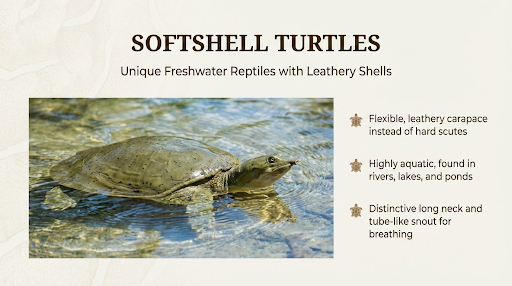
A rare softshell turtle was discovered at 2,950 feet in Bageshwar, Uttarakhand, a higher altitude than its usual habitat.
Softshell turtles (Family Trionychidae) are unique freshwater reptiles characterized by the absence of the hard, bony scales (scutes) found on other turtles.
They possess a leathery, flattened shell that allows them to swim faster and hide in the muddy bottoms of rivers and lakes.
Features
Anatomy: They have long, snorkel-like snouts and webbed feet with three claws.
Habitat: Primarily found in the freshwater systems of the Indo-Gangetic plain, the Brahmaputra basin, and the Mahanadi river.
Behavior: Known as "ambush predators," they bury themselves in sand or mud to surprise prey such as fish, crustaceans, and mollusks.
Diet: As omnivorous scavengers, they consume fish, mollusks, and frogs, but more importantly, they feed on rotting vegetation and animal carcasses.
Ecosystem Significance
Water Purifiers: By consuming carrion (dead animals), they prevent the spread of diseases in river systems.
Nutrient Cycling: Their movement and feeding habits help stir bottom sediments, aiding in nutrient oxygenation for the aquatic floor.
Indicator Species: Their presence or absence indicates the health of the riverbed and the level of pollution in the water.
|
Species |
Conservation Status (IUCN) |
WPA, 1972 Schedule |
Details |
|
Leith’s Softshell Turtle |
Critically Endangered |
Schedule IV |
Endemic to peninsular India (Mahanadi, Godavari, Krishna rivers). |
|
Indian Softshell Turtle |
Endangered |
Schedule I |
Found in major northern Indian rivers; heavily targeted by poachers. |
|
Black Softshell Turtle |
Critically Endangered |
Schedule I |
Historically found in the Brahmaputra; now mostly survives in temple ponds of Assam and Bangladesh. |
Major Threats
Illegal Wildlife Trade: Softshell turtles are heavily trafficked for their meat (calipee) and cartilage, particularly to East Asian markets where they are considered a delicacy or used in traditional medicine.
Habitat Degradation: Sand mining, dam construction, and river pollution destroy their nesting sites and diminish their food supply.
Bycatch: Entanglement in fishing nets remains a silent killer in the Ganges and Brahmaputra basins.
Source: HINDUSTANTIMES
|
PRACTICE QUESTION Q. The illegal trade of "Calipee" is associated with which of the following animals? A) Sea Cucumbers B) Softshell Turtles C) Pangolins D) Star Tortoises Answer: B Explanation: The illegal trade of "Calipee" is associated with B) Softshell Turtles. Calipee is a cartilaginous, jelly-like, yellow substance found inside the lower shell (plastron) and along the edges of the shell (carapace) of turtles. |
Unlike other chelonians, softshell turtles lack hard, keratinized epidermal plates (scutes). Instead, they feature a flattened, leathery carapace that reduces drag in the water. They also have snorkel-like snouts and heavily webbed feet, allowing them to remain submerged in deep waters while breathing.
The 'Calipee' trade involves the illegal poaching of turtles for the yellowish, gelatinous cartilaginous tissue found inside their lower shell. Traffickers smuggle this dried tissue to East Asian markets for use
'Operation Save Kurma' is a pan-India law enforcement initiative launched by the Wildlife Crime Control Bureau (WCCB) to dismantle organized turtle smuggling syndicates. The operation successfully seized over 15,000 live turtles and led to multiple arrests, earning the WCCB an award from the UNEP.



© 2026 iasgyan. All right reserved