India-UK Offshore Wind Taskforce, Offshore Wind Energy, Viability Gap Funding, UPSC GS 3, Contracts for Difference, National Green Hydrogen Mission, Renewable Energy Infrastructure, Vision 2035, India-UK Relations
Copyright infringement not intended
Picture Courtesy: DOWNTOEARTH
Context
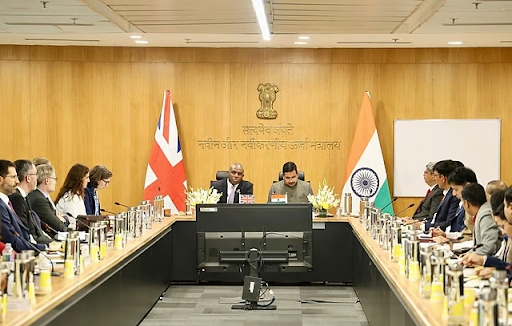
India and the UK launched the India-UK Offshore Wind Taskforce, pairing the UK's technical expertise with India's market potential in offshore wind.
|
Read all about: India-UK Relations l India-UK FTA 2025: Key Trade Deal |
What is the India-UK Offshore Wind Taskforce?
The Taskforce was officially launched in February 2026, as a strategic collaboration to accelerate the development of India's nascent offshore wind sector.
It operates under the India-UK Vision 2035 and the Fourth Energy Dialogue framework. It provides measurable progress through three priority pillars:
What is Offshore Wind?
Offshore wind generates electricity using turbines over large bodies of water, primarily the ocean. These turbines convert the stronger, more consistent kinetic energy of sea breezes into clean, renewable power.
How It Works?
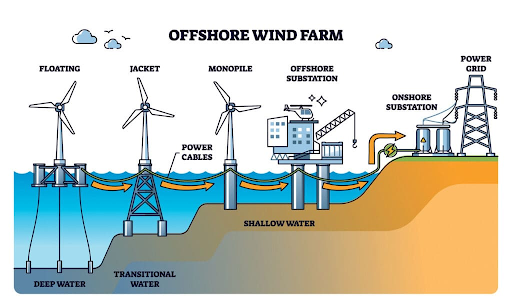
Offshore winds are more reliable and stronger because they are not obstructed by buildings or hills.
Strategic Importance of Offshore Wind for India
Offshore wind is key to India's goals of 500 GW non-fossil fuel capacity by 2030 and Net Zero by 2070. India's 7,600 km coastline offers over 70 GW potential, mainly off Gujarat and Tamil Nadu.
Higher Efficiency and Reliability
Offshore winds are stronger and more consistent, offering a Capacity Utilisation Factor (CUF) of up to 50–55%, which is higher than the 30–35% for onshore wind, providing more reliable "round-the-clock" (RTC) power. (Source: National Institute of Wind Energy)
Overcoming Land Constraints
By moving projects to the sea, India can bypass the challenges and delays associated with land acquisition for large-scale renewable energy projects.
Energy Security
Developing domestic offshore resources reduces reliance on imported fossil fuels and enhances energy independence.
Synergy with Green Hydrogen
Offshore wind provides high-quality renewable power directly to coastal industrial clusters, essential for meeting the goals of the National Green Hydrogen Mission.
Meeting Energy Security Targets
India's non-fossil fuel capacity surpassed 270 GW by early 2026. Offshore wind is the next major focus for continued growth and energy security. (Source: PIB)
Blue Economy Integration
It drives coastal economic growth by creating specialized jobs in marine logistics, port modernization, and underwater infrastructure
Government Initiatives and Policy Framework
Viability Gap Funding (VGF): The Union Cabinet approved a ₹7,453 crore scheme to make early offshore projects financially viable, including ₹600 crore specifically for upgrading two ports to support marine operations.
Bidding Trajectory: India plans to auction 37 GW of offshore site leases by FY 2030. The first 4 GW tender for sites off Tamil Nadu was initiated under a multi-model approach.
India-UK Offshore Wind Taskforce: Launched in February 2026, this "trustforce" leverages UK expertise in large-scale offshore markets to accelerate India's ecosystem development.
Transmission Incentives: A 25-year waiver on inter-state transmission system (ISTS) charges is provided for projects commissioned before 2032 to lower the Levelised Cost of Electricity (LCOE).
What are the Challenges Facing the Offshore Wind Sector?
High Initial Costs
Capital expenditure for offshore wind is estimated to be 2–3 times higher than onshore wind due to specialized foundations, subsea cabling, and complex marine logistics.
Infrastructure Gaps
India currently lacks the dedicated specialized vessels and port facilities required for large-scale offshore turbine assembly and installation.
Environmental & Livelihood Impacts
Projects must navigate complex approvals related to marine ecosystems, migratory bird routes, and potential disruptions to artisanal fishing communities.
Prohibitive Costs
Without subsidies, the cost of offshore wind power (approx. Rs 8/kWh) is higher than solar (Rs 2.5/kWh) or onshore wind (Rs 3/kWh), making it unviable for DISCOMs. (Source: CRISIL Report)
Technical Complexity
The harsh marine environment, with challenges like saltwater corrosion and cyclones, requires highly robust and advanced technology.
Way Forward
Localize Manufacturing
Utilize schemes like the Production Linked Incentive (PLI) to build a domestic supply chain for turbines, foundations, and subsea cables, to reduce costs and create jobs.
Operationalize Blended Finance
Utilize the India-UK Offshore Wind Taskforce to secure low-cost international climate finance, blending it with public and private funds to de-risk projects and lower high initial capital expenditure.
Focus on Execution
Ensure timely and successful deployment of initial pilot projects off Gujarat and Tamil Nadu coasts to strengthen regulatory and operational models.
Learn from Global Best Practices
The UK's 'Contracts for Difference' (CfD) model reduced offshore wind costs (by nearly 70%). It guarantees producers a fixed 'strike price,' ensuring revenue certainty.
The UK developed industrial clusters, like the Humber region, combining manufacturing, port logistics, and skilled labor to boost efficiency and cut costs.
Conclusion
Developing offshore wind is a strategic opportunity for India, not just for clean energy, but also to boost industrial competitiveness and become a global hub for manufacturing and services in the offshore wind sector.
Source: DOWNTOEARTH
|
PRACTICE QUESTION Q. Discuss the strategic significance of offshore wind energy in achieving India’s energy security. 150 words |
Onshore wind refers to turbines located on land, while offshore wind refers to turbines placed in bodies of water, usually the ocean. Onshore is generally cheaper to install and maintain, whereas offshore provides stronger, more consistent, and higher-capacity power generation due to fewer surface obstacles.
The taskforce, described as a "Trustforce," aims to fast-track the deployment of offshore wind energy in India by leveraging UK expertise in ecosystem planning, supply chain infrastructure, and financing under the Vision 2035 framework.
It is a UK model where the government guarantees a fixed price for electricity to producers. If the market price falls below this, the government pays the difference, ensuring revenue certainty for developers and reducing investment risk.



© 2026 iasgyan. All right reserved