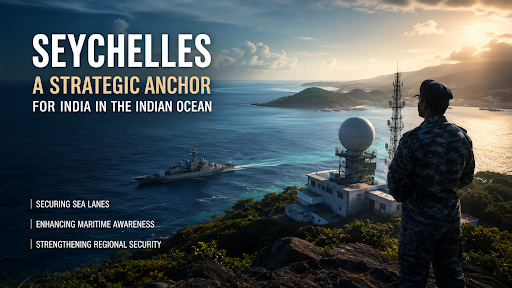
Prime Minister Modi's 2026 state visit to Seychelles marked 50 years of diplomatic ties, resulting in the $175M Joint Vision SESEL. This operationalizes India's Vision MAHASAGAR, focusing on Western Indian Ocean maritime security, the Blue Economy, coastal surveillance, and countering geopolitical challenges.
Why In News?
Prime Minister Narendra Modi’s state visit to Seychelles from June 27–29, 2026, marks the 50th anniversary of diplomatic relations and operationalizes India's Vision MAHASAGAR.
What is Vision MAHASAGAR?
MAHASAGAR (Mutual and Holistic Advancement for Security and Growth Across Regions) is India’s evolved maritime vision for the Global South, succeeding the 2015 SAGAR doctrine to prioritize mutual security, sustainable ocean governance, and equitable economic cooperation.
Technological Shift: The vision integrates Underwater Domain Awareness (UDA), moving beyond surface-level tracking to three-dimensional, data-driven ocean management using acoustic fingerprinting and real-time surveillance.
Regional Role: India acts as the net security provider and first responder in the Indian Ocean Region (IOR), championing a decentralized, climate-resilient supply chain.
About Seychelles
Location: Seychelles is an archipelagic Large Ocean State comprising 115 islands in the southwestern Indian Ocean.
Demographics: It remains Africa’s smallest nation by population with approximately 130,000 residents and a high nominal per capita GDP exceeding $21,600.
Maritime Scale: Despite a landmass of 452 square kilometers, it commands an Exclusive Economic Zone (EEZ) of 1.37 million square kilometers.
Blue Economy Leadership: Seychelles launched the world’s first sovereign Blue Bond in 2018 and utilizes debt-for-nature swaps to protect nearly one-third of its EEZ.
Strategic Importance of Seychelles for India
Geostrategic Vantage: The nation sits at the Mozambique Channel, providing a critical observation point for the Western Indian Ocean.
Trade Security: Seychelles commands primary Sea Lanes of Communication (SLOCs) connecting the Gulf of Aden with Southern Africa, through which over two-thirds of global oil shipments transit.
Security Node: India utilizes Seychelles as a base to deploy radar systems and aircraft to combat Illegal, Unreported, and Unregulated (IUU) fishing and transnational organized crime.
India–Seychelles Relations
Historical Ties: Roots trace back to the 1770s, with Seychelles previously administered from the Bombay Presidency. India established diplomatic relations immediately upon Seychelles' independence in 1976.
Defence Framework: The relationship relies on the 2003 MoU on Defence Cooperation. India conducts the biennial tri-service Exercise LAMITYE, which completed its 11th edition in March 2026.
Capacity Building: India trains over 1% of the total Seychellois population via the Indian Technical and Economic Cooperation (ITEC) programme, the highest per-capita rate globally.
Development Partnerships: The 2026 $175 million Special Economic Package—comprising a $125 million Line of Credit and a $50 million grant—funds projects in housing, e-mobility, renewable energy, and fintech.
Maritime Security Cooperation
Surveillance Grid: India has integrated six Coastal Surveillance Radar (CSR) systems across Seychelles, linking them to India’s Information Management and Analysis Centre (IMAC) to monitor a 7,500-kilometer regional grid.
Operational Interoperability: Seychelles participates in India-led engagements like MILAN and PRAGATI.
Domain Awareness: The Information Fusion Centre-Indian Ocean Region (IFC-IOR) maintains an MoU with Seychelles’ Regional Coordination Operations Centre (RCOC) to synthesize white shipping data.
Challenges
Strategic Competition: China employs "chequebook diplomacy" through projects like the La Gogue Dam and media facilities to advance its Belt and Road Initiative.
Infrastructure Hurdles: Domestic political opposition stalled the Assumption Island military base project, limiting India’s ability to expand hard military infrastructure.
Climate Vulnerability: Small Island Developing States (SIDS) face existential threats from ocean acidification and cyclones, which strain local coastal guard capacities.
Security Risks: A resurgence in armed piracy, combined with dark shipping and sabotage of undersea infrastructure, challenges conventional tracking networks.
Way Forward
Advanced Defence: India must accelerate the deployment of AI-driven predictive sonar to transition from Maritime Domain Awareness (MDA) to Underwater Domain Awareness (UDA).
Connectivity: Both nations should scale direct flight networks and establish specialized maritime logistics hubs for SMEs.
Blue Economy Advocacy: India must fast-track technical assistance for Multi-Hazard Early Warning Systems and advocate for the Multidimensional Vulnerability Index (MVI) at international financial institutions.
Source: ECONOMICTIMES
|
PRACTICE QUESTION Q. Consider the following statements regarding the geographical location and features of the Seychelles:
Which of the statements given above is/are correct? A) 1 and 2 only B) 1 and 3 only C) 2 and 3 only D) 1, 2, and 3 Answer: D Explanation: Statement 1 is correct: The Seychelles archipelago lies entirely in the Southern Hemisphere. Statement 2 is correct: Geographically, the Seychelles is situated in the western Indian Ocean. It is situated west of the Maldives. Statement 3 is correct: The Seychelles features a unique geological composition. It is an archipelago composed of both granitic islands (mountainous, rocky inner islands like Mahé and Praslin) and coralline islands (flat coral atolls and reefs making up the outer islands). |
Vision MAHASAGAR is a high-level maritime security and cooperative outreach initiative launched by the Indian Navy to foster collective, multi-national security and growth through active dialogue among heads of navies and maritime agencies across the Indian Ocean Region (IOR).
Seychelles is a critical strategic partner for India because it sits directly along crucial global sea lines of communication, hosts key maritime surveillance infrastructure, and serves as a vital security anchor in the Western Indian Ocean to counter regional piracy and external military expansion.
While the overarching SAGAR (Security and Growth for All in the Region) policy serves as India's broad geopolitical and diplomatic vision for the entire maritime neighborhood, MAHASAGAR is a specialized, Navy-led operational mechanism that converts that philosophy into active, institutionalised naval cooperation and real-time security coordination.
The Indian Ocean is globally critical because it carries over one-third of the world’s bulk cargo traffic and two-thirds of global oil shipments, serves as the primary maritime highway connecting the Atlantic and Pacific oceans, and acts as a central arena for competitive geopolitical influence among major world powers.

© 2026 iasgyan. All right reserved