The Kimberley Process faces a relevance crisis due to its narrow mandate and paralysis over Russia. As chair in 2026, India can drive reforms by expanding the definition of conflict diamonds, modernising governance, and restoring credibility to ensure an ethical global diamond trade.
Copyright infringement not intended
Picture Courtesy: tribuneindia
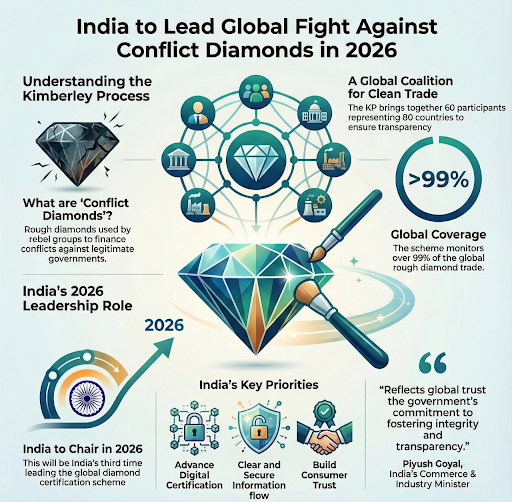
India has been selected to chair the Kimberley Process (KP) for a one-year term starting January 1, 2026. This is India's third chairmanship, following 2008 and 2019.
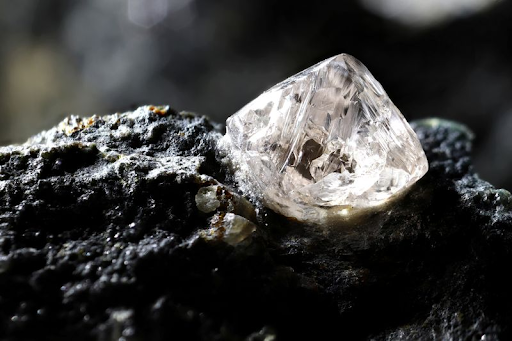
The Kimberley Process (KP) is an international, multi-stakeholder initiative created to prevent the trade of ‘conflict diamonds’ or ‘blood diamonds’.
It was established in 2003, to ensure that diamond purchases do not finance violence by rebel movements and their allies seeking to undermine legitimate governments.
It operates as a tripartite coalition, bringing together governments, the diamond industry, and civil society to stop the flow of conflict diamonds into the global market.
As of 2025, the KP has 60 participants (representing 86 countries, with the EU and its members counting as one) that account for about 99.8% of global rough diamond production.
The primary tool of the Kimberley Process is the Kimberley Process Certification Scheme (KPCS), which came into effect on January 1, 2003.
This scheme imposes extensive requirements on its members to certify shipments of rough diamonds as ‘conflict-free’ and prevent conflict diamonds from entering the legitimate trade.
Key Requirements of KPCS:
India is a founding member of the Kimberley Process Certification Scheme (KPCS).
India will serve as the Chair of the Kimberley Process for the 2026 calendar year, beginning January 1. This marks India's third time leading the body, following tenures in 2008 and 2019.
India processes nearly 90% of the world's rough diamonds, making its participation in the KPCS vital for global supply chain integrity.
The Department of Commerce is the main government body, and the Gem & Jewellery Export Promotion Council (GJEPC) issues Kimberley Process Certificates as the authorized importing/exporting authority.
Source: THE HINDU
|
PRACTICE QUESTION Q. Consider the following statements about the Kimberley Process (KP): 1. It is a tripartite body comprising governments, industry, and civil society. 2. India was a founding member. 3. All decisions within the KP are made based on a majority voting system to ensure efficiency. Which of the statements given above is/are correct? A) 1 and 2 only B) 2 and 3 only C) 1 and 3 only D) 1, 2 and 3 Answer: A Explanation: Statement 1 is correct: The Kimberley Process (KP) is a tripartite initiative that unites three distinct pillars: governments (participants), the diamond industry, and civil society organizations (observers). Statement 2 is correct: India is a founding member (or founding participant) of the Kimberley Process. India has played a leading role since its inception in 2003 and has chaired the body multiple times, including in 2008, 2019, and will do so again in 2026. Statement 3 is incorrect: Decisions within the Kimberley Process are made by consensus, not by a majority voting system. |
The Kimberley Process is a multi-stakeholder international initiative established in 2003. It brings together governments, the diamond industry, and civil society to prevent the trade of "conflict diamonds" or "blood diamonds"—rough diamonds used by rebel movements to finance wars against legitimate governments.
The KPCS is the regulatory framework of the Kimberley Process. It requires member countries to certify that shipments of rough diamonds are 'conflict-free'. Under the scheme, all cross-border shipments must be in tamper-proof containers, be accompanied by a government-validated KP Certificate, and trade is only permitted between KP participants.
India is a central player in the global diamond trade. It is the world's largest cutting and polishing hub, processing around 90% of the world's rough diamonds. The industry is a significant contributor to India's exports and employment.


© 2026 iasgyan. All right reserved