Marking 75 years of ties, India and Jordan are upgrading relations to a strategic partnership. Jordan’s stability, role in the Aqaba Process, and IMEC potential matter for India. Fertiliser trade anchors ties, while defence, energy, and connectivity will drive future cooperation.
Copyright infringement not intended
Picture Courtesy: PIB
As part of a three-nation tour, Prime Minister Narendra Modi made his first full-fledged bilateral visit to Jordan.
Five Memoranda of Understanding (MoUs) and Agreements Signed:
India and Jordan share a robust partnership built on decades of goodwill, mutual respect, and converging strategic interests.
High-level visits, including by King Abdullah II to India (2018) and PM Narendra Modi to Jordan (transit in 2018), have provided momentum to the partnership.
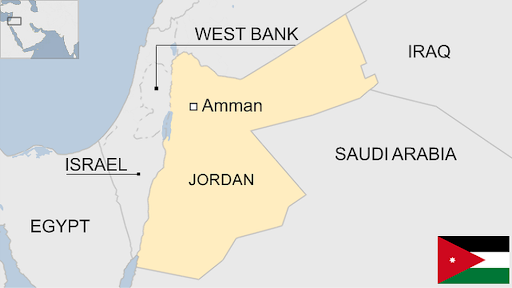
Highlights of the Bilateral Relationship
|
Indicator |
Details |
|
Diplomatic Relations |
Established in 1950. 2025 marks the 75th anniversary. |
|
Bilateral Trade (2023-24) |
$2.875 billion (India is Jordan's 4th largest trading partner). India’s exports to Jordan amount to $1,465 billion. |
|
Trade Target |
Double trade to $5 billion in the next five years. |
|
Indian Diaspora |
Around 17,500 nationals, mainly in textiles, construction, and manufacturing sectors (Source: Embassy of India). |
Geopolitical Bridge in West Asia
Jordan's status as a stable, moderate monarchy with peaceful relations with its neighbors, including Israel, allows India to engage with multiple regional actors.
It acts as a crucial link in India's "Link West" policy without getting evolved in sectarian regional conflicts.
Fertilizer and Food Security
Jordan is a leading supplier of phosphates and potash fertilizers for India.
The Jordan India Fertiliser Company (JIFCO), a joint venture between Indian Farmers Fertiliser Cooperative (IFFCO) and Jordan Phosphate Mines Company (JPMC), ensures a steady supply of phosphoric acid to India.
Counter-Terrorism and Security
An MoU on Defence Cooperation was signed in 2018, for military exchanges, training, and intelligence sharing.
Jordan's King Abdullah II launched the Aqaba Process in 2015, a counter-terrorism initiative and multilateral forum to coordinate global anti-extremism strategies.
Connectivity & Regional Hub
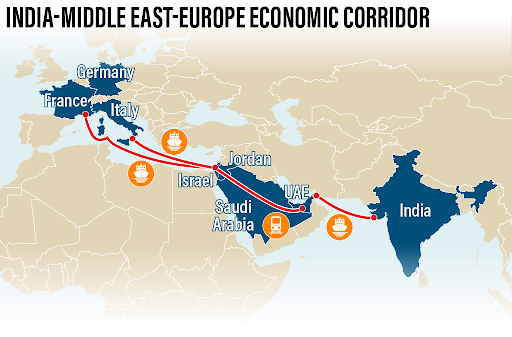
Jordan is a key node in the proposed India–Middle East–Europe Economic Corridor (IMEC), positioning it as a strategic land bridge and logistics hub connecting Asia to Europe.
Technology and Capacity Building:
Trade and Economy
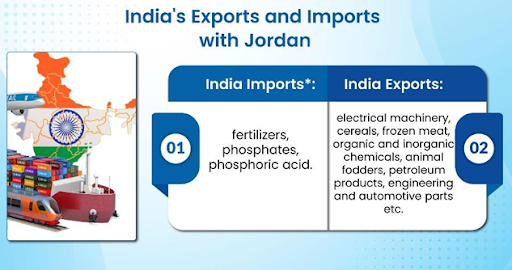
Bilateral trade stood at $2.875 billion in 2023-24. India's exports include engineering goods, cereals, and petroleum products, while its primary imports are fertilizers (phosphates and potash) and phosphoric acid.
Trade Concentration: The trade basket is narrow, heavily dependent on fertilizers from Jordan and a few select commodities from India.
Regional Instability: The volatile security situation in West Asia impacts investor confidence and long-term economic planning.
Connectivity Gaps: Limited direct flight connectivity restricts the full potential for tourism and business exchanges, although new direct flights have been initiated.
Economic Headwinds in Jordan: Jordan faces domestic economic challenges, including high unemployment, which can limit the scope for deeper bilateral economic expansion.
Diversify Economic Basket: Focus on new sectors like renewable energy, IT services, pharmaceuticals, MSMEs, and startups to broaden the trade relationship.
Enhance Digital Partnership: Expedite collaboration on Digital Public Infrastructure (DPI) by sharing India's expertise with UPI and other population-scale digital solutions.
Green and Water Cooperation: Collaborate on solar energy, green hydrogen, desalination, and smart irrigation technologies to address Jordan's severe water scarcity
Leverage Jordan as a Regional Gateway: Utilize Jordan's strategic location as a hub for humanitarian aid, reconstruction supply chains, and business operations for the wider West Asia region.
Strengthen Multilateral Cooperation: Encourage Jordan's active participation in Indian-led initiatives like the International Solar Alliance (ISA) and the Coalition for Disaster Resilient Infrastructure (CDRI).
India and Jordan, celebrating 75 years of stable ties rooted in fertilizer trade and Jordan's West Asia mediating role, are now focusing on growth via digital innovation, green energy, and connectivity.
Source: PIB
|
PRACTICE QUESTION Q. With reference to the 'Aqaba Process', often seen in the news, which of the following statements is most accurate? (a) It is a UN-led initiative to resolve the Israel-Palestine conflict. (b) It is a Jordanian initiative to coordinate global counter-terrorism efforts. (c) It is a trade agreement between India and West Asian countries for fertilizer supply. (d) It is a framework for water-sharing arrangements concerning the Jordan River. Answer: B Explanation: The Aqaba Process was launched by King Abdullah II of Jordan to enhance security and military coordination and cooperation among regional and international stakeholders to counter terrorism and extremism. |
Jordan is a stable, moderate voice in a volatile West Asia. It acts as a diplomatic bridge for India with Israel and Arab states, is a key partner in counter-terrorism via the Aqaba Process, and is a vital logistics hub for projects like the India–Middle East–Europe Economic Corridor (IMEC).
The Aqaba Process is a Jordanian initiative launched by King Abdullah II to coordinate global efforts against terrorism and extremism. India is an active participant, reflecting the deep security convergence and shared commitment between the two nations to combat terrorism through intelligence sharing and coordinated action.
The bilateral trade is based on economic complementarity. India's main imports from Jordan are fertilisers, phosphates, and phosphoric acid. India's key exports to Jordan include petroleum products, cereals, frozen meat, and electrical machinery.

© 2026 iasgyan. All right reserved