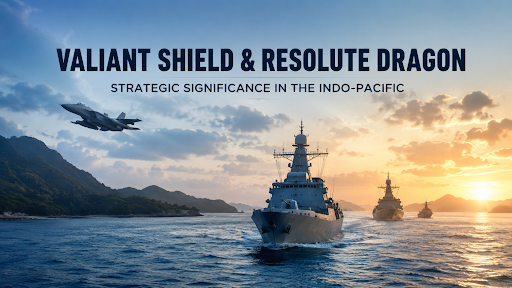
India–Fiji relations are entering a new phase, moving from Girmitiya-era bonds to a strategic partnership. Fiji supports India’s Act East and Indo-Pacific vision through FIPIC and development cooperation. Despite China’s influence, ties are set to grow via security cooperation and climate resilience.
Copyright infringement not intended
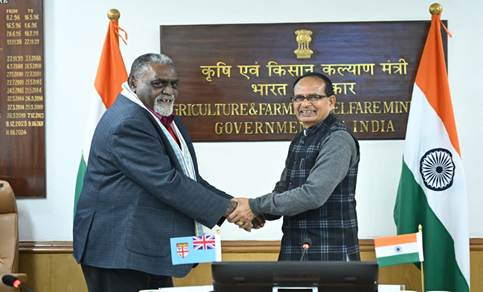
Picture Courtesy: PIB
The Union Minister of Agriculture and Farmers Welfare held a bilateral meeting with the Minister for Agriculture and Waterways of Fiji, at New Delhi.
Girmitiya Legacy: The socio-cultural link began in 1879 when the British brought over 60,000 Indian indentured laborers to Fiji's sugarcane plantations between 1879 and 1916. (Source: PIB)
People of Indian Origin (PIOs): Today, the Indo-Fijian community constitutes about 37% of Fiji's total population, serving as a vital "living bridge" between the two nations (Source: MEA).
Early Diplomatic Ties: India established a Commissioner's post in Suva in 1948 to protect the Indian diaspora, upgrading it to a High Commission upon Fiji's 1970 independence.
Post-Independence: The relationship faced strains due to political instability in Fiji, particularly the coups of 1987 and 2000 which targeted Indo-Fijian-led governments.
Post-2014: The visit of the Indian Prime Minister in 2014, the first by an Indian PM in 33 years, launched the Forum for India-Pacific Islands Cooperation (FIPIC), institutionalizing India's engagement with 14 Pacific Island Countries (PICs), with Fiji as a central hub.
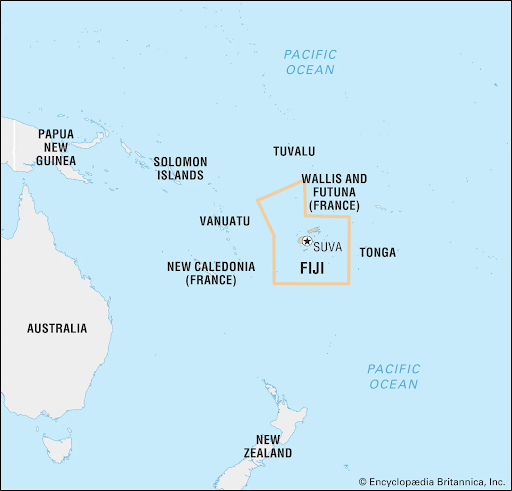
Act East Policy & Indo-Pacific Vision
Fiji is central to India's 'Act East Policy' and its broader vision for a free, open, and inclusive Indo-Pacific. India views Fiji as a key partner and a hub for its engagement with other PICs.
Countering China's Influence
As China increases its economic and military footprint in the Pacific through its Belt and Road Initiative (BRI) and security pacts, a strong partnership with Fiji helps India and like-minded partners (like Australia, US, Japan) to offer a credible, transparent alternative and maintain a balanced regional order.
Maritime Security
Fiji's strategic location across vital sea lanes of communication makes it a crucial partner for maritime domain awareness and security cooperation.
Diaspora Connect
The large and influential Indo-Fijian community provides a strong foundation for cultural diplomacy and soft power projection.
Voice of the Global South
Both nations advocate for the Global South. Fiji supports India's bid for a permanent seat in a reformed UN Security Council and collaborates in forums like the UN and the Commonwealth.
Blue Economy
There is immense potential for cooperation in sustainable harnessing of marine resources, including fisheries, ocean energy, and marine biodiversity.
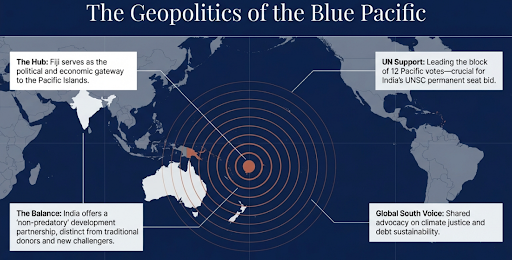
India's policy is anchored in its broader framework for the Pacific Islands, focusing on a development-centric, collaborative, and non-intrusive approach.
Defence & Security
Economic & Trade
Healthcare
Development & Capacity Building
Political Instability in Fiji
Fiji's history of military coups creates a degree of political uncertainty which can impact long-term policy consistency and bilateral engagement.
China's Pervasive Influence
China's "debt-trap diplomacy" and vast economic engagement in the Pacific present a strategic challenge, putting India at a competitive disadvantage against China's massive regional investments.
Trade Imbalance
The bilateral trade is heavily skewed in India’s favor, which is a point of concern for Fiji's smaller economy.
Geographical Distance & Limited Resources
Logistical issues due to distance. India's aid and investment capacity, though increasing, remains smaller than that of established powers like Australia or major economies like China.
Enhance Maritime Security Cooperation
Deepen collaboration in maritime domain awareness, joint patrols, and sharing of white shipping information to secure Fiji's EEZ and vital sea lanes.
Boost Trade and Investment
Work towards diversifying Fiji's export basket and encourage Indian private sector investment in Fiji's key sectors like tourism, agro-processing, and IT.
Strengthen Climate Action Partnership
As Small Island Developing States (SIDS) are highly vulnerable to climate change, India should spearhead collaboration through the ISA and CDRI, focusing on resilient infrastructure and renewable energy projects.
Leverage Digital and Space Technology
Expand cooperation in digital connectivity, e-education, telemedicine, and space applications for resource management and disaster early warning systems.
Deepen People-to-People Connect
Promote greater engagement through tourism, youth exchange, and educational partnerships to further solidify the goodwill between the two nations.
The India-Fiji relationship has evolved into a modern, strategic partnership, crucial for India's Indo-Pacific vision and Fiji's developmental aspirations, demonstrating a model of South-South cooperation.
Source: PIB
|
PRACTICE QUESTION Q. The term 'Girmitiyas', frequently seen in the news, refers to: A) The first generation of Indian politicians in Fiji post-independence. B) Indian indentured laborers sent to various colonies during the 19th and 20th centuries. C) A specific community from Bihar that settled in Mauritius. D) Members of the Indian diaspora who hold Overseas Citizenship of India (OCI). Answer: B Explanation: 'Girmitiyas' were indentured Indian laborers who were sent to British, French, and Dutch colonies between the 19th and early 20th centuries. The term is derived from 'girmit', an anglicized version of 'agreement'. |
Fiji is a crucial partner for India's 'Act East' Policy and its vision for a free and open Indo-Pacific. It acts as a gateway to the 14 Pacific Island Countries (PICs) and hosts the Pacific Islands Forum secretariat. A strong partnership with Fiji helps India counter China's growing influence and promote a rules-based order in the region.
FIPIC is the primary platform for India's engagement with the 14 Pacific Island Countries. It was launched in Suva, Fiji, in 2014 during Prime Minister Narendra Modi's visit. It aims to strengthen cooperation in areas like development, climate change, healthcare, and capacity building.
The term "Girmitiya" refers to Indian indentured laborers who were transported to British colonies in the 19th and early 20th centuries. It is derived from the word "girmit," which was the local pronunciation of the English word "agreement," referring to the labor contracts they signed.


© 2026 iasgyan. All right reserved