Description
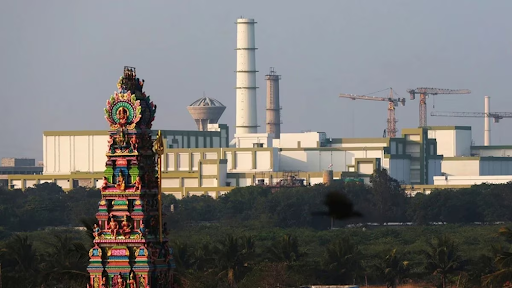
The Department of Atomic Energy announced that the core loading process is nearing completion, bringing the reactor closer to its first criticality.
Why in News?
The Department of Atomic Energy announced that the core loading process is nearing completion, bringing the reactor closer to its first criticality. This development is significant as India becomes the second country, after Russia, to operate a commercial-scale Fast Breeder Reactor.
Key Features of the Fast Breeder Reactor
- Fuel Composition: The reactor uses a mixed oxide fuel, which is a combination of Plutonium-239 and depleted uranium.
- The Breeding Principle: Unlike conventional reactors that only consume fuel, a breeder reactor converts fertile material (Uranium-238) into fissile material (Plutonium-239) during operation, effectively generating more fuel than it uses.
- Liquid Sodium Coolant: It utilizes liquid sodium as a coolant due to its excellent heat transfer properties. Because sodium reacts violently with water and air, the reactor features highly advanced, indigenous safety and containment systems.
- Fast Neutrons: Unlike pressurized heavy water reactors that use a moderator to slow down neutrons, the PFBR uses high-energy fast neutrons to sustain the fission chain reaction.
Strategic Importance for India
- Three-Stage Program: The PFBR is the linchpin of Stage II. Once stabilized, these reactors will provide the plutonium necessary to kickstart Stage III, which involves using Thorium-232 to produce Uranium-233.
- Energy Independence: India holds roughly 25 percent of the world's thorium deposits. The success of the breeder program is the only viable pathway to utilizing this thorium, potentially providing carbon-free electricity for centuries.
- Waste Management: Fast reactors are more efficient at burning long-lived radioactive waste, thereby reducing the environmental burden and complexity of nuclear waste storage.
- Indigenous Technology: The PFBR is a testament to India's self-reliance in high-technology sectors, having been designed and built almost entirely with domestic expertise and components.
Challenges and Safety Measures
- The journey to the PFBR has been technologically demanding, leading to several delays in the initial timeline.
- Managing liquid sodium requires extreme precision to prevent leaks and fires.
- The breeding process requires a very high flux of neutrons, which puts significant thermal and radiation stress on the reactor materials.
Way Forward
- Following the successful core loading and criticality, the focus will shift to integrating the reactor with the national grid.
- The experience gained at Kalpakkam will be used to construct a series of twin fast breeder reactors of 600 MWe each in the coming decade.
- Simultaneously, research must be accelerated on the Advanced Heavy Water Reactor to prepare for the commercial deployment of Stage III.
- Strengthening the domestic supply chain for specialized nuclear components will also be essential for scaling up this technology.
Conclusion
The Prototype Fast Breeder Reactor at Kalpakkam is more than just a power plant; it is a symbol of India's scientific tenacity and its unique vision for a sustainable energy future. By mastering the breeder technology, India is moving closer to unlocking its massive thorium potential, which could fundamentally transform the country from an energy-importer to an energy-secure nation.
Source: Indian Express
|
PRACTICE QUESTION
Q. "India’s strategy to utilize its vast thorium reserves is contingent upon the success of the Fast Breeder Reactor technology." Analyze this statement in the context of the three-stage nuclear roadmap envisioned by Dr. Homi Bhabha. (250 words)
|
|
Key Insights
Nuclear fuel consists of fissile isotopes, primarily Uranium-235 or Plutonium-239, which undergo controlled nuclear fission to release massive amounts of thermal energy. In the Indian context, the three-stage nuclear power program also emphasizes the use of Thorium-232, which is fertile and must be converted into Uranium-233 to become fuel. These materials are typically processed into ceramic pellets and encased in metal rods to sustain the chain reaction within a reactor core. This energy is subsequently harnessed to produce steam for electricity generation, providing a high-density and low-carbon alternative to fossil fuels.
|