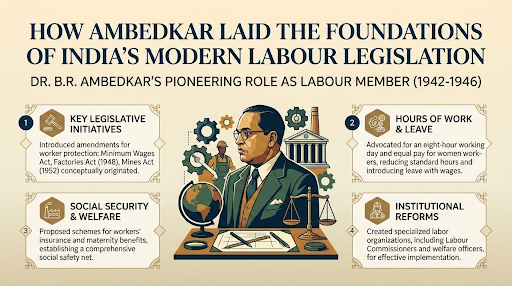
Dr. B.R. Ambedkar revolutionized worker rights as a Labour Member (1942–46), establishing the eight-hour workday and employment exchanges. He championed maternity benefits and laid the constitutional groundwork for a living wage and equal pay for equal work.
Why In News?
As British India's first Labour Minister, Dr. B.R. Ambedkar institutionalized the 8-hour workday, maternity benefits, and insurance, aligning India with Labour Day principles.
|
Read all about: DR. B.R. AMBEDKAR LEGACY |
Who was B. R. Ambedkar?
Dr. B. R. Ambedkar was a visionary leader, the chief architect of the Indian Constitution, and the first Union Law Minister of independent India.
His work, especially during his tenure as the Labour Member of the Viceroy's Executive Council from 1942 to 1946, laid the foundational principles for labour welfare, social security, and workers' rights in India.
What was the Condition of Labour in Colonial India?
Excessive Working Hours: Workers commonly endured grueling work shifts of 12 to 16 hours a day with no legal safeguards.
Meager Wages: Wages were minimal and barely sufficient for survival, leading to widespread indebtedness among the working class. The Whitley Commission on Labour noted that in most industrial centers, two-thirds of families were in debt.
Lack of Social Security: There were no provisions for social security, health benefits, accident compensation, or job security, leaving workers vulnerable to the extreme uncertainties of industrial life.
Unsafe Working Conditions: Factories, mines, and plantations had little to no safety regulations, resulting in frequent accidents and hazardous environments, particularly affecting women and children.
Exploitative Recruitment: Labour recruitment, especially for plantations and mines, often involved coercive contract systems that resembled slavery more than free employment.
Suppression of Unions: Early attempts by workers to organize were met with resistance from both employers and the colonial administration. Labour welfare was largely neglected in favor of industrial productivity.
Ambedkar’s Guiding Principles on Labour
Labour is Not a Commodity
Core Belief: Ambedkar rejected the notion that labour is merely a commodity to be bought and sold. He argued that labour involves human beings with rights, dignity, and the capacity for development.
Humanizing Labour: He insisted that industrial efficiency should not come at the cost of human exploitation, emphasizing that the state must intervene to ensure workers are treated as citizens with rights, not just tools of production.
State Socialism within Democracy
Economic Framework: He advocated for "State Socialism" within a parliamentary democracy; State should own key industries and land to prevent the concentration of wealth in private hands.
Balanced Approach: He sought a middle path between unregulated capitalism (which he viewed as exploitative) and totalitarian socialism (which suppressed individual liberty), proposing a system where the state guarantees economic security without sacrificing democratic freedom.
Liberty, Equality, Fraternity in Industry
Triad of Values: Ambedkar applied the French Revolution's principles to the industrial sphere. He argued that political democracy (one man, one vote) is meaningless without economic democracy (one man, one value).
Worker Empowerment: He believed that workers must have the "right to strike" as a fundamental aspect of freedom, equating the prohibition of strikes to "involuntary servitude" or slavery.
Caste as a Division of Labourers
Critique of Caste: He famously stated that the caste system is not just a "division of labour" but a "division of labourers" into watertight, graded hierarchies that destroy dignity and choice.
Dignity of Work: He fought to dismantle the stigma attached to manual labour, arguing that all work should be respected and that the "graded inequality" of caste prevented true economic progress.
Key Labour Reforms Introduced by Ambedkar
Reduction in Working Hours
8-Hour Workday: He reduced the statutory working hours in factories from 12 hours to 8 hours per day, bringing India in line with international standards.
Factories (Amendment) Act, 1946: This legislation set the maximum weekly working hours at 48 hours, a norm that continues to this day.
Social Security & Insurance
Employee State Insurance (ESI): He drafted and introduced the bill that later became the Employees' State Insurance Act, 1948, providing medical care and unemployment benefits to workers.
Provident Fund: He framed the Coal Mines Provident Fund and Bonus Scheme, which was the first provident fund initiative in India, later expanded to other sectors.
Women's Welfare & Maternity Benefits
Maternity Leave: He enacted the Mines Maternity Benefit Act of 1941, which was the first central law to guarantee paid maternity leave (16 weeks) for women in mines.
Equal Pay: He championed the principle of "Equal Pay for Equal Work" irrespective of sex, lifting the ban on women working in underground coal mines while ensuring their safety and fair compensation.
Pithead Baths: He made it mandatory for mine owners to provide separate pithead baths and crèches for female workers to ensure dignity and hygiene.
Industrial Relations & Trade Unions
Tripartite Labour Conference: In 1942, he established the Tripartite Consultative Council (now the Indian Labour Conference), bringing Government, Employers, and Employees to the same table to resolve disputes.
Compulsory Recognition: He introduced the Indian Trade Unions (Amendment) Bill, 1943, which made it mandatory for employers to recognize trade unions.
Employment & Wages
Employment Exchanges: He established the first National Employment Exchanges in India to help skilled and semi-skilled workers find jobs and to track unemployment data.
Dearness Allowance (DA): He institutionalized the payment of Dearness Allowance to offset the rising cost of living (inflation) for workers.
Minimum Wages: He laid the groundwork for the Minimum Wages Act, 1948, arguing that a worker's wage must cover not just subsistence but also education, healthcare, and comfort.
What is the relevance of Ambedkar’s labour vision in contemporary India?
In the contemporary context of globalization, the gig economy, and new labour codes, Dr. Ambedkar's vision remains deeply relevant.
Universal Social Security: Ambedkar’s vision of inclusive protection remains vital for today's unorganized workforce. India's new Labour Codes reflect this by striving to extend essential safeguards to informal sectors.
Gig Economy Protections: Modern gig and platform workers lack legal "employee" status; applying Ambedkar's principles of fair wages and social security is necessary to ensure their professional dignity.
Strengthening Social Dialogue: His tripartite model is vital for resolving industrial disputes and ensuring equitable economic transitions.
Combating Discrimination: Ambedkar linked labour rights to the fight against social prejudice, highlighting that workplace equality requires addressing caste and gender biases.
Conclusion
Dr. B.R. Ambedkar revolutionized India's labour landscape, moving the state toward active welfare. His legacy of social justice continues to guide modern policy, ensuring that human rights remain central to economic progress.
Source: INDIANEXPRESS
|
PRACTICE QUESTION Q. "Dr. B.R. Ambedkar’s contribution goes beyond the drafting of the Constitution to laying the very foundation of modern labour legislation." Evaluate. 150 words |
Convened by Ambedkar in 1942, the Tripartite Labour Conference brought the government, employers, and employees together as equal partners to build consensus on labour policies. This historic move laid the institutional foundation for the modern Indian Labour Conference (ILC).
Ambedkar strongly championed maternity benefits, ensuring 16 weeks of leave and wage support for women working in mines. He fundamentally rejected the notion that women must choose between childbirth and livelihood, and he also mandated separate pithead baths to ensure dignity for female workers.
The rapidly growing gig economy currently lacks formal contracts, fixed employers, and social security. Ambedkar’s historical models, such as sector-specific welfare funds and institutionalized safety nets, provide a highly relevant legislative blueprint for extending protections to today's vulnerable gig workers.



© 2026 iasgyan. All right reserved